Aina AI Smart Ring Predicts What You Need Before You Ask

Published
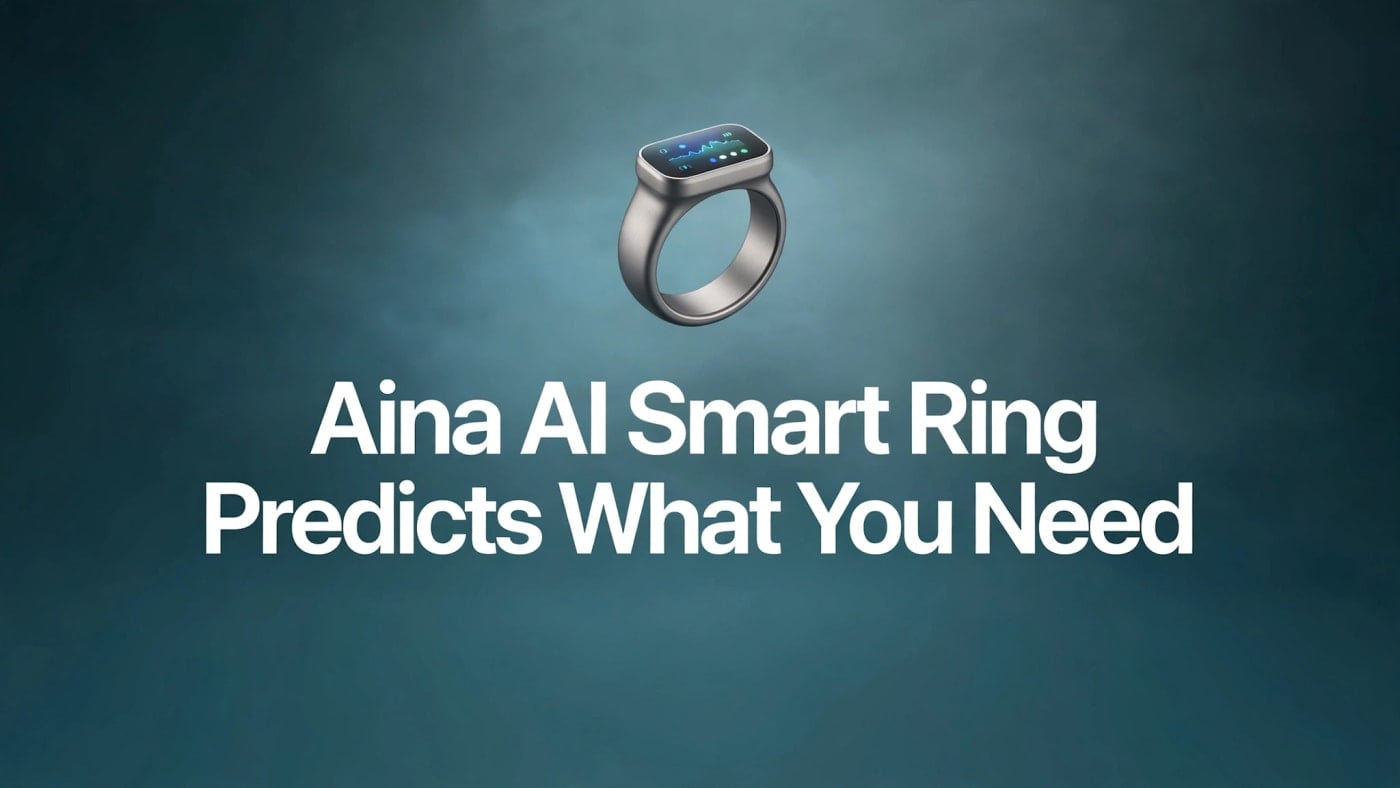
A ring that wants to think ahead of you
Most wearables wait for you to ask. You tap a screen, open an app, or speak a command, and only then does the device respond. Aina, a Bengaluru- and San Francisco-based startup, wants to reverse that relationship. Its AI-powered smart ring, unveiled at a private launch event in Bengaluru on 5 November 2026, is built around a simple but ambitious idea: a device that notices what you are doing and surfaces what you need next before you have to ask.
The ring is priced at $499, about Rs 47,000. A limited Super Early Bird pre-order price of $399, about Rs 37,700, was offered when pre-orders opened on 5 November 2026, and shipping is planned from January 2027. Those facts, reported by YourStory and GlobeNewswire on 5 November 2026, place Aina in an interesting position. This is not a budget wearable, nor a fitness tracker with a few clever extras. It is presented as a new kind of personal device, a quiet layer between you and your phone, computer, and software agents.
Whether that promise holds up in everyday use is still an open question. The ring has had only limited user testing, which began in October 2026. What we can do today is look carefully at what Aina has actually said, what the device is claimed to do, and who is behind it.
Who is behind Aina
Aina was founded in May 2025 by Apoorv Shankar, a former vice president of hardware at Ultrahuman. Shankar has already worked through the hard parts of building hardware at scale: sourcing components, managing suppliers, designing for comfort, and shipping a product people wear every day.
The company raised $5.5 million in seed funding in July 2026, according to reports from the launch. For a hardware startup barely a year old, that is a meaningful vote of confidence. Aina spent about fifteen months developing the ring, which suggests it was a priority from the earliest days, not a later addition.
What the ring actually is
The Aina ring weighs under 13 grams and has a titanium body. That puts it in the same general territory as other premium smart rings, and titanium is a familiar choice for devices that must be light, strong, and comfortable all day. It comes in four colours: Eclipse Black, Amber Gold, Mercury Silver, and Slate Titanium. Seven sizes are available, which should cover most hands, although the exact sizing range has not been detailed in the launch reports.
The most striking hardware choice is the full-colour display. Most smart rings have no screen at all, relying instead on a phone app. Aina has gone the other way, putting a display directly on the ring. The company has not specified the display's size, resolution, or brightness in the reported launch details, and those figures should not be assumed.
Alongside the display, the ring offers haptic feedback and directional audio. Haptics give it a silent way to get your attention, a small vibration signalling that something needs a decision. Directional audio suggests sound aimed at the wearer rather than broadcast nearby, which would matter in offices or on trains. The launch reports give no detailed audio specifications, so exact quality should be tested once the ring reaches real users. Battery life is claimed at up to 18 hours, which would cover a working day but not a full day and night. Real battery life will depend on display use, audio use, and how actively the AI features run, so 18 hours should be read as a ceiling, not a guarantee.
Cues, Voice and Remote
Aina has built the ring around three features: Cues, Voice, and Remote. Cues is the feature behind the launch headline. It predicts and surfaces what you need next, noticing patterns in your day and offering the right thing at the right moment, rather than waiting for you to search. If you are heading into a meeting, it might surface the relevant notes or dial-in details. The launch reports do not give a full list of situations Cues handles, and it would be a mistake to invent one.
Voice is the most familiar of the three. It allows you to speak to the ring, to ask questions, give instructions, or respond to what it has suggested. Voice on a ring is different from voice on a phone or smart speaker. It is more private and more immediate, but also more dependent on good microphones and software that can understand you in noisy places. How well that works will be one of the first things early users notice.
Remote, the third pillar, suggests control at a distance. The launch reports do not spell out every function it covers, so the safest reading is the general one: the ring can act as a controller for other devices and software, extending your reach without forcing you to pick up your phone or sit at your computer. That fits naturally with the rest of the product. If the ring knows what you are doing and can hear what you want, it makes sense for it also to act on your behalf.
A Context Aware Operating System
Underpinning all three features is what Aina calls a proprietary Context Aware Operating System. According to the launch reports, this system learns patterns and pulls context from your phone, your computer, and your agents. Here, "agents" means AI agents, software tools that increasingly handle scheduling, research, drafting, and coordination on your behalf.
The idea of context is doing a lot of work in Aina's pitch. A device that only knows the time and your location can do very little. A device that also knows your calendar, messages, documents, and tools can, in theory, do a great deal more, such as surfacing the file for the project you are working on now.
That is the promise, but the challenge is trust. For the ring to be useful, it needs access to a great deal of personal information. For people to be comfortable giving it that access, they need to believe the information is handled carefully and used only in their interest. The launch reports do not set out Aina's full privacy approach, and that is a gap future coverage will need to fill.
A five-way joystick, operated by your thumb
One of the most unusual details is how the ring is controlled. It is operated with a five-way joystick-like control, used to approve or reject suggestions with the thumb. That choice says a great deal about how Aina imagines the ring being used. Most interactions, if the pitch is accurate, will be short decisions: yes, show me that; no, not now; yes, do that for me.
A small joystick that moves in several directions is a neat fit for that kind of interaction. You do not need to type, swipe through menus, or take your phone out of your pocket. You glance, nudge with your thumb, and move on. It is also a choice that will divide opinion: some will find it intuitive, while others may find it fiddly on a small device. Only extended use will show whether that bet pays off.
Dune, the keypad that came first
The ring is not Aina's first product. In April 2026, the company introduced Dune, a context-aware three-key keypad for Mac, which shipped to hundreds of early adopters. Dune matters because it shows the direction Aina was already travelling before the ring existed. Three keys cannot do much on their own, but if they are context-aware and change what they do depending on what you are working on, they can become surprisingly useful, and that experience is likely to have shaped the ring.
Price, pre-orders and timing
The pricing is straightforward. The Aina AI smart ring costs $499, about Rs 47,000, with a limited Super Early Bird price of $399, about Rs 37,700, when pre-orders opened on 5 November 2026. Shipping is planned from January 2027, giving Aina roughly two months between launch and first deliveries.
| Detail | What Aina has announced |
|---|---|
| Standard price | $499, about Rs 47,000 |
| Super Early Bird price | $399, about Rs 37,700 |
| Pre-orders opened | 5 November 2026 |
| Shipping planned from | January 2027 |
| Weight | Under 13 grams |
| Body | Titanium |
| Colours | Eclipse Black, Amber Gold, Mercury Silver, Slate Titanium |
| Sizes | Seven |
| Claimed battery life | Up to 18 hours |
At launch, the ring supports iOS and Mac. That is a clear, limited starting point, aimed first at people who live inside Apple's ecosystem and use an iPhone and a Mac together. Whether and when support for other platforms follows has not been confirmed, and it should not be assumed. For now, anyone who does not use iOS and Mac should treat that as a genuine limitation.
Why a smart ring, and why now
The wearable market has been looking for its next step. Smartwatches are mature, fitness bands are cheap and capable, and smart rings have grown quickly, but most have focused on health: sleep, recovery, activity, and readiness. Aina is trying something different. On the basis of the launch reports, it is not leading with health tracking. It is leading with intelligence: a device that understands context, predicts needs, and acts on your behalf.
That is a bolder and riskier pitch. Health data is relatively straightforward to measure and present, while context is messy, personal, and constantly changing. Getting it right most of the time is hard, and getting it wrong occasionally can be annoying enough to make someone stop wearing the device. The timing is still understandable. AI agents are becoming more capable and more deeply woven into work, and a small device you already wear, able to show a suggestion without demanding full attention, is in principle a natural home for that help.
What we do not know yet
A launch event is a controlled performance. The device works, demonstrations go smoothly, and the audience sees the product at its best. The real test begins when the ring leaves that room. We do not yet know how accurate Cues is in everyday use, or how often it surfaces something genuinely useful. We do not know how well voice performs in noisy environments, or how natural it feels to speak to a ring rather than a phone.
We also do not know how comfortable the ring is for long stretches, how the display holds up in bright sunlight, or how the battery performs under heavy use. Nor do we know the full details of Aina's privacy approach, or how its operating system stores and processes information from a phone, a computer, and a user's agents. Those are central to whether people will trust it.
What to watch next
If you are interested in the Aina ring, watch for independent, hands-on impressions from people who have worn it for more than a few minutes at a launch event. Limited user testing began in October 2026, so there may already be people with meaningful experience. What they say about comfort, battery life, Cues, and the five-way joystick will tell us far more than any specification sheet.
Also watch for further detail on pricing and availability, including whether the Super Early Bird offer remains open. For now, the ring stands as a genuinely interesting launch from a young startup with an experienced founder and a clear idea. It is priced as a premium device, aimed at Apple users first, and built around a simple belief: the most useful wearable is not the one that shows the most information, but the one that shows the right information at the right moment. Whether it succeeds will depend on execution, on comfort, battery life, prediction accuracy, and trust.
Sources: YourStory, 5 November 2026; GlobeNewswire, 5 November 2026.
FAQs
What is the Aina AI smart ring?
The Aina AI smart ring is an AI-powered wearable unveiled by Bengaluru- and San Francisco-based startup Aina at a private launch event in Bengaluru on 5 November 2026. It is built around three features, Cues, Voice and Remote, and is powered by a proprietary Context Aware Operating System. It is designed to predict and surface what you need next, rather than simply waiting for commands.
How much does the Aina AI smart ring cost?
The standard price is $499, about Rs 47,000. A limited Super Early Bird pre-order price of $399, about Rs 37,700, was offered when pre-orders opened on 5 November 2026. The rupee figures are approximate conversions reported at launch, and buyers should confirm the final price in their own currency before ordering.
When will the Aina ring ship?
Shipping is planned from January 2027, according to the launch reports from YourStory and GlobeNewswire on 5 November 2026. Pre-orders opened on the same day as the launch event, 5 November 2026. No more specific shipping date has been confirmed in those reports.
What are the key features of the Aina ring?
The ring is built around Cues, which predicts and surfaces what you need next, Voice, and Remote. It has a full-colour display, haptic feedback, and directional audio, and it is operated with a five-way joystick-like control used to approve or reject suggestions with the thumb. It weighs under 13 grams and has a titanium body.
How long does the Aina ring battery last?
Aina claims up to 18 hours of battery life. That figure should be read as a maximum rather than a guaranteed result, since real battery life will depend on display use, audio use, and how actively the AI features are running. Independent testing after shipping begins in January 2027 will give a clearer picture.
Who founded Aina?
Aina was founded in May 2025 by Apoorv Shankar, a former vice president of hardware at Ultrahuman. The company raised $5.5 million in seed funding in July 2026. In April 2026, Aina introduced Dune, a context-aware three-key keypad for Mac, which shipped to hundreds of early adopters.
Which devices does the Aina ring support at launch?
At launch, the ring supports iOS and Mac. That means it is aimed first at people who use an iPhone and a Mac together. Support for other platforms has not been confirmed in the launch reports, so it should not be assumed until Aina announces it.
Was this article helpful?

Written By
TechorCoffeeContributing Writer
TechorCoffee is a technology reporter and software creator writing reviews and tutorials for TechOrCoffee.
Comments (0)
Leave a Comment
Read Next

Thu Mar 12 2026
Leaks & Rumors: MacBook Air M4 vs MacBook Neo: Full Comparison
MacBook Air M4 and MacBook Neo target different users in Apple’s lineup. Neo focuses on affordability and everyday tasks, while Air M4 delivers stronger performance, better graphics, and higher memory options for demanding workloads like coding, editing, and multitasking.

Tue Mar 03 2026
MacBook Air M5: Apple's Game-Changing 2026 Launch Review
Apple unveils the MacBook Air M5 with revolutionary 3nm chip technology, enhanced AI capabilities, improved battery life, and stunning display upgrades. This comprehensive analysis covers specifications, performance benchmarks, pricing, and this new release justifies upgrading from previous models.

Thu Mar 12 2026
Leaks & Rumors: MacBook Neo vs MacBook Air M1: Full Performance Comparison
MacBook Neo powered by the A18 Pro chip introduces a new direction for Apple laptops, competing directly with the classic MacBook Air M1. This detailed comparison explores performance benchmarks, display quality, and battery life to help buyers decide which Apple laptop delivers the best value.