ChatGPT Wallet: OpenAI Lets AI Agents Pay for You Now

Published (Updated )
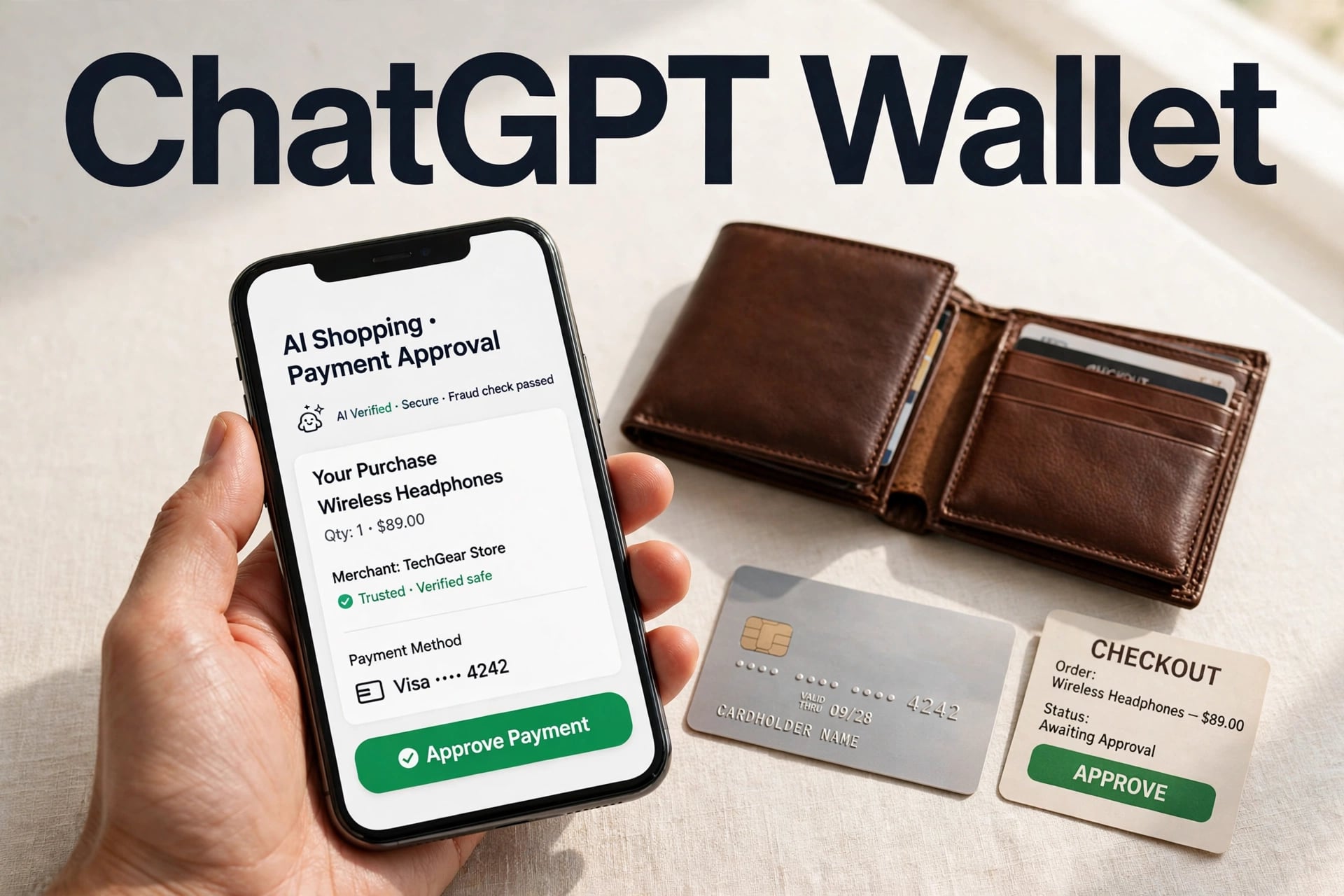
The agent can now pay, not just find
OpenAI announced and launched ChatGPT Wallet on 13 November 2026. Until now, AI shopping worked a simple way: ChatGPT could find products, compare options, and prepare a checkout, but the last step still belonged to you. You had to enter your card details and finish the purchase.
ChatGPT Wallet changes that last step. It lets OpenAI's "dots" agents complete payments on a user's behalf, using a registered card and a per-purchase approval. That means the agent does not only point at a product and wait. It can finish the purchase, while you check and approve the details.
That is a small change in wording and a big change in trust. Paying is different from browsing. It is closer to giving an agent a wallet than giving it a search box. This article explains what it is, how a purchase works, who can use it now, and why some websites will refuse it anyway.
What ChatGPT Wallet actually is
Start with the basics, because the name can mislead. ChatGPT Wallet is not a bank account. It does not hold funds, extend credit, or replace a card. It is a payment setup inside ChatGPT that lets a card be used by an agent.
It is a way to register a card once, and then let a dots agent use it to pay a merchant, with your approval each time. The merchant still gets paid by your card, and OpenAI does not become a party to the sale.
In other words, OpenAI is not becoming the shop, the bank, or the customer service desk. It is providing a way for an agent to pay within the conversation where the shopping already happens.
Image 1 — after the "What ChatGPT Wallet actually is" section
Dots first: where it works, and where it does not
This is one of the easiest details to get wrong, so it is worth stating clearly. ChatGPT Wallet works only in conversations with a dot. It does not work in ordinary Chat, in Work, or in a standalone Codex thread.
If you want to use it, you have to set up a dot first.
A dot, in OpenAI's setup, is the agent you talk to for a task. Ordinary Chat is for asking questions. Work and Codex are for other kinds of work, but they are not the payment setting. The wallet is tied to the dots setting.
That limit keeps the payment feature inside the agent setting it was built for, rather than letting it spread across every kind of ChatGPT use.
How a purchase works
The flow, as OpenAI describes it, is built around two ideas: register once, approve every time.
You register a card once. Then, for each purchase, you approve it — the product, the total, and the card. That approval happens with a security check such as Face ID or a fingerprint. The check is the point at which the purchase becomes yours, not just the agent's suggestion.
That approval step is the heart of the product. The agent may find the product and prepare the purchase, but nothing is paid until you say yes. The agent cannot charge the card without that step.
OpenAI says it later expects users to be able to pre-approve some purchases within spending limits, but that is a later step, not the launch behaviour. At launch, each purchase needs approval.
Your card details never reach the agent
The other idea doing a lot of work here is tokenisation. Card information is not passed to the agent. Instead, the payment network issues a tokenised substitute that the agent can use for the transaction. That substitute stands in for the real card details.
In plain terms, the agent does not get to see your real card number. It gets a stand-in value that can be used for this payment, without exposing the details that would let it be used elsewhere.
Without it, an agent that could read your full card details would be a much bigger risk. Tokenisation is what makes handing a card to an agent less dangerous than it first sounds.
Image 2 — after the "Your card details never reach the agent" section

What stays the same: points, protections, and the merchant
A new way to pay raises an obvious question: do you lose anything by paying this way? OpenAI's answer is that the purchase still goes through your card, so points, rewards, and protections should still apply as they would for a normal purchase.
That means points and rewards should still apply as they would on a normal card purchase, and protections are not lost by using the agent to pay.
The merchant side stays the same, too. The transaction is direct between you and the merchant, which means the merchant handles delivery, returns, and support in the usual way. OpenAI is not in the middle of the sale.
Who can use it, and who cannot yet
The rollout is gradual, and the limits at launch are tight. Initially, ChatGPT Wallet is limited to ChatGPT Pro subscribers in the United States, aged 18 and over, with eligible US-issued credit cards. The card networks involved are American Express, Mastercard, and Visa, and eligible Chase cards are included.
Most ChatGPT users will not be able to use this on day one. Debit cards are not supported, so if you only have a debit card, this is not for you yet.
No fee, merchant count, or worldwide timetable has been announced, so we do not know what it will cost, how many merchants will take it, or when it will reach other countries.
Why some sites will block it, for now
There is one more detail in the launch picture that is easy to miss, and it says a lot about where agentic commerce stands. Some websites will block purchases made by agents, because their bot-detection systems cannot tell a legitimate agent purchase from a bot attack.
That is, a site may stop a purchase made by an agent not because it has decided to ban agents, but because it cannot tell the difference between a purchase made by a helpful agent and an attack made by a bot.
That will be a practical problem for early users: you may approve a purchase and then hit a wall because the merchant's site refuses the agent's request. It is not a failure of the wallet, but a sign that the web is not yet set up for agents that pay.
Image 3 — after the "Why some sites will block it, for now" section

What this launch really tests
ChatGPT Wallet is less a test of payments technology than a test of trust. The technology is familiar — tokenised cards, biometric approval, and an agent completing a checkout are all known parts. What is new is whether users will let an agent spend their money, and whether merchants will let agents buy from them.
Image 4 — after the "What this launch really tests" section
At a glance
| Detail | ChatGPT Wallet |
|---|---|
| Launched | 13 November 2026 |
| What it does | Lets dots agents complete payments on your behalf |
| Card setup | Register a card once; approve each purchase |
| Approval | Product, total, and card, with Face ID or fingerprint |
| Card details | Not passed to the agent — tokenised substitute |
| Built with | American Express, Mastercard, Visa; eligible Chase cards |
| Who can use it at launch | ChatGPT Pro subscribers in the US, aged 18+, eligible US-issued cards |
| What it is not | Not a bank account; does not hold funds or extend credit |
FAQs
What is ChatGPT Wallet?
ChatGPT Wallet is a feature announced and launched by OpenAI on 13 November 2026 that lets its dots agents complete payments on a user's behalf, after the user registers a card once and approves each purchase.
How does a purchase get approved?
The user approves each purchase — the product, the total, and the card — with a security check such as Face ID or fingerprint. At launch, every purchase still requires this check.
Does the agent see my card details?
No. Card information is not passed to the agent. The payment network issues a tokenised substitute instead, so the agent can pay without receiving the real card details.
Is ChatGPT Wallet a bank account?
No. It is not a bank account, it does not hold funds, and it does not extend credit. Transactions are direct between the user and the merchant, and the merchant handles pricing, shipping, returns, and customer service.
Who can use ChatGPT Wallet at launch?
Rollout is gradual, initially limited to ChatGPT Pro subscribers in the US, aged 18 and over, with eligible US-issued cards and a US billing address. Debit cards are not supported.
Where does ChatGPT Wallet work?
It works only in conversations with a dot, not in ordinary Chat, Work, or standalone Codex threads. You need to set up a dot first.
Will I have to approve every purchase forever?
At launch, yes. OpenAI says it later expects users to be able to pre-approve some purchases within spending limits, categories, or time windows, but no fee, merchant count, or worldwide timetable has been announced.
Was this article helpful?

Written By
TechorCoffeeContributing Writer
TechorCoffee is a technology reporter and software creator writing reviews and tutorials for TechOrCoffee.
Comments (0)
Leave a Comment
Read Next

Fri Oct 30 2026
DeepSeek V4.1 Flash 1017: Cheap Coding AI Explained
DeepSeek V4.1 Flash 1017 explained for developers: 77.0 DeepSWE score, faster shorter outputs, Search and Fetch APIs, MIT open weights, and off-peak pricing.

Fri Nov 06 2026
AI Hackers Target Banks at Machine Speed, CERT-In Warns
CERT-In warns 'Crafty Falcon' is using AI tools to breach Indian lenders, fintech and crypto firms at machine speed. What the advisory says.

Fri Oct 30 2026
GPT-6.1 Terra: Faster Agents at Half the Price
OpenAI GPT-6.1 Terra explained: half-price API, faster computer use, 1.05M-token context, Codex and ChatGPT Work availability, benchmarks and safety limits.