Galaxy Z Fold8 vs Xiaomi 18 Fold

Published
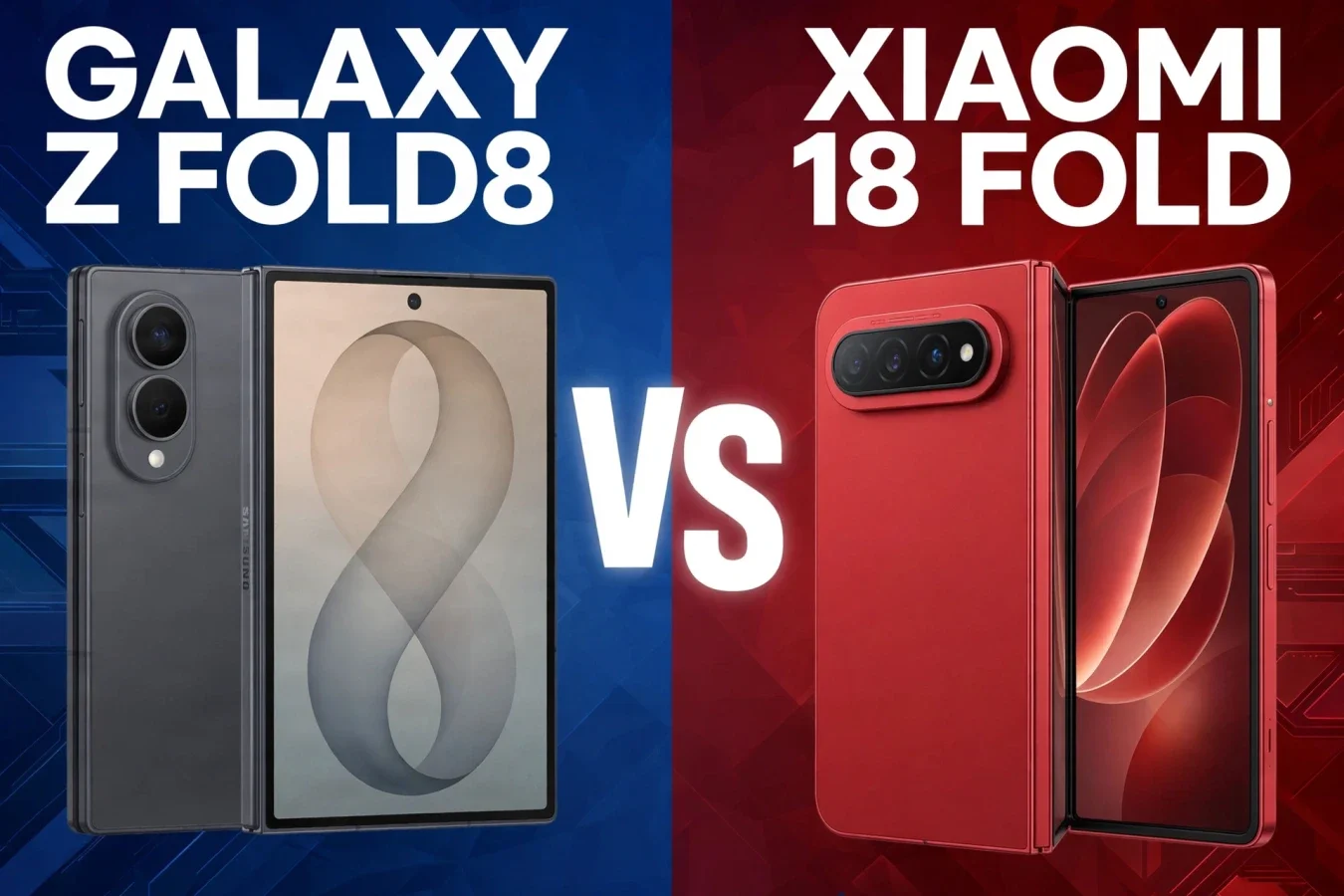
Samsung foldable you can buy vs China-only Xiaomi — availability decides this one
Galaxy Z Fold8 vs Xiaomi 18 Fold is a foldable versus foldable comparison where availability matters more than specs. The Samsung is on sale in the US and Europe, while the Xiaomi 18 Fold is China-only for now, with no confirmed US or Europe launch. If you are in the US or Europe and want a foldable today, buy the Samsung. If you want the Xiaomi, you would need to import it, with warranty and software caveats.
| Galaxy Z Fold8 | Xiaomi 18 Fold | |
|---|---|---|
| Displays | 7.6-inch inner Dynamic AMOLED 2X, 1848 x 2448, 120Hz, 4:3 + 5.5-inch cover, 120Hz | 7.58-inch inner LTPO AMOLED, 2364 x 1672, 1–120Hz + 5.38-inch cover, 1712 x 1168, up to 4,000 nits peak in one listing |
| Chip | Snapdragon 8 Elite Gen 5 for Galaxy | Xiaomi XRing O3 (3nm, 10-core, up to 4.35GHz), up to 16GB RAM |
| Cameras | Dual 50MP (main + ultrawide, no telephoto in the comparison listings) | 200MP main (OIS) + 50MP telephoto (3.5x, OIS) + 50MP ultrawide, Leica lenses |
| Battery | 4,800mAh, 45W wired / 20W wireless | 6,000mAh, 67W wired / 50W wireless |
| Weight / thickness | 201g, 4.5mm unfolded in one listing / 9.7mm folded | 219g, 5.0mm unfolded / 10.7mm folded |
| Software | Android 17, One UI 9 | HyperOS 4 / Android 17 (China firmware) |
| US price | $1,899.99 (256GB, before sales tax) | Not officially sold in the US; China CNY 10,999 (12/256, China only, not a US price) |
| Europe price | €1,999 (256GB, tax included), £1,699 UK | Not officially sold in Europe; shown at IFA Berlin, no Europe price or date |
Build and design
The Samsung is 201g, with a wide-format design, a 7.6-inch inner display at near 4:3 and a 5.5-inch cover display, with IP48 rating in one listing, Gorilla Glass Ceramic 3 cover and Advanced Armor Aluminum. The Xiaomi is 219g, 5.0mm unfolded and 10.7mm folded, with a passport-sized folded form that Xiaomi calls a mid-fold. Both phones are thin unfolded, but the Samsung wins on weight, while the Xiaomi wins on folded thickness on paper.
Water rating is a flagged disagreement for the Xiaomi: one listing gives IP58/IP59, while another report says Xiaomi gave no water or dust rating at IFA. Do not buy either foldable on a water rating alone — check the official listing for your exact model, and treat foldable durability as a long-term review question.
Display and benchmarks
The Samsung offers a 7.6-inch inner display at 1848 x 2448 with 120Hz and a 5.5-inch cover display, both Dynamic AMOLED 2X, with a near-4:3 inner ratio that suits reading and browsing. The Xiaomi offers a 7.58-inch inner display at 2364 x 1672 with 1–120Hz and a 5.38-inch cover display at 1712 x 1168, with up to 4,000 nits peak in one listing. Both inner displays are almost identical in size, so the difference is not size, but aspect ratio and brightness — the Samsung's wider inner is better for reading, while the Xiaomi's cover is passport-sized for one-handed use.
On benchmarks, the Samsung uses Snapdragon 8 Elite Gen 5 for Galaxy and the Xiaomi uses its own XRing O3 chip on 3nm, with ten cores up to 4.35GHz and a 16-core GPU, with Xiaomi claiming an 85% GPU improvement over its predecessor — a self-reported claim, not an independent benchmark. No controlled side-by-side benchmark between these two phones was reviewed, so no speed winner is claimed. For multitasking, both should handle split-screen work on their inner displays, with the Xiaomi's up to 16GB RAM helping on paper.
Cameras and video
The Samsung offers dual 50MP cameras in the comparison listings, a main and an ultrawide, with no telephoto, after Samsung dropped the telephoto lens for this wider form factor. The Xiaomi offers a 200MP main with OIS, a 50MP telephoto at 3.5x with OIS and a 50MP ultrawide, with Leica lenses and laser autofocus. On paper, the Xiaomi wins on megapixels and telephoto, while the Samsung wins on simplicity and Samsung video pipeline.
No controlled side-by-side camera test between these two phones was reviewed, so no photo winner is claimed beyond the hardware gap. If you shoot zoom often, the Xiaomi is stronger on paper. If you shoot at 1x and ultrawide and want Samsung's ecosystem, the Samsung is adequate. For everyday photos at 1x, both should be close, despite the megapixel gap.
Battery, software and price
Battery is where the Xiaomi wins on paper, with 6,000mAh and 67W wired and 50W wireless charging, versus the Samsung's 4,800mAh with 45W wired and 20W wireless charging. For most users, the Xiaomi will last longer on paper, while the Samsung's smaller battery is the trade-off for its lighter 201g body. Charging is faster on the Xiaomi on paper, though real-world charging should be checked in reviews.
| Galaxy Z Fold8 | Xiaomi 18 Fold | |
|---|---|---|
| US | $1,899.99 (256GB), $2,099.99 (512GB), $2,499.99 (1TB) | Not officially sold; China CNY 10,999–14,999, converted ~$1,640–$2,235, not a US price |
| Europe | €1,999 (256GB), £1,699 UK | Not officially sold; no Europe price or date |
Software is Android 17 with One UI 9 on the Samsung, with Galaxy AI and DeX in Samsung's ecosystem, while the Xiaomi runs HyperOS 4 on Android 17 in China, with no confirmation of which Google services its Chinese firmware includes — a practical obstacle for import buyers. In the US and Europe, the Samsung is the only one you can buy today, from $1,899.99 in the US and €1,999 in Europe.
Verdict
Buy the Galaxy Z Fold8 if you want a foldable in the US from $1,899.99 or in Europe from €1,999. Do not buy the Xiaomi 18 Fold in the US or Europe on specs alone, because it is China-only for now, with no confirmed launch. For most US and Europe buyers, the Samsung is the only choice — the Xiaomi is a wait-and-see import.
FAQs
Which has the bigger inner display?
Both at 7.6 / 7.58 inches — almost identical.
Which has a telephoto camera?
Xiaomi only, at 3.5x; Samsung has dual 50MP with no telephoto in the comparison listings.
Which is lighter?
Samsung, at 201g, vs Xiaomi at 219g.
Which has the bigger battery?
Xiaomi, at 6,000mAh, vs Samsung at 4,800mAh.
Which can I buy in the US or Europe?
Samsung only, from $1,899.99 US / €1,999 Europe; Xiaomi is China-only for now.
Which is faster?
Neither on paper; Samsung uses Snapdragon 8 Elite Gen 5, Xiaomi uses XRing O3, no side-by-side benchmark reviewed.
Which should I buy?
Samsung for US/Europe buyers today; Xiaomi only if you import and accept the caveats.
Was this article helpful?

Written By
TechorCoffeeContributing Writer
TechorCoffee is a technology reporter and software creator writing reviews and tutorials for TechOrCoffee.
Comments (0)
Leave a Comment
Read Next

Thu Apr 09 2026
Leaks & Rumors: iPhone 18 Pro Max vs iPhone 17 Pro Max: Full Comparison
The iPhone 17 Pro Max is already a fully matured flagship—top camera, insane battery life, and stable performance. The iPhone 18 Pro Max is expected to refine the experience further, not revolutionize it.
Tue Jun 16 2026
Samsung Galaxy Z Fold 8 vs Galaxy Z Fold 7:Worth to Upgrade?
Samsung Galaxy Z Fold 8 vs Galaxy Z Fold 7: Is it worth the upgrade? Compare specs, battery upgrades, 45W charging, and camera leaks before you buy.

Wed Apr 08 2026
Leaks & Rumors: iPhone 18 Pro Max: Every Leak, Spec and Upgrade Confirmed
The iPhone 18 Pro Max is expected in September 2026 as Apple’s most powerful iPhone yet. It features a 6.9-inch LTPO OLED display, A20 Pro chip, 48MP camera with variable aperture, 5,100–5,200mAh battery, C2 modem with satellite support, and a starting price of $1,199.