iPhone 17 Pro Camera: 48MP, 8x Zoom, ProRes Guide

Published
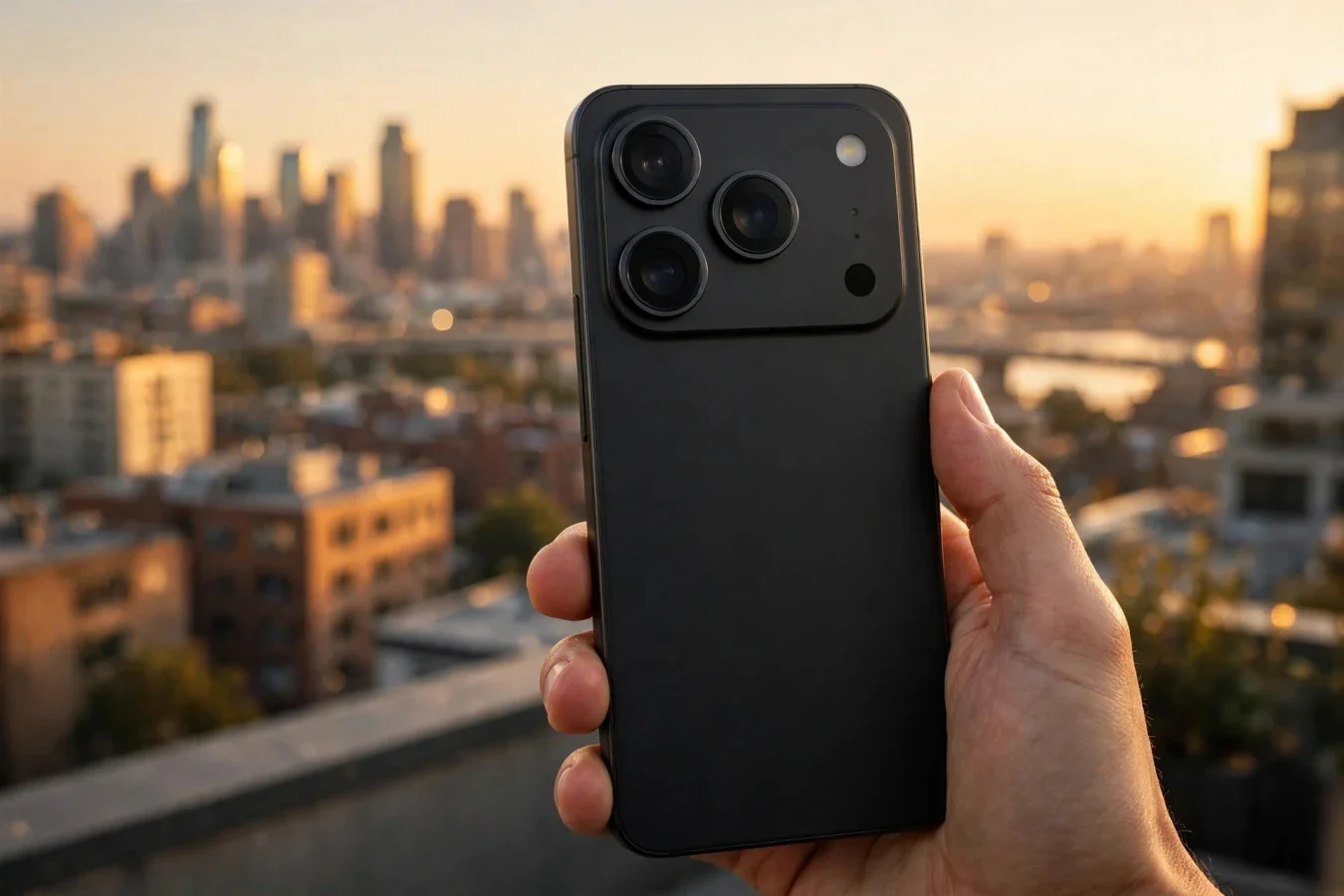
The shot that usually gets away
Picture this. You're at a wedding, or a match, or just on a rooftop at sunset, and the moment you actually want is not right in front of you. It's across the room. It's on the far side of the stage. Your phone's main camera is fine for the table in front of you, but the second you pinch to zoom, everything goes soft.
That's the problem Apple is trying to solve with the iPhone 17 Pro camera. Not by adding one more megapixel for a spec sheet, but by giving you a proper long lens, a bigger sensor behind it, and video tools that used to need a separate camera bag.
The headline is simple enough: three 48MP Fusion cameras on the back, and an 18MP Center Stage camera on the front. The interesting part is what those numbers actually do when you're shooting in real light, in a hurry, with no second take.
Three lenses, three jobs
Forget the marketing names for a second. Here's what each camera is for, in plain terms.
The main camera is your everyday lens. It's a 48MP Fusion Main camera, 24mm equivalent, at f/1.78, with second-generation sensor-shift stabilisation and 100% Focus Pixels. In practice, that means it gathers a lot of light, focuses fast, and gives you a clean 24MP default photo, with the option to shoot at full 48MP when you want the detail for a crop or a large print.
The ultra-wide is your "step back without stepping back" lens. It's a 48MP Fusion Ultra Wide camera, 13mm equivalent, at f/2.2, with a 120-degree field of view. It handles big rooms, tight streets, landscapes, and macro shots of things very close up. Apple also lists 48MP macro, which is a nice upgrade if you like shooting food, flowers, or product details and you've been frustrated by mushy close-ups in the past.
Then there's the telephoto. This is the one people will actually notice.
| Camera | What it is | Key spec |
|---|---|---|
| Main | 48MP Fusion Main, 24mm | f/1.78, sensor-shift OIS |
| Ultra Wide | 48MP Fusion Ultra Wide, 13mm | f/2.2, 120-degree view, macro |
| Telephoto | 48MP Fusion Telephoto, 100mm | f/2.8, 4x optical, up to 8x optical-quality |
| Front | 18MP Center Stage | Auto-framing, Dual Capture, 4K video |
The telephoto is the real story
On the iPhone 17 Pro, the telephoto starts at 100mm, which is 4x zoom. From there, it can reach 200mm, or 8x, as an optical-quality zoom, using a next-generation tetraprism design. Apple describes the whole range as 16x optical-quality, with digital zoom going up to 40x.
Why does that matter? Because 100mm to 200mm is portrait and event territory. Faces look more natural at those focal lengths. Backgrounds compress in a flattering way. You can shoot a speaker on stage, a kid on a football pitch, or a bird on a branch without walking into the middle of the scene — and without the photo falling apart the way a heavy digital crop does.
Apple says the telephoto sensor is 56% larger than its predecessor. A larger sensor, all else being equal, helps in lower light and helps keep detail when the light drops. It won't turn night into day, and it won't replace a dedicated mirrorless camera with a fast prime lens, but it does explain why the 8x shots on this phone look usable in a way that older phone zooms often didn't.
The main camera: boring in the best way
"Boring" sounds like an insult. Here, it's a compliment.
Most of your photos will come from the main camera, and most of the time you won't think about it at all. You point, you shoot, and the photo looks right: skin tones that don't go orange, skies that don't blow out to white, shadows that still have detail in them. That's where Apple's computational photography does most of its work — Smart HDR 5, Deep Fusion, and the Photonic Engine, which all work together to merge exposures and clean up noise before you ever see the file.
Photographic Styles are back too, including a Bright style, and you can set a default lens if you find yourself always shooting at 2x, for example. Next-generation Portraits with Focus and Depth control let you adjust the focus point and background blur after the shot, which saves a lot of portraits that would otherwise be ruined by the camera focusing on the wrong person.
None of this is flashy. It's the stuff that makes a phone camera trustworthy. You hand it to a friend to take your photo, and you don't have to check every frame.
The front camera finally got serious
Selfies and video calls have been an afterthought on a lot of phones. Apple has tried to change that here with an 18MP Center Stage front camera.
Center Stage does two useful things. First, it can automatically widen the frame for group shots, so you don't have to stretch your arm out or hand the phone to a stranger. Second, it keeps you framed during video calls as you move around. Tap to zoom and rotate, and you can switch between a wider and tighter view without digging through settings.
For creators, there's another trick: Dual Capture. That lets you record from the front and rear cameras at the same time, in 4K at 30 frames per second. It's made for reaction videos, tutorials, and travel vlogs where you want to show your face and what you're looking at, in the same clip, without editing two videos together later.
Video from the front camera is ultra-stabilised at 4K 60, which matters more than it sounds. Shaky selfie video is the fastest way to make a good clip look amateur, and stabilisation is often the difference between footage you actually post and footage you delete.
Video: where "Pro" stops being a label
If you only take stills, you can stop reading the specs here and you'll still be happy. If you shoot video, this is where the iPhone 17 Pro pulls away from most phones.
The Pro video list is long, so here are the bits that actually change what you can make:
- 4K Dolby Vision up to 120 frames per second on the main camera, for smooth slow motion in high dynamic range.
- ProRes recording up to 4K 120, with external recording support, for editors who want maximum flexibility in post.
- ProRes RAW, for the highest-quality, most flexible files — with correspondingly huge file sizes, so bring storage.
- Apple Log 2, a flat profile that preserves highlight and shadow detail for colour grading.
- ACES colour support, which matters if you're matching phone footage with footage from a cinema camera.
- Genlock and timecode support, via the Blackmagic Camera ProDock, for multi-camera shoots that need to stay in sync.
- Action mode up to 2.8K 60, spatial video at 1080p 30, macro video, slo-mo up to 4K 120 or 1080p 240, and Night-lapse for low-light timelapses.
Put together, that means a small creator team can shoot a short film, a product video, or a wedding highlight reel on this phone and not immediately hit a wall in editing. It doesn't mean the phone replaces a cinema camera. It means the gap between "phone footage" and "proper footage" is now mostly about lighting, sound, and storytelling — not about the sensor in your pocket.
One practical warning: ProRes RAW and high-frame-rate 4K will eat storage fast, so offload footage the same day if you shoot in those formats regularly.
What it still can't do
No phone camera is perfect, and it's worth being honest about the limits before you spend Pro money.
First, it's still a phone. The sensors are far larger and better than they were five years ago, but they're still small compared with a full-frame camera. In very dark bars, or at a concert with harsh stage lighting, you'll still get noise, and you'll still sometimes prefer the main camera over the telephoto, simply because it gathers more light.
Second, zoom is not magic. The 8x optical-quality option is genuinely useful, but the 40x digital end of the range is for "I can just about read that sign" moments, not for photos you'll print. Use it when you need information, not when you need art.
Third, Pro video takes work. Log footage looks flat and grey straight out of camera by design. If you don't grade it, it will look worse than the standard video mode, not better. Learn the workflow before an important shoot, not during it.
Finally, check the software side. The phone ships with iOS 26, with its Liquid Glass design and Apple Intelligence features, including Live Translation, Smart Summaries, and AI-powered photo editing tools in supported apps. Feature availability can vary by language and region, so if one specific AI feature is the reason you're buying, check that it's available where you live before you order.
Who should care, and who can skip it
You should care about this camera if you shoot a lot of events, travel, portraits, or short-form video, and if you've ever been annoyed by how quickly phone zoom falls apart. The telephoto alone is a reason to look at this phone over a base iPhone, which has only two rear cameras and a shorter reach.
You should also care if you make video for a living, or you're trying to. ProRes RAW, Log 2, genlock, and 4K 120 Dolby Vision are not toys — they're tools that let a phone slot into a professional workflow, even if it's as a B-camera rather than the main camera.
You can probably skip it if you mostly take photos of friends, food, and everyday life in good light, and you rarely zoom past 2x. The base iPhone 17 also has a strong dual 48MP system and the same 18MP front camera, and it will cover that use case for less money. Similarly, if you already own a recent Pro iPhone and you're happy with its photos, this is an upgrade for zoom and video shooters first, not a must-buy for everyone.
So, should you upgrade for the camera alone?
For most people, the honest answer is: it depends on how often you hit the limits of your current phone.
If your current phone's zoom is the thing that frustrates you — at school plays, on holiday, at gigs — then yes, the 200mm telephoto and the larger sensor behind it are a meaningful jump, not a marginal one. Pair that with a front camera that actually handles groups and calls well, and the iPhone 17 Pro starts to make sense as a camera-first upgrade.
If you don't hit those limits, don't buy a Pro just for the word "Pro" on the box. Buy it for the whole package — the A19 Pro chip, the display, the battery, the build — and treat the camera as a very good bonus.
Either way, the direction is clear. Phones aren't trying to be "good enough" cameras anymore. With a triple 48MP system, a real long lens, and video formats that editors actually use, the iPhone 17 Pro is trying to be the camera you reach for first, not the one you settle for because it's in your pocket. For a lot of people, in 2026, it already is.
FAQs
What cameras does the iPhone 17 Pro have?
The iPhone 17 Pro has a triple 48MP rear camera system: a 48MP Fusion Main, a 48MP Fusion Ultra Wide, and a 48MP Fusion Telephoto, plus an 18MP Center Stage front camera.
How far can the iPhone 17 Pro zoom?
It offers 4x optical zoom at 100mm, up to 8x optical-quality zoom at 200mm, a 16x optical-quality zoom range, and up to 40x digital zoom.
Does the iPhone 17 Pro shoot ProRes RAW?
Yes. It supports ProRes RAW, ProRes up to 4K 120, Apple Log 2, Dolby Vision HDR up to 4K 120, and genlock and timecode with the Blackmagic Camera ProDock.
What is the iPhone 17 Pro front camera?
It is an 18MP Center Stage camera with auto-framing for groups, tap-to-zoom and rotate, Dual Capture in 4K 30, and ultra-stabilised 4K 60 video.
Is the iPhone 17 Pro camera better than the base iPhone 17?
For zoom and Pro video, yes. The Pro adds a dedicated telephoto with 200mm reach and ProRes RAW and Log 2, while the base iPhone 17 has a dual-camera system. For everyday photos in good light, both are strong.
What is iOS 26 on the iPhone 17 Pro?
iOS 26 is the operating system the iPhone 17 Pro ships with, featuring the Liquid Glass design and Apple Intelligence tools. Availability of specific AI features can vary by language and region.
Does the iPhone 17 Pro telephoto work well in low light?
The telephoto sensor is 56% larger than its predecessor, which helps in lower light, but it still gathers less light than the main camera. In very dark scenes, the main camera will usually give a cleaner result.
Was this article helpful?

Written By
TechorCoffeeContributing Writer
TechorCoffee is a technology reporter and software creator writing reviews and tutorials for TechOrCoffee.
Comments (0)
Leave a Comment
Read Next

Thu Apr 09 2026
Leaks & Rumors: iPhone 18 Pro Max vs iPhone 17 Pro Max: Full Comparison
The iPhone 17 Pro Max is already a fully matured flagship—top camera, insane battery life, and stable performance. The iPhone 18 Pro Max is expected to refine the experience further, not revolutionize it.
Tue Jun 16 2026
Samsung Galaxy Z Fold 8 vs Galaxy Z Fold 7:Worth to Upgrade?
Samsung Galaxy Z Fold 8 vs Galaxy Z Fold 7: Is it worth the upgrade? Compare specs, battery upgrades, 45W charging, and camera leaks before you buy.

Wed Apr 08 2026
Leaks & Rumors: iPhone 18 Pro Max: Every Leak, Spec and Upgrade Confirmed
The iPhone 18 Pro Max is expected in September 2026 as Apple’s most powerful iPhone yet. It features a 6.9-inch LTPO OLED display, A20 Pro chip, 48MP camera with variable aperture, 5,100–5,200mAh battery, C2 modem with satellite support, and a starting price of $1,199.