iPhone Duo: Specs, Price, Release Date & First Impressions

Published
How TechOrCoffee Evaluated & Tested This
If you searched for an iPhone Duo review, here's the most useful thing to know upfront: Apple's first foldable iPhone was only unveiled on September 9, 2026, and it doesn't reach buyers until October 23. No outlet, including this one, has been able to use it as a daily phone yet, which means camera samples, battery drain tests, and gaming benchmarks you might see floating around aren't real testing data. What follows instead is a complete, accurate picture of everything Apple has officially confirmed about the iPhone Duo, combined with the earliest hands-on impressions from journalists who got a short amount of time with the device at the launch event. Think of this as the guide to have ready before the reviews land, not a substitute for one.
What Is the iPhone Duo?
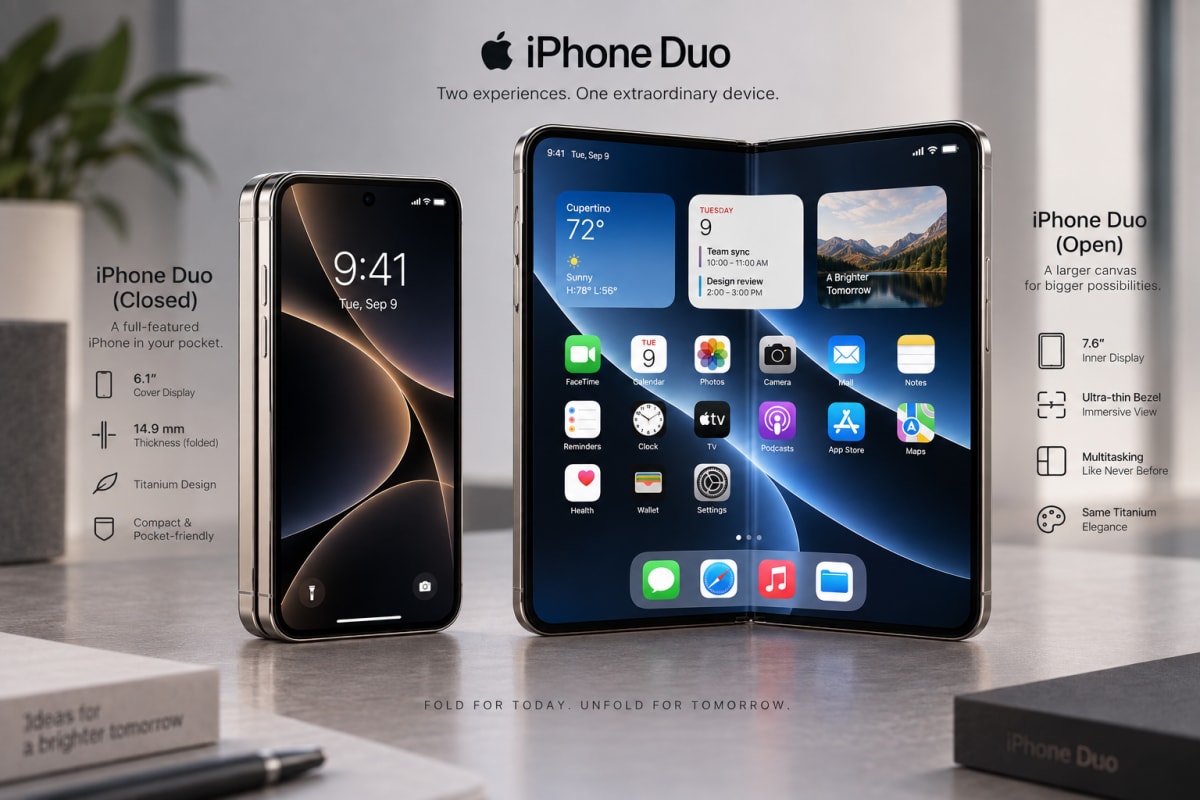
The iPhone Duo is Apple's first book-style foldable phone, sitting above the iPhone 18 Pro and iPhone 18 Pro Max as a new, separate tier rather than a replacement for either. It opens like a small book to reveal a large internal display, while a second screen on the outside works like a normal phone when closed. Apple's new CEO John Ternus, who took over from Tim Cook earlier in September 2026, introduced the Duo as the biggest change to the iPhone since the original 2007 model.
Notably, Apple skipped a base iPhone 18 and a second-generation iPhone Air this cycle, meaning the only 2026 options are the iPhone 18 Pro, the iPhone 18 Pro Max, and the Duo. Apple has said the standard model and a new Air are expected in spring 2027.
iPhone Duo Design and Build Quality
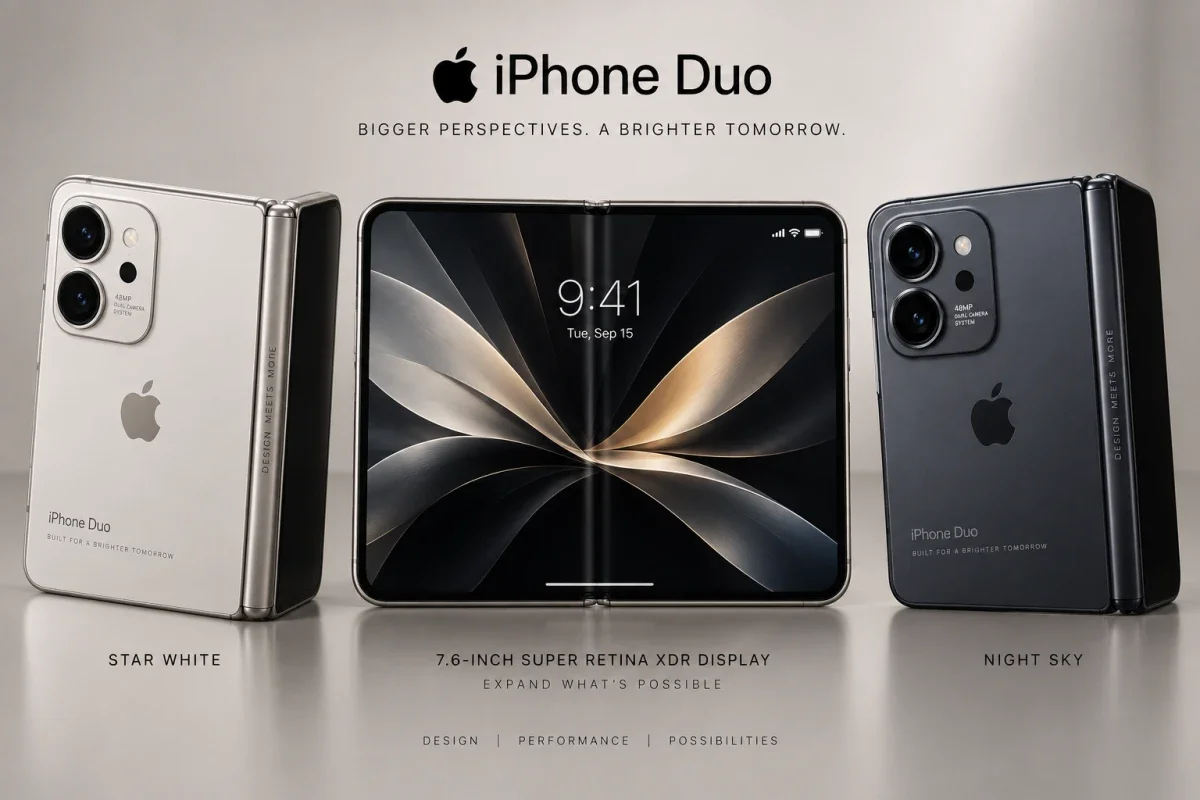
The Duo uses a grade 5 titanium frame and folds along a hinge Apple describes as engineered to distribute weight evenly. Closed, it measures 117.8 x 84.1 x 11.3 mm and weighs 254 g; unfolded, it's just 5.2 mm thick. It comes in two finishes, Star White and Night Sky, and carries an IP68 rating for dust and water resistance. Instead of Face ID, the Duo uses Touch ID built into the side power button, since there's no consistent spot for a Face ID module across both a folded and unfolded state.
Early hands-on impressions on the design have been largely positive. The Independent described the open-and-close action as feeling immediately natural and solid, while The Verge and Engadget both praised how smoothly the hinge operates and how the image transitions between the outer and inner screens as the phone opens. Gizmodo's Adriano Contreras, who got a few minutes with the device at the Steve Jobs Theater, said it didn't feel fragile even when flexed against the hinge, and singled out the matte, paper-like texture of the inner display.
That said, the Duo isn't the thinnest or lightest foldable on the market. Engadget's comparison put Samsung's Galaxy Z Fold 8 at roughly 9.7 mm closed and 201 g, noticeably slimmer and lighter than the Duo's 11.3 mm and 254 g. The Wall Street Journal made a similar observation, noting the Duo is chunkier than recent rival foldables. Apple's marketing calls it the company's thinnest iPhone when open, which is technically accurate but only tells half the story for anyone planning to carry it folded in a pocket.
The Crease Question
Every foldable phone has to deal with a visible fold line where the screen bends, and the Duo is no exception. Apple uses a matte nano-texture coating on the inner display specifically to reduce glare and help disguise the crease. TechRadar called the 7.6-inch panel impressive, and The Verge said the crease is nearly impossible to feel with a finger. Others were a little more measured: Engadget could still see it, describing it as subtle, and MacRumors reported it remains visible under certain lighting angles. It's also worth remembering that all of these impressions come from brand-new demo units. How the fold looks after a year of daily opening and closing is something nobody can answer yet.
Display: 7.6-Inch Inner Screen, 5.4-Inch Outer Screen
The iPhone Duo has two Super Retina XDR OLED displays. The main inner screen measures 7.6 inches with a resolution around 1878 x 2670 pixels, while the outer cover display is 5.4 inches at roughly 1398 x 2034 pixels. Both run at 120Hz with ProMotion and support Always-On functionality, and Apple rates peak brightness at up to 1,600 nits for HDR content and 3,000 nits outdoors.
Apple says the inner screen is about 50% larger than the iPhone 18 Pro Max display, which lines up with how reviewers have described the experience so far. Streaming apps like Netflix have already been optimized to fill the larger canvas, and Tom's Guide's Mark Spoonauer called the screen quality breathtaking in his brief hands-on time, adding that the crease essentially disappears once content is playing.
Camera System
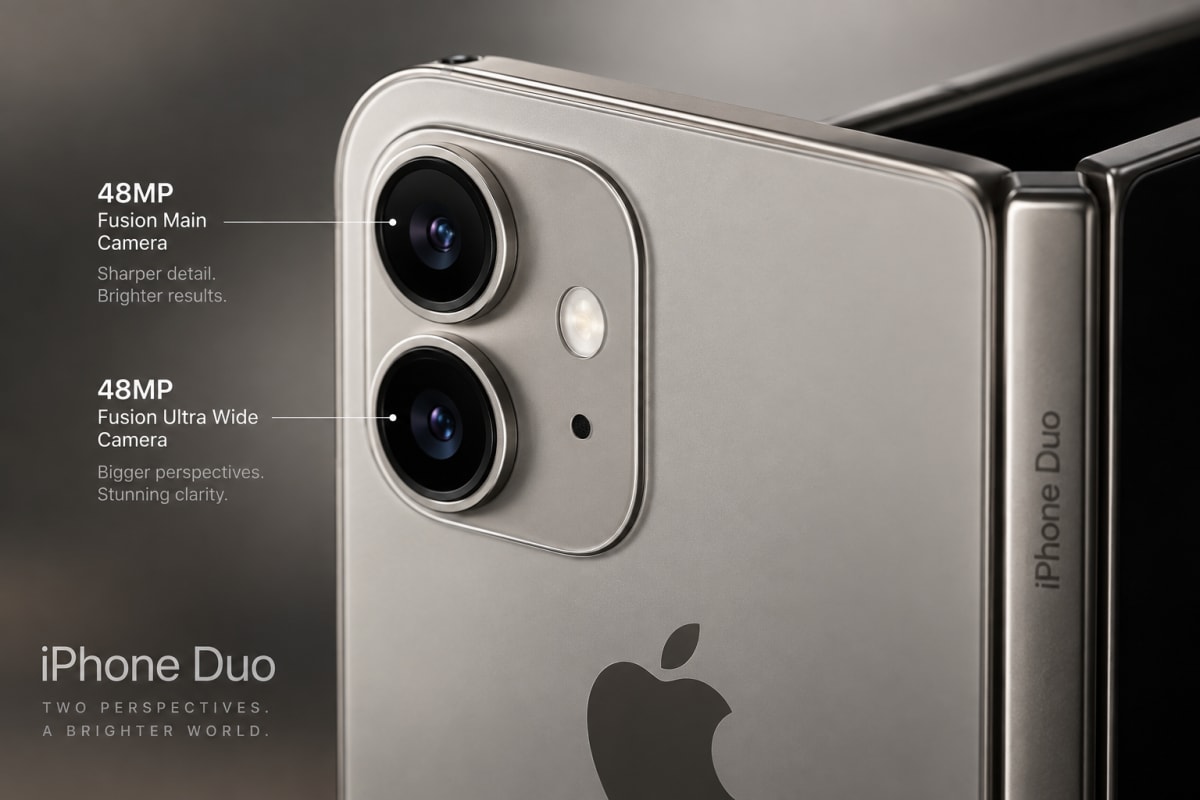
On the back, the iPhone Duo has two 48-megapixel cameras: a Fusion Main camera with a built-in 2x optical-quality telephoto, and a Fusion Ultra Wide camera for landscapes and group shots. Unlike the iPhone 18 Pro, the Duo does not get a variable aperture or a third telephoto lens, so its camera hardware sits a step below Apple's Pro lineup despite the higher price tag.
The front-facing camera is built under the inner display, which lets Apple avoid a notch or cutout on the large screen. Apple has also built a couple of foldable-specific camera features into iOS 27: Duo Preview shows the subject a live feed on the outer screen before a photo is taken, and Duo FaceTime lets someone standing nearby join a video call using that same outer display.
None of this has been tested in real shooting conditions yet. Daylight detail, low-light noise handling, portrait mode accuracy, and video stabilization all remain unverified until reviewers can shoot with a retail unit, so treat any specific image-quality claims you see before October 23 with caution.
Performance: A20 Pro Chip
The Duo runs the same A20 Pro chip and C2 modem found in the iPhone 18 Pro models, built on a 2-nanometer process with a 6-core CPU (including two high-performance cores Apple describes as desktop-class), a 7-core GPU, and dual 16-core Neural Engines. Apple's chip lead Sribalan Santhanam described it as the fastest processor in any smartphone, and the company claims sustained performance up to 35% higher than the iPhone 17 Pro, aided by a vapor chamber three times larger than in previous models.
Those are Apple's own figures, not independently verified benchmark results. On paper, the combination of a fast chip and a bigger cooling system should help with sustained loads like gaming or long video exports, but real-world thermal behavior and frame-rate consistency during extended sessions won't be known until third-party testing is possible after launch.
Battery Life and Charging
The Duo introduces Apple's first dual-battery layout, with one cell on each side of the hinge, managed by iOS as a single battery. Apple's official ratings are up to 31 hours of video playback using the larger inner screen, up to 44 hours using only the outer screen, and up to 24 hours under a typical mixed-use pattern of messaging, photos, streaming, gaming, and browsing.
For comparison, Apple rates the iPhone 18 Pro Max at up to 45 hours of video playback, still ahead of the Duo on that specific metric, since a larger foldable display simply draws more power. Charging tops out at 50% in about 20 minutes with a 60W or higher USB-C adapter, and the Duo supports MagSafe and Qi2 wireless charging at up to 25W.
iOS 27 and Software Features
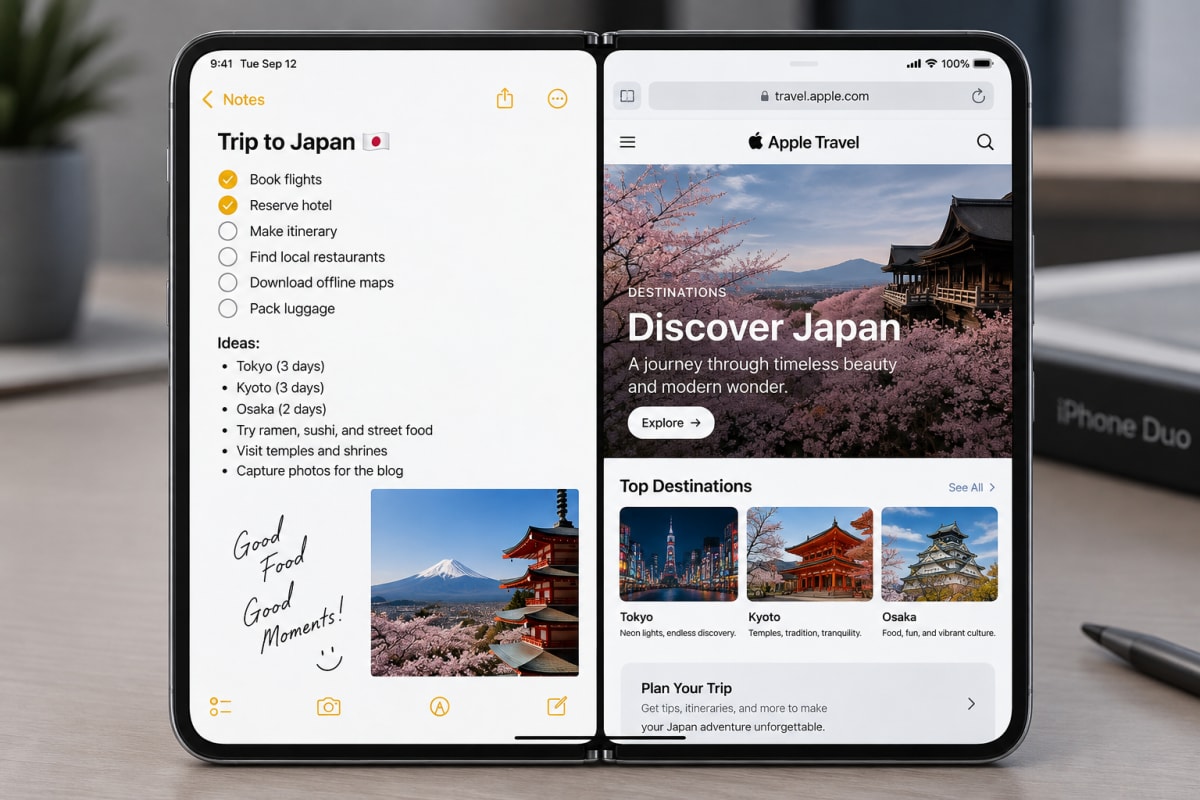
Software is where Apple is leaning hardest to justify the Duo as more than a stretched iPhone screen. iOS 27 adds a native split-view multitasking mode for running two apps side by side on the unfolded display, along with App Pairs that let you save a two-app combination to the Home Screen for one-tap launching. The dock also relocates from the bottom of the screen to the side, positioned for easier reach with one thumb while holding the device open.
Early impressions suggest Apple put real effort into the transition between folded and unfolded states. The Verge specifically praised how the display animates progressively as the phone opens rather than snapping abruptly from one screen to the other, and both Tom's Guide and 9to5Mac described the software handling as noticeably more polished than they expected from a first-generation foldable.
iPhone Duo Price and Release Date
The iPhone Duo starts at $1,999 in the US for 256GB, with pre-orders opening October 16 and general availability on October 23 in an initial group of markets including the US, Japan, India, Australia, China, Singapore, South Korea, and Malaysia. Another set of markets follows on October 30. It's an eSIM-only device everywhere it launches.
Storage | US Price |
|---|---|
256GB | $1,999 |
512GB | $2,199 |
1TB | $2,599 |
2TB | $3,199 |
For context, the iPhone 18 Pro starts at $1,199 and the iPhone 18 Pro Max at $1,299, both $100 higher than last year's Pro models. That puts the Duo about $700 above the Pro Max at the entry tier, making it the most expensive iPhone Apple has ever released.
iPhone Duo vs iPhone 18 Pro Max vs Galaxy Z Fold 8
Spec | iPhone Duo | iPhone 18 Pro Max | Galaxy Z Fold 8 |
|---|---|---|---|
Starting price | $1,999 | $1,299 | Not covered in this preview |
Main display | 7.6-inch foldable OLED | 6.9-inch OLED | Foldable OLED |
Chip | A20 Pro | A20 Pro | Not covered in this preview |
Thickness (closed) | 11.3 mm | 8.25 mm | ~9.7 mm (folded) |
Weight | 254 g | Not covered in this preview | ~201 g |
Rated video playback | Up to 44 hrs (outer screen) | Up to 45 hrs | Not covered in this preview |
Biometrics | Touch ID | Face ID | Not covered in this preview |
The most useful takeaway from this comparison is that the Duo trades thinness and weight for Apple's software ecosystem and a titanium build. If a slimmer, lighter foldable matters more to you than iOS, that's worth weighing carefully once full reviews of both devices are available.
Early Hands-On Impressions (Not a Full Review)
It's worth being precise about what exists right now. A handful of journalists, including writers from Tom's Guide, Gizmodo, The Verge, Engadget, TechRadar, 9to5Mac, and MacRumors, got brief, supervised time with the Duo in a demo area immediately after the announcement. Gizmodo's own writer was explicit that his piece was first impressions, not a review, and that proper testing would require a unit to use daily. That distinction matters, because a few minutes with a demo unit in ideal lighting and controlled conditions can't reveal how a phone performs on a commute, in direct sunlight, or after a week of real use.
With that caveat in place, the consistent themes across these early impressions are: a hinge and software transition that feel more refined than expected from a first-generation product, a crease that's easy to overlook but not invisible, and a price and thickness that put it at a real disadvantage next to established foldable rivals. None of that adds up to a verdict yet, but it's a reasonable set of expectations to walk into launch day with.
What This Preview Can't Tell You Yet
How the cameras actually perform in daylight, low light, portraits, and video compared with the iPhone 18 Pro
Real-world battery life across a full day of mixed use, rather than Apple's lab-based video playback ratings
Sustained gaming performance and whether the larger vapor chamber meaningfully reduces throttling
How the inner display and hinge hold up after months of daily folding
Whether third-party apps beyond Apple's launch partners actually take advantage of the larger screen
Expect these questions to be answered as reviewers publish full testing after the October 23 release.
Who Might Want the iPhone Duo, and Who Should Wait
Based purely on what's confirmed so far, the Duo looks aimed at existing iPhone users who want a genuinely larger screen for productivity, reading, or media without leaving Apple's ecosystem, and who are comfortable paying a significant premium for a first-generation foldable design. Anyone primarily focused on camera quality would likely get more for their money from the iPhone 18 Pro Max, which keeps a third telephoto lens and a variable aperture at a lower price. Buyers who care most about thinness and weight in a foldable have reason to compare it directly against Samsung's Galaxy Z Fold 8 once both have been reviewed side by side.
If you're on the fence, waiting two to three weeks past the October 23 launch for independent battery, camera, and durability testing is the safer move, especially given the price involved.
Is the iPhone Duo Worth Buying?
It's too early to answer that with confidence, and any article claiming otherwise before October 23 is guessing. What can be said is that Apple has built a technically ambitious first foldable, backed by a fast, familiar chip, a genuinely large display, and software that early impressions describe as more polished than typical for a first attempt at a new form factor. Whether that translates into a device worth $1,999 and up, next to a mature rival like the Galaxy Z Fold 8, depends on real-world camera, battery, and durability results that simply don't exist yet. Bookmark this page or check back after launch, since this preview will be followed by a full review once hands-on testing is possible.
FAQs
When does the iPhone Duo release?
Pre-orders open October 16, 2026, with general availability starting October 23, 2026, in an initial group of markets. A second group of markets receives it October 30.
How much does the iPhone Duo cost?
It starts at $1,999 in the US for 256GB, rising to $2,199 for 512GB, $2,599 for 1TB, and $3,199 for 2TB.
What chip does the iPhone Duo use?
It uses the same A20 Pro chip and C2 modem as the iPhone 18 Pro and iPhone 18 Pro Max, paired with a larger vapor chamber for cooling.
Does the iPhone Duo have Face ID?
No. It uses Touch ID built into the side power button instead of Face ID.
How big are the iPhone Duo's screens?
The inner foldable display is 7.6 inches, and the outer cover display is 5.4 inches. Both run at 120Hz with ProMotion.
Is the iPhone Duo waterproof?
It carries an IP68 rating, meaning it's resistant to dust and can withstand submersion up to 6 meters for around 30 minutes.
Is the iPhone Duo better than the Galaxy Z Fold 8?
That comparison can't be settled yet without full reviews of both phones. What's confirmed is that the Duo is thicker and heavier when closed than the Z Fold 8, while offering Apple's software ecosystem and a titanium frame.
Was this article helpful?

Written By
TechorCoffeeContributing Writer
TechorCoffee is a technology reporter and software creator writing reviews and tutorials for TechOrCoffee.
Comments (0)
Leave a Comment
Read Next

Thu Apr 09 2026
Leaks & Rumors: iPhone 18 Pro Max vs iPhone 17 Pro Max: Full Comparison
The iPhone 17 Pro Max is already a fully matured flagship—top camera, insane battery life, and stable performance. The iPhone 18 Pro Max is expected to refine the experience further, not revolutionize it.
Tue Jun 16 2026
Samsung Galaxy Z Fold 8 vs Galaxy Z Fold 7:Worth to Upgrade?
Samsung Galaxy Z Fold 8 vs Galaxy Z Fold 7: Is it worth the upgrade? Compare specs, battery upgrades, 45W charging, and camera leaks before you buy.

Wed Apr 08 2026
Leaks & Rumors: iPhone 18 Pro Max: Every Leak, Spec and Upgrade Confirmed
The iPhone 18 Pro Max is expected in September 2026 as Apple’s most powerful iPhone yet. It features a 6.9-inch LTPO OLED display, A20 Pro chip, 48MP camera with variable aperture, 5,100–5,200mAh battery, C2 modem with satellite support, and a starting price of $1,199.