OPPO Find X10 Pro Max vs vivo X500 Pro Max

Published
Two camera flagships, one chip, very different bets
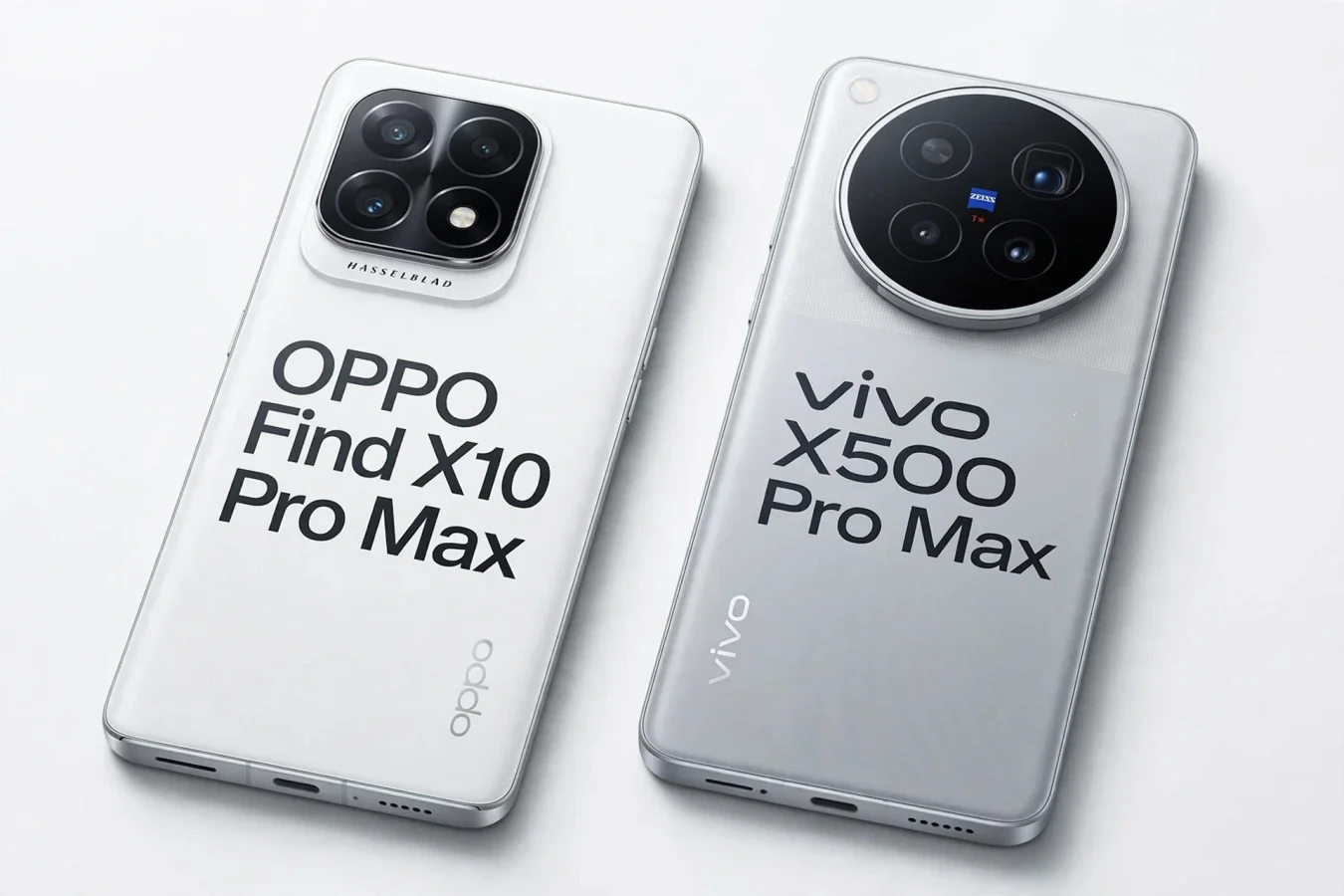
OPPO Find X10 Pro Max and vivo X500 Pro Max are the most direct flagship comparison of late October 2026. Both launched globally within days of each other, both use MediaTek's Dimensity 9600 Pro, and both are built around photography — but they bet on different camera ideas. OPPO puts 200MP behind all three rear cameras. vivo puts a 50MP main and a 50MP ultrawide next to a single, very large 200MP telephoto, and leans on ZEISS optics and tracking.
That shared chip means this is not about raw processor class. It is about cameras, display, regional battery, software, and — for Indian buyers — price and availability, where the phones are in very different positions on 30 October 2026.
A warning before the specs: both phones have regional battery and configuration differences. Do not compare a China battery with a Europe battery and declare a winner. This article flags every regional figure it uses, and for India it separates confirmed OPPO pricing from vivo's reported, unconfirmed expectations.
At a glance
| OPPO Find X10 Pro Max | vivo X500 Pro Max | |
|---|---|---|
| Global announcement | 21 October 2026, Mallorca | 27 October 2026, global expansion (China debut September) |
| Chip | MediaTek Dimensity 9600 Pro, 2nm | MediaTek Dimensity 9600 Pro, 2nm |
| Display | 6.78-inch AMOLED, 1–120Hz adaptive (144Hz in some gaming scenarios) | 6.85-inch 2K ZEISS Master Color Display, 1–144Hz adaptive |
| Rear cameras | Triple 200MP: main, ultrawide, telephoto | 50MP main, 50MP ultrawide, 200MP ZEISS telephoto |
| Front camera | 50MP autofocus | Not the headline feature in sources reviewed — check regional spec sheet |
| Battery (varies by region) | 8,000mAh global typical; 7,150mAh Europe | 7,800mAh Singapore/Malaysia; 8,000mAh China; 6,750mAh Europe |
| Charging | 80W wired, 50W wireless | 90W wired, 40W wireless |
| Software | ColorOS 17 | OriginOS 7, based on Android 17 (per global coverage) |
| India price / availability | ₹1,99,999 (12GB + 512GB), MRP ₹2,39,999, sale from 29 October 2026 | India launch unconfirmed; expected ₹1.3–1.4 lakh reported by 91mobiles via Business Today |
Cameras: triple 200MP vs one giant telephoto
This is where the phones diverge most, and where megapixel counts alone mislead.
OPPO's system, described by OPPO as an industry-first triple 200MP setup, uses a 200MP main camera (Type 1/1.3 sensor, f/1.5, 24mm equivalent), a 200MP ultrawide (Type 1/1.56, f/2.2, 13mm, 124-degree view) and a 200MP periscope telephoto (Type 1/1.56, f/2.1, 70mm, 3x). It also lists a separate 3.2MP multispectral sensor. All three rear cameras record 8K at 30fps and 4K at 120fps, with open-gate recording, and the default capture is 26MP from ultrawide through 9.9x, with full 50MP/200MP output in Hasselblad Hi-Res Mode. An optional Hasselblad Teleconverter adds 3.28x optical magnification to the telephoto.
vivo's system is built around ZEISS. The main camera is a 50MP ZEISS TrueDynamic camera (Sony LYTIA L910, 1/1.28-inch, f/1.57, 24mm, gimbal-grade OIS), the ultrawide is 50MP, and the telephoto is a 200MP ZEISS APO camera (1/1.4-inch, 85mm equivalent, CIPA 7.0 stabilisation). vivo also offers a 400mm-equivalent ZEISS Telephoto Extender Gen 2 Ultra. Video includes 8K at 30fps on the Pro Max, 4K 120fps Pro AF Tracking Video, and Cinematic Pro Log Video.
So the choice is not "200MP vs 50MP". It is:
- OPPO: consistency across all three focal lengths. If you shoot ultrawide, main and telephoto in the same session and want the same high-resolution approach everywhere, OPPO's system is the more uniform one. Its ultrawide is the standout difference — 200MP where vivo uses 50MP.
- vivo: specialisation at the long end. Its telephoto sensor is larger (1/1.4-inch) than OPPO's telephoto sensor (1/1.56-inch), its focal length is longer natively (85mm vs 70mm), and its ZEISS APO design, stabilisation and extender are aimed at distant subjects. If your photography is portraits and telephoto, vivo's telephoto is the stronger single camera on paper.
No photo-quality winner can be declared from specs alone: sensor, lens, stabilisation, processing (OPPO LUMO vs vivo ZEISS/X-Track) and colour all matter, and sources here are launch reports, not a controlled camera test. Buy by shooting style — all-lens consistency (OPPO) or telephoto-first (vivo) — and check independent samples before spending flagship money.
Performance: same chip, different jobs
Both phones use the Dimensity 9600 Pro, described as a 2nm MediaTek chip. vivo describes a 2+3+3 CPU architecture for it. OPPO lists 12GB or 16GB configurations with 512GB storage and no storage-card support in global specifications. vivo's Singapore launch offered a single 12GB + 512GB configuration; other regions list 12GB + 256GB as well.
Daily differences will come more from software, thermals and display handling than chip name. Check regional reviews for sustained performance, gaming stability, and ColorOS 17 (AI Mind Pilot, AI Photo Agent) vs OriginOS 7 (X-Track tracking) behaviour — those software experiences are where the phones will actually feel different.
No independent benchmark comparison between these two specific phones was available in the sources reviewed for this article, so no AnTuTu, Geekbench or battery-test winner is claimed here. If a later review publishes controlled tests for both, that should outweigh any spec-table verdict.
Display and design: bigger vs more compact flagship
vivo's Pro Max is the bigger phone: a 6.85-inch 2K display with 1–144Hz adaptive refresh, Dolby Vision and Ultra XDR support, and a weight reported at 225–229g in Malaysian coverage. OPPO's Pro Max is slightly smaller at 6.78 inches, with a 2772 x 1272 AMOLED panel, 1–120Hz adaptive refresh (144Hz restricted to certain gaming scenarios in OPPO's specifications), and up to 3,600 nits peak brightness in Australian launch coverage.
Neither is compact. vivo's size/weight is the bigger one-handed compromise — and the reason it fits the larger telephoto and, in some regions, larger battery. Try both in hand: a 6.85-inch phone with a large camera island feels different from a 6.78-inch phone, even if specs look similar.
OPPO lists IP66/IP68/IP69, vivo IP68/IP69 in launch coverage — check your regional spec sheet, as not every variant carries every rating.
Battery and charging: region is the whole story
Battery is where a careless comparison goes wrong, so read this section by region.
- OPPO: global typical capacity 8,000mAh, with 80W wired and 50W wireless charging. European specifications list 7,150mAh, and Australian launch coverage also lists 7,150mAh. The difference is not a typo in this article; it is a regional variant. Indian buyers should check the Indian spec sheet for the unit sold in India, not assume the global 8,000mAh figure.
- vivo: Singapore and Malaysia Pro Max battery 7,800mAh, with 90W wired and 40W wireless charging and bypass charging. China Pro Max battery 8,000mAh, Europe 6,750mAh, according to TechRepublic's regional comparison. Again, region changes the answer.
On charging speed, vivo wins on wired power (90W vs 80W) and OPPO wins on wireless power (50W vs 40W) in the figures above. Neither difference, alone, should decide a purchase, because charging time depends on the charger, the battery size in your region, and thermal limits — none of which are captured by a watt number. What matters more is that both phones now carry batteries in the 7,000–8,000mAh class, a huge step from the 5,000–6,000mAh flagships of a few years ago, and both should comfortably last a full day for most users, with two-day use possible for lighter users in the larger-battery regions. That claim is about capacity class, not a tested battery-life result for either phone.
Software and support: ColorOS vs OriginOS
OPPO ships ColorOS 17, vivo ships OriginOS 7 based on Android 17 in global coverage. Both are Android-based, both include AI photo and organisation features, and both will feel very different from stock Android and from each other. Software support duration — how many years of OS and security updates each phone gets in India — was not confirmed in the sources reviewed for this article, and it should be checked before buying, because a flagship bought in late 2026 should still be supported in 2030. Do not assume the two brands offer the same update policy in India; check the Indian product page and any launch announcement for update commitments.
Ecosystem matters too. If you already use OPPO or vivo accessories, watches or earbuds, staying in the same brand usually gives smoother pairing and sharing. If you are switching brands, budget a week to learn the new software's notification, permission and AI settings, because both ColorOS and OriginOS are heavily customised.
India price and availability: the deciding factor today
This is where the comparison becomes practical rather than theoretical.
- OPPO Find X10 Pro Max in India: ₹1,99,999 for 12GB + 512GB, MRP ₹2,39,999, with sales scheduled from 29 October 2026, according to Business Today. That is a confirmed Indian price and sale date in the sources reviewed.
- vivo X500 Pro Max in India: India launch unconfirmed in Business Today's comparison, with an expected price of ₹1.3–1.4 lakh reported by 91mobiles. The user's research snapshot expects an India launch by late November, but that is a report, not a confirmed vivo India announcement. Treat any vivo India price as an estimate until vivo India confirms it.
So on 30 October 2026, an Indian buyer can actually buy the OPPO today, at a known price, while the vivo is a wait-and-see. If the reported ₹1.3–1.4 lakh expectation proves correct, vivo would be significantly cheaper in India — roughly ₹60,000–70,000 less than OPPO's ₹1,99,999 — which would change the value verdict completely. But it is not confirmed, and a comparison that declares vivo the value winner on an unconfirmed price would be misleading. The honest verdict today is: OPPO wins on availability and certainty in India; vivo may win on value if its India price lands where reports suggest, and that "if" is doing a lot of work.
For buyers outside India, the picture is different again: Singapore Pro Max pricing was S$2,499 for 12GB + 512GB, with sales from 31 October 2026, and Australian OPPO Pro Max pricing was A$2,699. Always compare the price in your own market, in your own currency, for the same configuration.
Verdict: which flagship wins?
There is no single winner, and any article that gives one without conditions is oversimplifying. Here is the conditional verdict, based only on confirmed specs and pricing in the sources reviewed:
- Buy OPPO Find X10 Pro Max if: you want triple-200MP consistency across ultrawide, main and telephoto, you want a confirmed Indian purchase today at ₹1,99,999, you prefer ColorOS 17, or you value 50W wireless charging and the Hasselblad Hi-Res workflow.
- Buy vivo X500 Pro Max if: you shoot portraits and telephoto most, you want the larger 1/1.4-inch 200MP telephoto with ZEISS APO optics and the 400mm extender option, you prefer a larger 6.85-inch 2K display, or you are willing to wait for an India launch and a potentially lower price.
- Wait if: you are in India and vivo's price matters to you, because the reported ₹1.3–1.4 lakh expectation, if confirmed, would make vivo the value pick, and buying OPPO today at ₹1,99,999 without knowing vivo's India price is a decision you cannot undo easily.
If you forced a single pick on specs alone, OPPO's camera system is broader and vivo's telephoto is deeper — a tie that breaks on how you shoot. If you forced a pick on India buying today, OPPO is the only confirmed option. That is the most useful way to read this comparison: not as a knockout, but as a choice between a broader camera system you can buy now, and a deeper telephoto system you may be able to buy cheaper soon.
FAQs
Which phone has better cameras, OPPO or vivo?
OPPO offers triple 200MP across all three lenses; vivo offers a larger 1/1.4-inch 200MP telephoto. No controlled side-by-side test was reviewed, so choose by shooting style, not megapixels alone.
Do both phones use the same chip?
Yes. Both use MediaTek Dimensity 9600 Pro, described as a 2nm chip, so daily performance differences come more from software and thermals than chip name.
What is the OPPO Find X10 Pro Max price in India?
₹1,99,999 for 12GB + 512GB, MRP ₹2,39,999, with sales from 29 October 2026 per Business Today.
Is vivo X500 Pro Max launched in India?
Not confirmed as of 30 October 2026. India launch by late November is reported, and ₹1.3–1.4 lakh is a reported expectation, not a confirmed vivo India price.
Which phone has a bigger battery?
It depends on region. OPPO lists 8,000mAh global / 7,150mAh Europe; vivo lists 7,800mAh Singapore/Malaysia, 8,000mAh China, 6,750mAh Europe. Check your regional spec sheet.
Which charges faster?
vivo lists 90W wired vs OPPO 80W; OPPO lists 50W wireless vs vivo 40W. Actual charging time depends on charger, battery size and thermals.
Which should I buy?
OPPO for triple-camera consistency and confirmed India availability today; vivo for telephoto-first shooting and potentially lower India pricing if the reported price is confirmed.
Was this article helpful?

Written By
TechorCoffeeContributing Writer
TechorCoffee is a technology reporter and software creator writing reviews and tutorials for TechOrCoffee.
Comments (0)
Leave a Comment
Read Next

Thu Apr 09 2026
Leaks & Rumors: iPhone 18 Pro Max vs iPhone 17 Pro Max: Full Comparison
The iPhone 17 Pro Max is already a fully matured flagship—top camera, insane battery life, and stable performance. The iPhone 18 Pro Max is expected to refine the experience further, not revolutionize it.
Tue Jun 16 2026
Samsung Galaxy Z Fold 8 vs Galaxy Z Fold 7:Worth to Upgrade?
Samsung Galaxy Z Fold 8 vs Galaxy Z Fold 7: Is it worth the upgrade? Compare specs, battery upgrades, 45W charging, and camera leaks before you buy.

Wed Apr 08 2026
Leaks & Rumors: iPhone 18 Pro Max: Every Leak, Spec and Upgrade Confirmed
The iPhone 18 Pro Max is expected in September 2026 as Apple’s most powerful iPhone yet. It features a 6.9-inch LTPO OLED display, A20 Pro chip, 48MP camera with variable aperture, 5,100–5,200mAh battery, C2 modem with satellite support, and a starting price of $1,199.