OPPO Find X10 Pro Max vs Xiaomi 18 Pro Max

Published
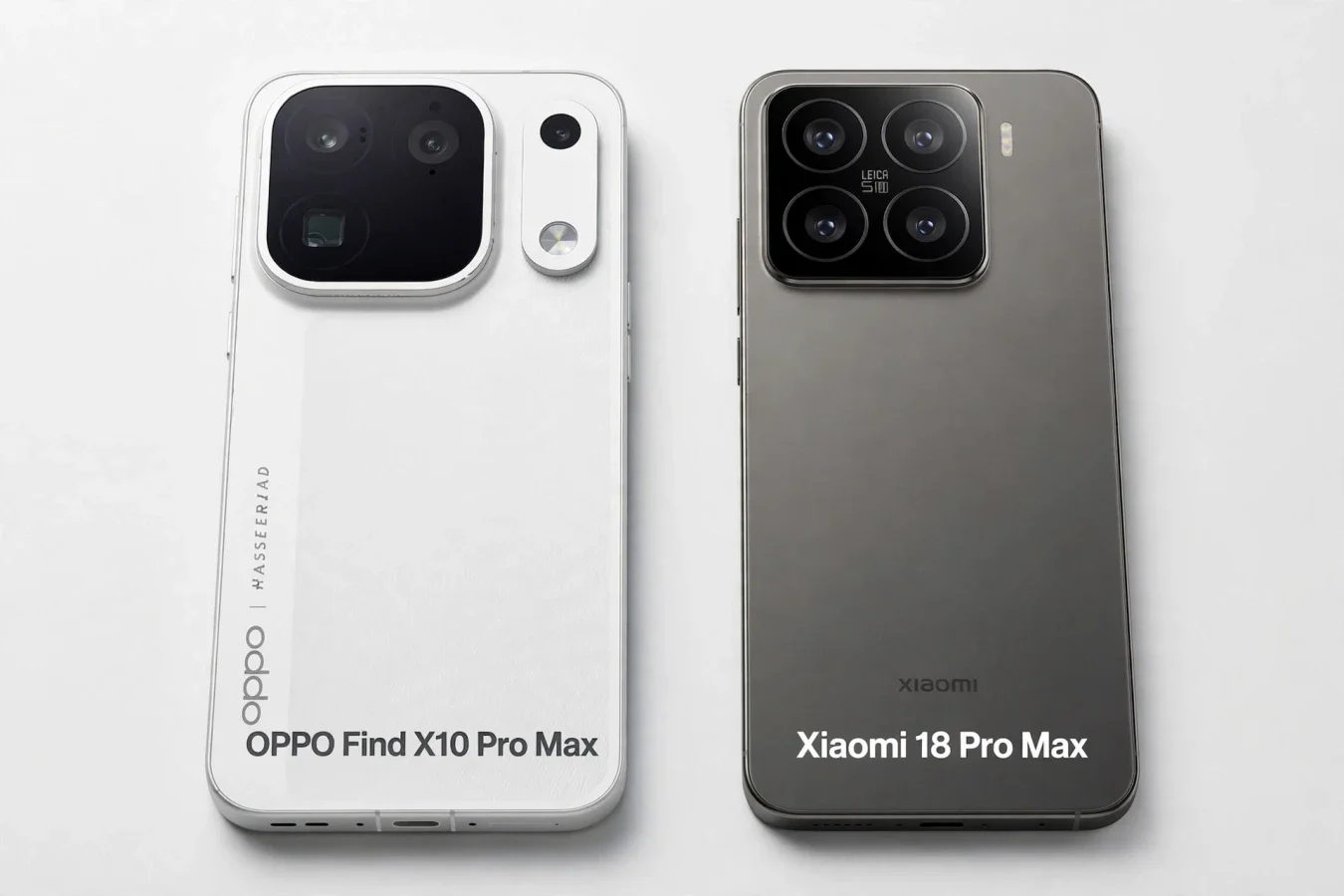
Hasselblad vs Leica, Dimensity vs Snapdragon
OPPO Find X10 Pro Max and Xiaomi 18 Pro Max are both camera-first flagships, but they arrive from opposite directions. OPPO, launched globally on 21 October 2026, bets on uniformity: 200MP behind all three rear cameras, Hasselblad processing, and a MediaTek Dimensity 9600 Pro chip. Xiaomi, launched in China on 23 September 2026, bets on extremes: dual 200MP Leica cameras, a 2.9-inch rear display, an 8,500mAh China battery, and Qualcomm's Snapdragon 8 Elite Extreme Gen 6.
The catch for Indian buyers is availability. OPPO is confirmed in India at ₹1,99,999 from 29 October 2026. Xiaomi has confirmed a global launch later in 2026, but has not confirmed an India launch date or India price for the Pro Max — and one current report even says Xiaomi may bring only the Xiaomi 18 Pro to India, with the Pro Max removed from the current India roadmap. That uncertainty shapes the whole verdict, so this article separates China specs (confirmed for China) from global/India facts (not yet confirmed).
At a glance
| OPPO Find X10 Pro Max | Xiaomi 18 Pro Max | |
|---|---|---|
| Launch | Global, 21 October 2026 | China, 23 September 2026; global later in 2026 (date unconfirmed) |
| Chip | MediaTek Dimensity 9600 Pro, 2nm | Snapdragon 8 Elite Extreme Gen 6, 2nm |
| Display | 6.78-inch AMOLED, 1–120Hz (144Hz in some gaming scenarios) | 6.9-inch LTPO AMOLED, 120Hz, plus 2.9-inch rear AMOLED display |
| Rear cameras | Triple 200MP: main, ultrawide, telephoto (Hasselblad) | Dual 200MP: main + periscope telephoto, plus 50MP ultrawide (Leica) |
| Battery (China / global) | 8,000mAh global typical; 7,150mAh Europe | 8,500mAh China; global capacity may be smaller, per reports |
| Charging (China) | 80W wired, 50W wireless | 100W wired, 50W wireless |
| Software | ColorOS 17 | HyperOS 4 |
| India | ₹1,99,999 (12GB + 512GB), sale from 29 October 2026 | No confirmed India date or price; estimates range widely |
Cameras: three 200MP vs two 200MP plus a rear screen
OPPO's triple-200MP system is the broader one. Main: 200MP, Type 1/1.3, f/1.5, 24mm. Ultrawide: 200MP, Type 1/1.56, f/2.2, 13mm, 124-degree view. Telephoto: 200MP, Type 1/1.56, f/2.1, 70mm, 3x, with a 10cm minimum focus distance for telemacro work. All three record 8K at 30fps and 4K at 120fps, with open-gate recording, and an optional Hasselblad Teleconverter adds 3.28x optical magnification to the telephoto. Default capture is 26MP from ultrawide through 9.9x, with 50MP/200MP in Hasselblad Hi-Res Mode.
Xiaomi's Leica system is the more specialised one. Main: 200MP Light Fusion 960L. Telephoto: 200MP periscope, 1/1.56-inch, 75mm equivalent, 3.2x optical zoom, 12cm minimum focus. Ultrawide: 50MP. Front camera: 50MP on both phones (OPPO 50MP autofocus; Xiaomi 50MP in launch coverage). Xiaomi video goes to 8K at 30fps. Xiaomi also adds a privacy feature, reported in launch coverage, where the front camera can detect an onlooker and activate privacy mode — a useful idea whose on-device vs cloud processing was not clarified in the coverage reviewed, so treat that detail as unconfirmed.
The practical difference: OPPO gives you 200MP on the ultrawide, where Xiaomi gives you 50MP. Xiaomi gives you a longer native telephoto (75mm vs 70mm) and a rear display for selfies and notifications. Neither difference, alone, decides photo quality. Sensor processing — OPPO's LUMO True Image Engine vs Xiaomi's Leica tuning — colour science, and stabilisation matter as much as resolution, and no controlled side-by-side camera test between these two phones was reviewed here. Do not buy on "triple vs dual 200MP" alone. Buy on whether you shoot ultrawide a lot (OPPO advantage on paper), or whether you want Leica telephoto and a rear screen (Xiaomi advantage on paper), and check independent samples for the exact regional model you would buy.
Performance: two different 2nm flagships
Both chips are 2nm, but they are not the same chip. OPPO uses MediaTek's Dimensity 9600 Pro. Xiaomi uses Qualcomm's Snapdragon 8 Elite Extreme Gen 6, the higher tier above the Snapdragon 8 Elite Gen 6 in the standard Xiaomi 18 Pro. Xiaomi's Pro Max also lists LPDDR5X RAM and UFS 4.1 storage in China-model coverage, with up to 16GB/1TB configurations, and a China starting price of CNY 6,999, rising to CNY 9,999 for 16GB + 1TB and CNY 10,999 for the Transparent Edition.
No controlled benchmark comparison between these two retail phones was reviewed, so this article claims no AnTuTu or Geekbench winner. Pre-launch Geekbench listings for a Xiaomi prototype (single-core 2,831, multi-core 8,843 in one report) are prototype figures and should not be treated as retail performance. In daily use, the difference is more likely to show in sustained gaming, thermal behaviour, and software — ColorOS 17 vs HyperOS 4 — than in a headline benchmark. If you are a heavy gamer, wait for sustained-performance tests on the regional models, not launch-day scores.
Display and design: one screen vs two
Xiaomi is the larger, more unusual phone: a 6.9-inch main display plus a 2.9-inch rear display, which can be used for selfies with the rear cameras, notifications, and quick controls. That rear screen is a genuine differentiator, but it also adds complexity, weight and a second screen to protect. OPPO is smaller at 6.78 inches, with a 2772 x 1272 AMOLED panel and up to 3,600 nits peak brightness in Australian coverage, and a camera-inspired Luna White / Titanium Grey design with a Hasselblad orange accent.
Xiaomi's display coverage lists 4,000 nits in some launch reports, but peak brightness figures are measured differently by different sources, so do not treat a nits gap as a visible difference without a side-by-side test. The real display choice is simpler: do you want a rear screen and a larger 6.9-inch phone, or a more conventional single-screen flagship at 6.78 inches?
Battery and charging: Xiaomi's China lead, with a global asterisk
On China figures, Xiaomi wins clearly: 8,500mAh vs OPPO's 8,000mAh global typical (7,150mAh Europe), with 100W wired charging vs OPPO's 80W, and 50W wireless on both. That is a real advantage — if you buy the China model.
For global and Indian buyers, the asterisk matters. Reports indicate global Xiaomi 18 Pro Max versions may use smaller batteries than the China 8,500mAh cell, and no confirmed global battery figure was available in the sources reviewed. OPPO's regional variation is the same warning in reverse: Europe gets 7,150mAh, not 8,000mAh. So the honest battery verdict is: China Xiaomi > global OPPO on paper, but global Xiaomi battery is unconfirmed, and Indian buyers should compare the Indian spec sheets, not China vs Europe figures, when both are published.
Charging follows the same logic. 100W vs 80W wired is a real watt gap, but actual charge time depends on battery size in your region, charger, and thermal limits. Do not buy on watts alone.
Software: ColorOS 17 vs HyperOS 4
OPPO ships ColorOS 17 with AI Mind Pilot and AI Photo Agent. Xiaomi ships HyperOS 4, with one report specifying Android 17 underneath. Both are heavily customised Android skins, both include AI photo and organisation features, and both will feel different from stock Android and from each other. Software support duration in India was not confirmed for either phone in the sources reviewed, and should be checked before buying a flagship in late 2026.
If you already own OPPO or Xiaomi accessories, staying in-brand usually gives smoother pairing. If you switch, expect a learning week for notifications, permissions and AI settings on either skin.
India price and availability: confirmed vs estimated
- OPPO: ₹1,99,999 for 12GB + 512GB, MRP ₹2,39,999, sale from 29 October 2026. Confirmed in Business Today coverage.
- Xiaomi: No confirmed India date or price. Estimates in third-party databases range from around ₹89,999–₹99,999 (Smartprix/Gizbot listings) to ₹1,30,000–₹1,50,000 (TechnoSports, citing industry insider Yogesh Brar via Smartprix), and one older report even suggested ₹1,50,999. That spread — roughly ₹60,000 wide — is itself the story: nobody outside Xiaomi knows the India price yet, and any article that picks one figure as "the price" is guessing.
There is also the roadmap question. One current report says Xiaomi may bring only the Xiaomi 18 Pro to India, not the Pro Max. If that proves correct, the comparison for Indian buyers becomes moot — you would buy OPPO, or wait for a different Xiaomi model. If Xiaomi does bring the Pro Max to India in December 2026, as some reports suggest, then the price will decide the value verdict. Until Xiaomi India confirms, the only honest India advice is: OPPO is buyable today; Xiaomi Pro Max is not confirmed for India at all.
For buyers outside India, China prices are reference only: Xiaomi Pro Max from CNY 6,999, OPPO Pro Max A$2,699 in Australia. Converted prices are not retail prices, because taxes, duties, bands and configurations differ.
Verdict
- Buy OPPO Find X10 Pro Max if: you want triple-200MP consistency, a confirmed India purchase today at ₹1,99,999, ColorOS 17, or a more conventional single-screen flagship.
- Buy Xiaomi 18 Pro Max if: you want the rear display, Leica dual-200MP cameras, Snapdragon 8 Elite Extreme Gen 6, and the largest China battery — and you are buying in China, or in a global market where Xiaomi confirms the same specs and a price you accept.
- Wait if: you are in India. Do not import a China Xiaomi on the assumption it will match Indian bands, warranty and software, and do not assume a December India launch or a ₹99,999 price until Xiaomi India confirms it. If Xiaomi confirms the Pro Max for India at a price well below ₹1,99,999, the value verdict flips; until then, OPPO is the only confirmed choice in this pair for Indian buyers.
On specs alone, Xiaomi's battery and rear screen are the more striking hardware, and OPPO's ultrawide is the more complete camera system. On buying reality in India today, OPPO wins by being available. That split — hardware vs availability — is the whole comparison.
FAQs
Which phone has better cameras?
OPPO has triple 200MP including a 200MP ultrawide; Xiaomi has dual 200MP Leica cameras plus a rear display. No controlled test was reviewed, so choose by ultrawide vs Leica telephoto/rear-screen preference.
Which chip is faster?
OPPO uses Dimensity 9600 Pro, Xiaomi uses Snapdragon 8 Elite Extreme Gen 6, both 2nm. No retail benchmark comparison was reviewed, so no speed winner is claimed.
What is OPPO Find X10 Pro Max price in India?
₹1,99,999 for 12GB + 512GB, MRP ₹2,39,999, sale from 29 October 2026.
Is Xiaomi 18 Pro Max launched in India?
Not confirmed. Global launch is confirmed for later in 2026, but India date and price are unconfirmed, and one report says only the 18 Pro may come to India.
Which has a bigger battery?
China Xiaomi 8,500mAh vs OPPO 8,000mAh global / 7,150mAh Europe. Global Xiaomi battery may be smaller per reports, so compare regional spec sheets.
What is special about Xiaomi's design?
A 2.9-inch rear AMOLED display, used for rear-camera selfies and notifications, plus Leica cameras and a 6.9-inch main display.
Which should I buy in India today?
OPPO, because it is confirmed and available. Xiaomi Pro Max is unconfirmed for India, so wait for Xiaomi India's announcement before deciding.
Was this article helpful?

Written By
TechorCoffeeContributing Writer
TechorCoffee is a technology reporter and software creator writing reviews and tutorials for TechOrCoffee.
Comments (0)
Leave a Comment
Read Next

Thu Apr 09 2026
Leaks & Rumors: iPhone 18 Pro Max vs iPhone 17 Pro Max: Full Comparison
The iPhone 17 Pro Max is already a fully matured flagship—top camera, insane battery life, and stable performance. The iPhone 18 Pro Max is expected to refine the experience further, not revolutionize it.
Tue Jun 16 2026
Samsung Galaxy Z Fold 8 vs Galaxy Z Fold 7:Worth to Upgrade?
Samsung Galaxy Z Fold 8 vs Galaxy Z Fold 7: Is it worth the upgrade? Compare specs, battery upgrades, 45W charging, and camera leaks before you buy.

Wed Apr 08 2026
Leaks & Rumors: iPhone 18 Pro Max: Every Leak, Spec and Upgrade Confirmed
The iPhone 18 Pro Max is expected in September 2026 as Apple’s most powerful iPhone yet. It features a 6.9-inch LTPO OLED display, A20 Pro chip, 48MP camera with variable aperture, 5,100–5,200mAh battery, C2 modem with satellite support, and a starting price of $1,199.