OPPO Find X10 vs OnePlus 16

Published
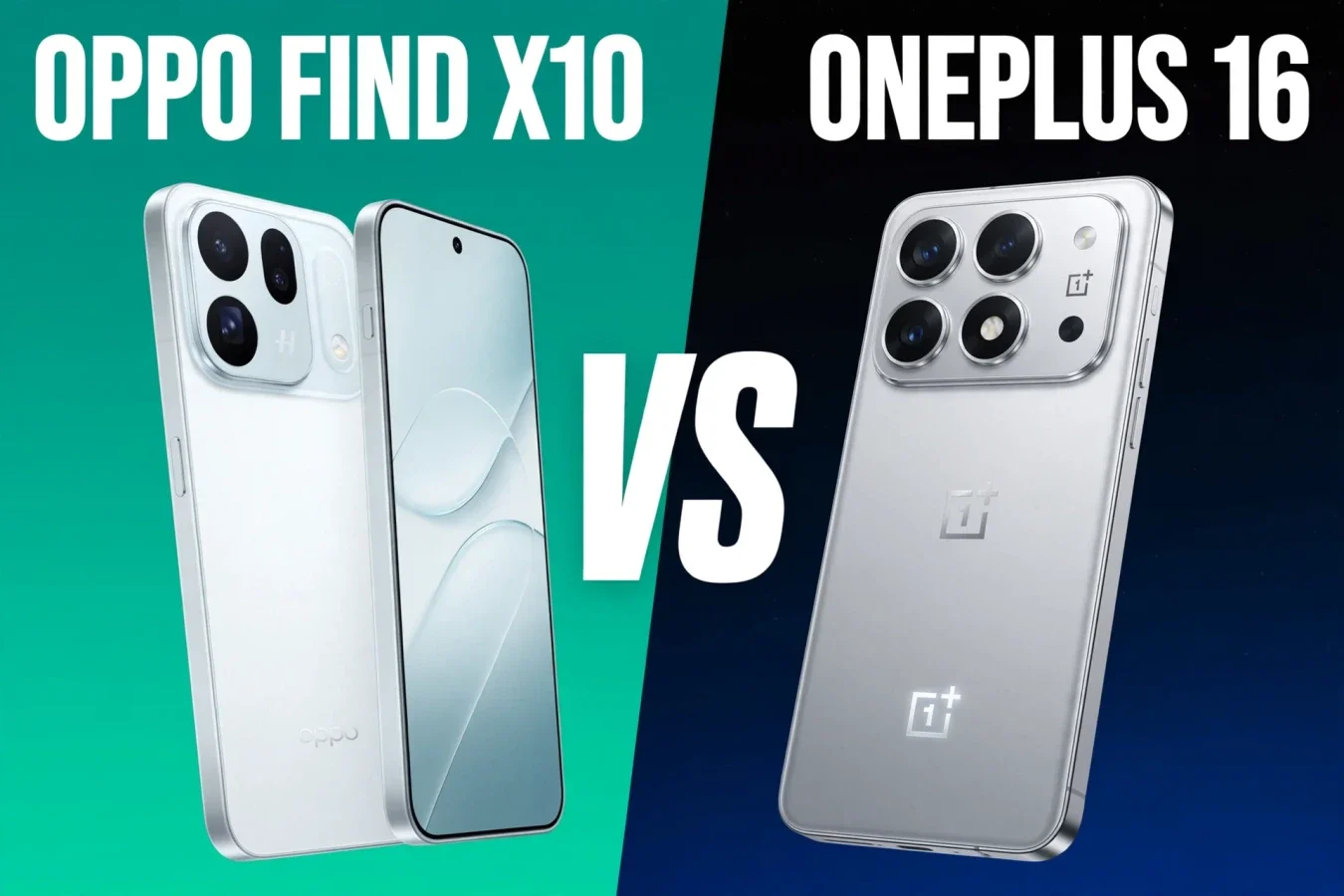
Camera flagship officially in India vs gaming flagship still China-only
OPPO Find X10 vs OnePlus 16 is a comparison between a camera flagship officially on sale in India and a gaming flagship still China-only. OPPO Find X10, launched in India on 22 October 2026 and on sale from 29 October 2026, offers a Hasselblad dual-200MP set, a Dimensity 9600M chip and an 8,000mAh battery. OnePlus 16, launched in China on 12 October 2026, offers a 200MP main, a 9,000mAh battery, dedicated gaming chips and bypass charging. For Indian buyers, the practical question is whether OnePlus's gaming and battery advantages are worth waiting for when OPPO is already officially sold here.
At a glance
| OPPO Find X10 | OnePlus 16 | |
|---|---|---|
| Launch / India | India 22 Oct 2026, sale from 29 Oct 2026 | China 12 Oct 2026, sales from 13 Oct; China-only for now |
| Chip | MediaTek Dimensity 9600M (3nm) | Snapdragon 8 Elite Extreme Gen 6 (2nm) |
| Rear cameras | 200MP main (1/1.4-inch, f/1.6, 23mm) + 200MP periscope tele (1/1.56-inch, f/2.6, 65mm, 2.8x) + 50MP ultrawide (1/2.75-inch, f/2.0, 15mm) | 200MP main (1/1.4-inch ISOCELL HPE, f/1.6, OIS) + 50MP 3x periscope tele (1/1.95-inch, f/2.6) + 50MP ultrawide |
| Front camera | 50MP | 50MP |
| Display | 6.59-inch LTPO, 2768 x 1272, 1–120Hz (144Hz in games), up to 3,600 nits local peak, Dolby Vision | 6.78-inch LTPO OLED, 1272 x 2772, 165Hz interface / 185Hz in games, P4 display / G3 eSports / T3 touch chips, bypass charging |
| Battery | 8,000mAh, 80W wired / 50W wireless | 9,000mAh, 100W wired / 50W wireless / 27W reverse, 80% in 37 min claimed |
| Software | ColorOS 17 (Android 17) | ColorOS 17 (China) |
| Extras | IP66/IP68/IP69, ultrasonic fingerprint, Snap Key, made in India | Bypass charging, dedicated gaming chips |
| India price | ₹1,39,999 (12+256), ₹1,69,999 (12+512) | No confirmed India/global launch; India estimates range wildly, never quote one figure |
| Other prices | Colours Glacier Blue, Mist Grey, Glow Coral | China CNY 5,999 (12+256) to 8,499 (16+1TB) |
Cameras: OPPO's dual-200MP vs OnePlus's 200MP main
OPPO's camera set is dual 200MP Hasselblad: a main (1/1.4-inch, f/1.6, 23mm) and a periscope telephoto (1/1.56-inch, f/2.6, 65mm, 2.8x), plus a 50MP ultrawide (1/2.75-inch, f/2.0, 15mm). OnePlus's camera set is a 200MP main (1/1.4-inch ISOCELL HPE, f/1.6, OIS) with a 50MP 3x periscope telephoto (1/1.95-inch, f/2.6) and a 50MP ultrawide, plus a 50MP front camera. Both phones offer a 50MP front camera, so selfies are close on paper, and both main cameras are 200MP at 1/1.4-inch with f/1.6, so main-camera hardware is very close on paper.
On telephoto, OPPO wins megapixels (200MP vs OnePlus 50MP) and sensor size, while OnePlus wins zoom length (3x vs OPPO 2.8x) — though the difference is small and OnePlus's telephoto sensor is smaller. On ultrawide, both offer 50MP, so neither has a clear advantage there. On front cameras, both offer 50MP, so neither has a clear advantage there either.
No controlled side-by-side camera test between these two phones was reviewed, so no photo winner is claimed. On paper, OPPO is the better zoom phone, OnePlus is the better gaming phone with a capable main camera, and Hasselblad colour science vs OnePlus's own processing will matter more than a single spec. For a photographer who shoots zoom and wants high-resolution crops, OPPO's dual-200MP set is more interesting; for a photographer who shoots mostly at 1x and wants a gaming phone, OnePlus's 200MP main is adequate, though its telephoto is less impressive on paper. Video: both phones offer flagship video in their launch coverage, and neither video pipeline can be judged without shooting the same scene on both.
Performance, display and battery: OnePlus's gaming chips vs OPPO's camera tuning
Performance: OnePlus uses Snapdragon 8 Elite Extreme Gen 6 (2nm), OPPO uses MediaTek Dimensity 9600M (3nm). On paper, OnePlus's newer 2nm chip should be more efficient and faster, though no retail comparison was reviewed and no speed winner is claimed. For gaming, OnePlus pulls ahead clearly with its 165Hz interface and 185Hz in games, dedicated P4 display, G3 eSports and T3 touch chips, plus bypass charging — which lets the phone run on charger power directly, reducing heat and battery wear during long gaming sessions. OPPO's display is 6.59-inch LTPO at 1–120Hz with 144Hz in games, which is good for gaming but without OnePlus's dedicated gaming chips or bypass charging, and at a lower refresh rate in games.
Display: OPPO 6.59-inch LTPO at 2768 x 1272 with Dolby Vision and up to 3,600 nits local peak, OnePlus 6.78-inch LTPO OLED at 1272 x 2772 with 165Hz interface and 185Hz in games. OnePlus's display is larger and faster for gaming, OPPO's display is well calibrated and tightly integrated with ColorOS. Both are excellent for HDR video and outdoor use, and display alone will not decide this comparison for most buyers, though gaming refresh rate will matter for a gamer.
Battery: OPPO 8,000mAh with 80W wired and 50W wireless charging, OnePlus 9,000mAh with 100W wired, 50W wireless and 27W reverse charging, claiming 80% in 37 minutes. On paper, OnePlus wins battery capacity and wired charging speed, while wireless charging is matched at 50W. For most users, both batteries will last a full day and more, and the difference will be in charging habits, not in a single battery number. OnePlus's battery is a China figure for a China-only phone, while OPPO's battery is an India figure for an officially sold phone — check OnePlus's regional battery when it launches, because a regional battery change can overturn a paper winner.
Software, durability and India availability: OPPO buyable, OnePlus uncertain
OPPO Find X10 runs ColorOS 17 (Android 17), is made in India, and offers IP66, IP68 and IP69 water and dust resistance, an ultrasonic fingerprint sensor and a customisable Snap Key. OnePlus 16 runs ColorOS 17 (China), with gaming modes and performance tuning, plus bypass charging and dedicated gaming chips, but its regional support policy for a future India or global version should be checked. Both phones run ColorOS 17, so software familiarity will be similar, though regional ColorOS features may differ.
For Indian buyers, OPPO is the only phone in this comparison you can actually buy today, officially on sale from 29 October 2026 at ₹1,39,999 for 12GB+256GB and ₹1,69,999 for 12GB+512GB. OnePlus 16 has no confirmed India or global launch, despite reported software testing and BIS listings, and despite OnePlus's July 2026 confirmation that it stops new launches in North America and Europe. Its China prices are CNY 5,999 to 8,499, which should not be converted into an India price. Do not import OnePlus on specs alone: regional battery, price, software and warranty may differ, and this article does not recommend importing a phone that is not officially sold where you live.
Verdict
- Buy OPPO Find X10 if: you want a dual 200MP Hasselblad set, an 8,000mAh battery, IP69 durability and a phone officially on sale in India from ₹1,39,999 (12+256).
- Consider OnePlus 16 only if: it launches officially in India or your region with warranty and support, at which point its 9,000mAh battery, 200MP main, gaming chips and bypass charging would make it a serious rival.
- Do not import OnePlus on specs alone: regional battery, price, software and warranty may differ, and this article does not recommend importing a phone that is not officially sold where you live.
On cameras, OPPO wins on paper; on gaming and battery, OnePlus wins on paper. For most Indian buyers, OPPO is the sensible purchase now; OnePlus is the gaming phone to watch if it launches officially. When OnePlus launches, compare its India price and battery directly with OPPO's — those two facts will decide whether waiting was worth it. Until then, OPPO's official warranty and service in India are worth more than a paper gaming advantage.
FAQs
Which has the better camera set?
OPPO, with a dual 200MP Hasselblad set; OnePlus offers a 200MP main and 50MP telephoto.
Which is better for gaming?
OnePlus, with 165/185Hz display, dedicated gaming chips and bypass charging.
Which has the bigger battery?
OnePlus 16 at 9,000mAh vs OPPO at 8,000mAh.
Can I buy OnePlus in India today?
No confirmed India/global launch; China-only for now.
Which chip is newer?
OnePlus Snapdragon 8 Elite Extreme Gen 6 (2nm) vs OPPO Dimensity 9600M (3nm).
Which display is faster for gaming?
OnePlus, at 165Hz interface and 185Hz in games, vs OPPO at 144Hz in games.
Which should I buy in India today?
OPPO, because it is officially on sale; OnePlus only after a confirmed India launch.
Was this article helpful?

Written By
TechorCoffeeContributing Writer
TechorCoffee is a technology reporter and software creator writing reviews and tutorials for TechOrCoffee.
Comments (0)
Leave a Comment
Read Next

Thu Apr 09 2026
Leaks & Rumors: iPhone 18 Pro Max vs iPhone 17 Pro Max: Full Comparison
The iPhone 17 Pro Max is already a fully matured flagship—top camera, insane battery life, and stable performance. The iPhone 18 Pro Max is expected to refine the experience further, not revolutionize it.
Tue Jun 16 2026
Samsung Galaxy Z Fold 8 vs Galaxy Z Fold 7:Worth to Upgrade?
Samsung Galaxy Z Fold 8 vs Galaxy Z Fold 7: Is it worth the upgrade? Compare specs, battery upgrades, 45W charging, and camera leaks before you buy.

Wed Apr 08 2026
Leaks & Rumors: iPhone 18 Pro Max: Every Leak, Spec and Upgrade Confirmed
The iPhone 18 Pro Max is expected in September 2026 as Apple’s most powerful iPhone yet. It features a 6.9-inch LTPO OLED display, A20 Pro chip, 48MP camera with variable aperture, 5,100–5,200mAh battery, C2 modem with satellite support, and a starting price of $1,199.