US Approved 879,868 Nvidia AI Chips for China Firms

Published (Updated )
The Quick Answer
- The US government approved the sale of 879,868 advanced AI chips made by Nvidia and AMD to Chinese companies, newly released congressional records show.
- The approvals covered the period from December 2025 through May 11, 2026, and were granted by the Commerce Department's Bureau of Industry and Security (BIS).
- Companies had applied to ship more than 3.4 million chips to China in the same period — so roughly one in four was approved.
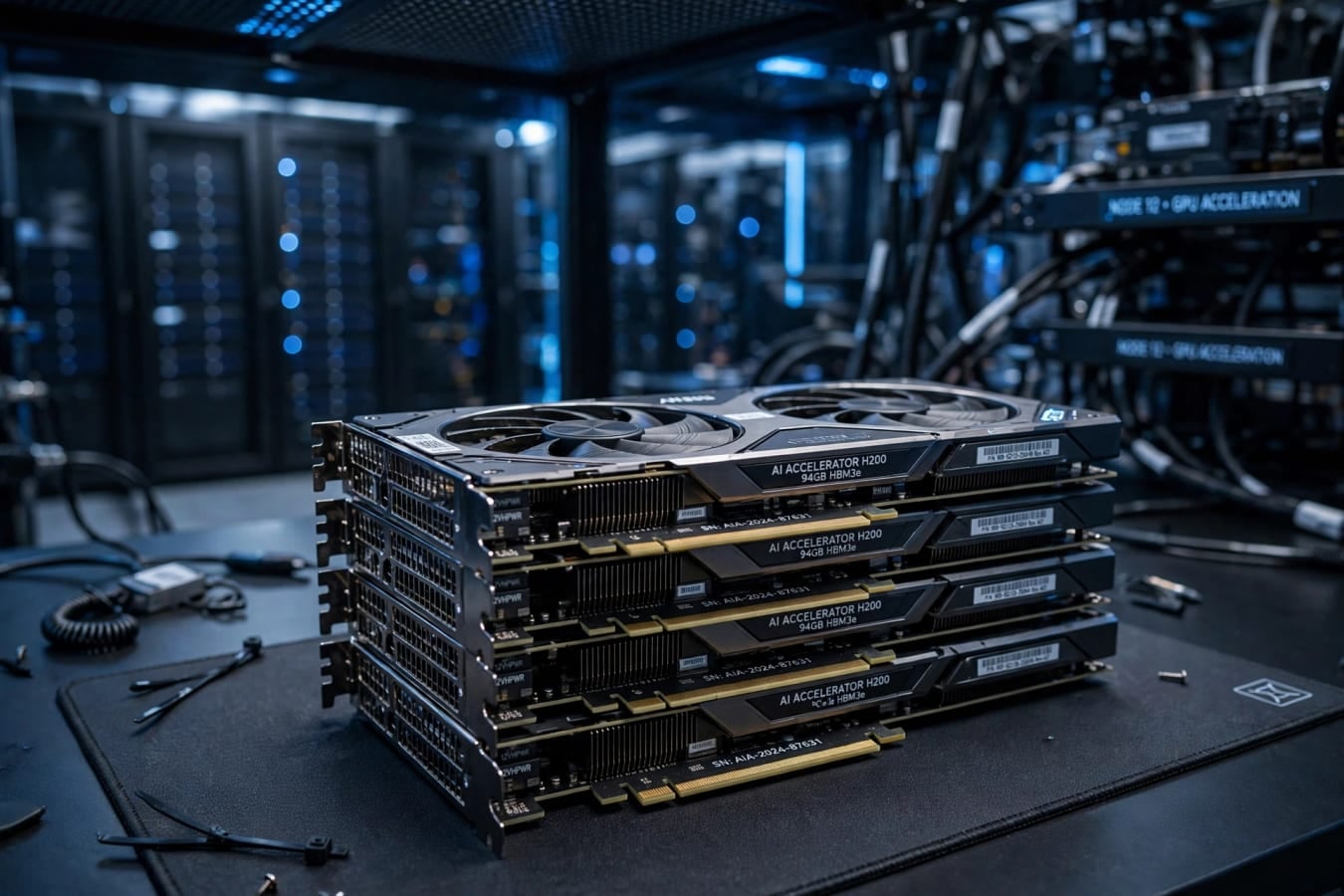
- The chips were Nvidia's H200 and AMD's roughly equivalent MI325X, powerful data-centre processors used to train and run AI systems.
- The biggest named recipients were Tencent (150,000 chips), Alibaba (75,000), Baidu (43,000) and BYD (4,000).
- All four of those companies appear on the Pentagon's list of alleged Chinese military companies.
- Approvals are not the same as deliveries. It is not clear how many of the approved chips actually reached China.
- Nvidia says its limited H200 shipments were legal and authorised, and that it has now stopped shipping H200 chips to China. AMD says it complies with US export control laws.
- US Treasury Secretary Scott Bessent said on November 20 that no further restrictions on the older chips are needed.
What the Records Show
The disclosure came from the House Foreign Affairs Committee on Thursday, November 19, 2026.
- Committee chairman Brian Mast used powers under the Export Control Reform Act to make the export licence application details public.
- Licence applications are normally confidential. This release is one of the most detailed public disclosures of its kind.
- The documents cover applications from Nvidia and AMD to sell advanced AI chips to buyers in China, or to companies with Chinese parent firms.
- In total, the companies applied to ship 3,444,160 chips. BIS approved 879,868 of them, across 21 licence applications.
- That is an approval rate of about one in four.
The hardware at the centre of the story is not the newest generation of AI chip, but it is still far beyond what China's own chipmakers can produce at scale.
- Nvidia's H200 is a data-centre GPU built for AI training and inference. It is one of Nvidia's more powerful products, though not its most advanced.
- AMD's MI325X is the company's roughly equivalent data-centre accelerator.
- Both chips are used to power the large computing clusters that train AI models and run AI services.
- The US permits H200 exports to China under a case-by-case licensing framework, rather than a blanket ban.
The timing matters. The disclosure landed in the same week that Nvidia was already under intense scrutiny in Washington, with the Securities and Exchange Commission examining the company's accounting and California's attorney general issuing an investigative subpoena. The chip licences are a separate issue, but they add to a picture of a company under pressure from several directions at once.
Who Got What
The committee's summary names the four largest recipients of approved chips.
- Tencent and its subsidiaries: 150,000 chips approved — all of the chips it sought.
- Alibaba and its subsidiaries: 75,000 chips approved, out of a much larger request. Nvidia had applied to sell 610,000 chips to Alibaba, and separate reporting puts Alibaba's total request at nearly 949,000.
- Baidu: 43,000 chips approved — all of the chips it sought.
- BYD: 4,000 chips approved — all of the chips it sought.
Together, those four companies account for 272,000 of the approved chips.
- All four appear on the Department of War's June 2026 list of Chinese Military Companies — firms the Pentagon says operate in the United States and are linked to China's military.
- Other applicants named in the documents include ByteDance, the owner of TikTok, JD.com, Kuaishou and Didi.
- Nvidia applied to sell 508,000 chips to ByteDance, through a Malaysian subsidiary.
- AMD applications included 75,000 chips each for a ByteDance subsidiary in Beijing and a Tencent subsidiary.
- BIS refused some of the largest requests. The 610,000-chip Alibaba application and the 508,000-chip ByteDance application were among those turned down in full or in part.
The approvals also covered chips destined for use in data centres outside mainland China, including Alibaba Cloud deployments in Malaysia and Indonesia and TikTok systems in Thailand.
The "Low Risk" Line
One detail in the documents has drawn particular attention. According to the committee, every Nvidia and AMD application stated that the proposed transfer posed a "low" risk of diversion — the risk that the chips would end up somewhere other than their stated destination.
- That self-assessment is now under intense scrutiny in Washington.
- The committee alleges that Nvidia sought to rely on companies it describes as possible smuggling fronts to install the chips in Chinese data centres.
- The firms named as possible installers include Maginfra, Beijing New Matrix Information Technologies, ZTE Kangxun Telecom and Lenovo or its subsidiaries.
- The committee says Maginfra and New Matrix were suspected of being front companies for smuggling.
The New Matrix detail is striking.
- The New York Times reported this month that the 17-month-old Beijing company operates from an empty building.
- Its owners have links to Wise Road, a Chinese private equity fund blacklisted by Washington since 2024.
- These are allegations made by the committee and by reporting, not findings by a court or regulator. No wrongdoing has been established.
There is also a separate reported claim about how the approvals were processed.
- The Information reported on November 18 that Jeffrey Kessler, the head of BIS, pressured staff to speed up H200 export approvals, sometimes overriding objections from other government departments.
- That report has not been confirmed by the Commerce Department.
How the Policy Changed
The approvals did not happen in a vacuum. They followed a sharp change in US policy in December 2025.
- The previous administration had cut off Chinese access to advanced AI chips over military and AI concerns.
- In December 2025, the Trump administration rolled back those curbs, allowing sales of Nvidia's H200 and AMD's MI325X to approved Chinese customers.
- In return, Nvidia agreed to hand the US government a 25 percent share of the revenue from those sales.
- The Commerce Department's approach to H200 licensing is based on a rule published in the Federal Register in January 2026.
- BIS says it has a "long track record of transparency with Congress about licensing activity for the H200 and equivalent chips, including both approvals and rejections."
The policy reversal is the reason the approvals exist at all. Under the earlier rules, these sales would not have been licensed. Under the new framework, they were licensed case by case, with conditions and limited volumes.
That framework has now changed again in one important respect.
- Earlier this week, the Trump administration moved to block Chinese firms from gaining remote access to advanced AI chips and servers.
- The move targeted a different route into the same technology: Chinese companies renting computing power on chips located outside China.
- That issue came under scrutiny after Jensen Huang stepped down as Nvidia's chief executive amid allegations about his affair with an executive at Megaspeed, a Singapore-based company that uses advanced chips to generate computing power that Chinese firms access remotely.
- The remote-access crackdown and the licence disclosures are two sides of the same debate: how much advanced computing power should reach China, and by what route.
Approvals Are Not Shipments
The most important caveat in the whole story is also the simplest: a licence approval is not a delivery.
- The committee's records show that none of the approved orders had shipped as of May 11, 2026.
- It is not immediately clear how many of the approvals resulted in actual China-bound shipments.
- Beijing has reportedly limited imports of the chips, and about 600,000 H200 chips are reported to be sitting in storage in Hong Kong. That figure is reported, not confirmed.
- Some of the approved chips were destined for data centres in Malaysia, Indonesia and Thailand, not mainland China.
This distinction matters for anyone reading the headline number. The 879,868 figure is the number of chips the US government said could be sold. It is not the number that arrived in China, and it is not the number now running in Chinese data centres. The real number is unknown, and may be much lower.
It also matters for the companies involved. A licence that is never used is a permission, not a sale. Nvidia and AMD applied for far more than they were allowed to ship, and were allowed to ship far more than they may actually have shipped.

What Nvidia and AMD Say
Both companies have responded to the disclosure.
- An Nvidia spokesperson said the "limited shipments we made under the H200 program were legal and authorized" by BIS.
- Nvidia said the review and licensing process "spanned more than half a year, with approvals subject to strict conditions and limited volumes."
- Earlier this week, Nvidia said it was no longer shipping H200 chips to China. A spokesperson confirmed on Friday that shipments had stopped despite the prior approvals.
- AMD said it complies with US export control laws and regulations, and maintains that position.
Neither company has been accused of breaking the law in this matter. The licences were granted by the US government through its own process. The debate is about whether that process was right, not about whether the companies followed it.
Bessent: No New Curbs
The Treasury Secretary weighed in on Friday, November 20, after returning from a trip to Asia with President Donald Trump.
- Scott Bessent told CNBC that no further restrictions on the sale of older Nvidia chips to China are needed.
- "The proper chip restrictions are in place," Bessent said. "And the remote access has been curtailed."
- His comments came a day after the committee released the licence details.
- The administration's position is that the existing rules, plus the new block on remote access, are enough.
The markets reacted to the disclosure itself.
- Nvidia shares fell 3.3 percent on Thursday, November 19.
- AMD shares fell 7.7 percent.
- The Nasdaq slid 2.2 percent.
The share moves came in a week when tech stocks were already falling sharply, with Nvidia down about 14 percent on Friday, November 20, as part of a broader sell-off. The licence story was one pressure among several, not the only one.
Why This Matters
The chip licences sit at the centre of the biggest technology argument in Washington: how to handle China's access to the hardware that powers AI.
- AI chips are the raw material of the AI race. Whoever has the most computing power can train the biggest models and run the most capable systems.
- The US has spent years trying to keep its most advanced chips out of China, on the grounds that they could support military and surveillance uses.
- The December 2025 policy change reversed that approach for one generation of chips, and the new records show how far the reversal went.
- Critics of the approvals say the US sold computing power to companies its own Pentagon links to China's military, and that the "low risk" self-assessments were not credible.
- Supporters of the policy say the chips were a previous generation, the volumes were limited, the sales were licensed and conditioned, and blocking them entirely would have handed the market to Chinese chipmakers instead.
There is also a commercial angle for the chipmakers themselves.
- China is one of the largest markets in the world for AI hardware.
- Nvidia and AMD both want to sell there, and both face growing competition from Chinese chip designers.
- Every chip the US blocks is a sale a Chinese rival may eventually take.
- Every chip the US approves is a sale that keeps an American company in the market, but also a chip that may end up training a Chinese AI model.
The disclosure does not settle that argument. It gives both sides numbers to argue with. What it does settle is the scale: nearly 880,000 chips approved, out of more than 3.4 million requested, in six months, under a policy that has already been tightened again.
What Happens Next
Several threads will keep this story alive.
- Congress is likely to keep pressing for more detail on the licence decisions, including which officials approved them and what conditions were attached.
- The Commerce Department's final position on H200 licensing, and whether the remote-access block extends further, will shape what happens to the remaining approvals.
- Nvidia's decision to stop H200 shipments to China means the approved-but-unshipped licences may simply lapse.
- The broader question — whether the US should sell previous-generation AI chips to China at all — is now an open political fight, with the Treasury Secretary on one side and the House Foreign Affairs Committee chairman on the other.
- The SEC's separate examination of Nvidia's accounting, and the California attorney general's subpoena, add to the scrutiny the company faces in Washington.
For readers, the number to remember is 879,868. It is the number of advanced AI chips the US government said could go to China in six months. Whether that was a sensible commercial decision or a national security mistake is the argument that will run for months.
Key Points at a Glance
- The House Foreign Affairs Committee released records on November 19 showing BIS approved 879,868 Nvidia and AMD AI chips for Chinese buyers.
- Companies applied for 3,444,160 chips between December 2025 and May 11, 2026 — about one in four was approved.
- The chips were Nvidia's H200 and AMD's MI325X, used to train and run AI systems.
- Tencent got 150,000, Alibaba 75,000, Baidu 43,000 and BYD 4,000 — all four are on the Pentagon's list of alleged Chinese military companies.
- Every application rated diversion risk as "low"; the committee alleges Nvidia sought to use possible smuggling fronts as installers.
- The approvals followed a December 2025 policy reversal; Nvidia agreed to give the US government 25 percent of the revenue.
- Approvals are not shipments — none of the approved orders had shipped as of May 11, and the true delivered number is unknown.
- Nvidia says its shipments were legal and authorised and has now stopped H200 shipments to China; AMD says it complies with export controls.
- Treasury Secretary Scott Bessent said no further restrictions on the older chips are needed.
FAQs
How many AI chips did the US approve for sale to China?
The Commerce Department approved 879,868 Nvidia and AMD AI chips for Chinese buyers between December 2025 and May 11, 2026, out of 3,444,160 chips requested, according to records released by the House Foreign Affairs Committee on November 19, 2026.
Which companies received the most chips?
Tencent was approved for 150,000 chips, Alibaba for 75,000, Baidu for 43,000 and BYD for 4,000. All four appear on the Pentagon's list of alleged Chinese military companies. ByteDance, JD.com, Kuaishou and Didi also appear in the applications.
Were the buyers linked to China's military?
The four largest named recipients — Tencent, Alibaba, Baidu and BYD — all appear on the Department of War's June 2026 list of Chinese Military Companies. The committee also alleges Nvidia sought to route sales through companies it describes as possible smuggling fronts.
Did all 879,868 chips actually reach China?
No — approvals are not shipments. The records show none of the approved orders had shipped as of May 11, 2026, and it is not clear how many chips were ever delivered. Nvidia says it has now stopped shipping H200 chips to China.
Why did the US approve the sales?
The approvals followed a December 2025 policy change that allowed sales of Nvidia's H200 and AMD's MI325X chips to approved Chinese customers, reversing an earlier ban. Nvidia agreed to give the US government 25 percent of the revenue from those sales.
What did Nvidia and AMD say about the disclosure?
Nvidia said its limited H200 shipments were legal and authorised by the Commerce Department and that it has stopped shipping H200 chips to China. AMD said it complies with US export control laws and regulations.
Was this article helpful?
Explore Specs, Comparisons & Related Topics

Written By
TechorCoffeeEditorial Team
The TechOrCoffee Editorial Team covers consumer hardware, artificial intelligence, software engineering, and regional smartphone & laptop market analysis.
Comments (0)
Leave a Comment
Read Next
Fri Oct 30 2026
GPU and RAM Prices 2026: Why AI Ate Your Upgrade
GPU and RAM prices in 2026 explained: AI memory shortage, DDR5 and RTX 50 price rises, RTX 50 Super delay, and when relief may come.
Sat Oct 31 2026
Intel Next-Generation Core Ultra vs AMD Ryzen AI
Intel Next-Gen Core Ultra vs AMD Ryzen AI preview: rumours, cores, AI, GPU, power and price for buyers in 2026 today, all unconfirmed.
Fri Oct 30 2026
NVIDIA in 2026: No New Gaming GPU, AI Takes Over
NVIDIA 2026 explained: no new gaming GPU, RTX 60 delayed to 2028, Rubin CPX for AI inference, memory shortage, and what PC gamers should buy now in 2026.