vivo X500 vs vivo X500 Pro

Published
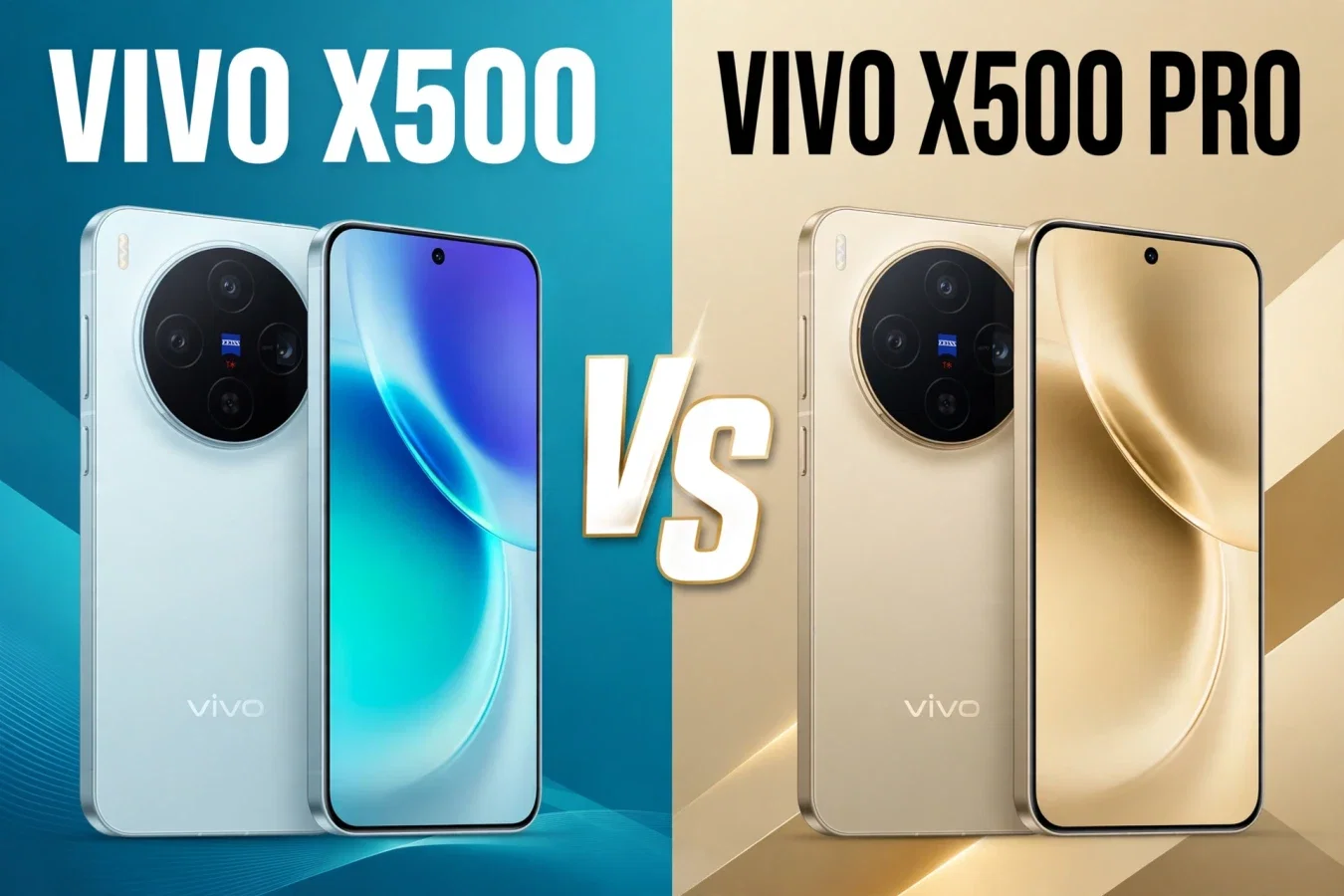
Same series, opposite strengths — the standard has the bigger battery, the Pro has the faster chip
vivo X500 vs vivo X500 Pro is a comparison within the same series, where the cheaper standard model actually wins on battery and the Pro wins on chip and compact size. vivo X500, launched in China on 21 September 2026, offers a 7,500mAh battery, a Dimensity 9600M chip and a 6.59-inch display. vivo X500 Pro, launched in China on the same date, offers a Dimensity 9600 Pro chip, a 6.36-inch LTPO display and a 6,510mAh battery. For Indian buyers, both phones are still unconfirmed here, with an India launch tipped for end-November 2026, so this is a wait-and-compare guide, not a buy-now decision.
At a glance
| vivo X500 | vivo X500 Pro | |
|---|---|---|
| Launch / India | China 21 Sep 2026, sale from 24 Sep 2026; India tipped end-Nov 2026, unconfirmed | China 21 Sep 2026, sale from 29 Sep 2026; India tipped end-Nov 2026, unconfirmed |
| Chip | MediaTek Dimensity 9600M (3nm) | MediaTek Dimensity 9600 Pro (2nm) |
| Rear cameras | 50MP main (LYTIA 828, 1/1.28-inch, gimbal OIS) + 64MP telephoto (LYTIA 610, 3.1x, CIPA 5.5) + 50MP ultrawide (JN1) | 50MP main (LYTIA L910, 1/1.28-inch, f/1.57, ZEISS T* coating, 17 stops claimed) + 64MP telephoto (APO, 85mm, 3.5x) + 50MP ultrawide (f/2.0, autofocus) |
| Front camera | 50MP | 50MP (Samsung JN1) |
| Display | 6.59-inch 1.5K LTPS AMOLED, 2750 x 1260, up to 144Hz, up to 5,000 nits peak (20% APL), HDR10+ | 6.36-inch LTPO AMOLED, 2660 x 1216, adaptive 1–144Hz, BOE Q11 material |
| Battery | 7,500mAh, 90W wired / 40W wireless | 6,510mAh typical (6,305mAh rated), 90W wired / 40W wireless |
| Software | OriginOS 7 (Android 17), 5 years promised support (one source) | OriginOS 7 (Android 17) |
| Extras | Blueprint Imaging Chip V3+, 211g, 8.15mm | Compact 151.8 x 71.9 x 8.1mm, 192–197g, IP68/IP69, video 4K240 and 8K30, DaVinci Resolve colour transform |
| India price | Unconfirmed; China CNY 5,499 (12+256, ~₹79,000 converted, not an India price) | Unconfirmed; China CNY 6,499 (12+256, ~₹93,000 converted, not an India price) |
| Other prices | China CNY 5,499–6,999 depending on storage | China CNY 6,499 starting, higher storage higher |
Cameras: same 50MP main size, different telephoto and video
Both phones offer a 50MP main at 1/1.28-inch, so main-camera hardware is close on paper, though the sensors differ: vivo X500 uses LYTIA 828 with gimbal OIS, vivo X500 Pro uses LYTIA L910 with ZEISS T* coating and a claimed 17 stops of dynamic range. Both phones offer a 64MP telephoto, but the Pro's is an APO telephoto at 85mm with 3.5x zoom, while the standard's is a 3.1x telephoto with CIPA 5.5 stabilisation. Both phones offer a 50MP ultrawide, with the Pro's offering autofocus at f/2.0, while the standard's ultrawide is a JN1 sensor.
On telephoto, the Pro wins zoom length (3.5x vs standard 3.1x) and APO optics, while the standard wins stabilisation rating on paper (CIPA 5.5 listed, Pro's stabilisation should be checked on its regional listing). On main-camera dynamic range, the Pro's 17-stop claim is a brand claim, not a measured test, and should not be treated as a photo winner on its own. On video, the Pro pulls ahead clearly with 4K at up to 240fps for slow motion, 4K at 120fps with autofocus tracking, 8K at 30fps, 10-bit 4:2:2 Log and an official DaVinci Resolve colour transform — features the standard does not highlight in the same way.
No controlled side-by-side camera test between these two phones was reviewed, so no photo winner is claimed. On paper, the Pro is the better video and zoom phone, the standard is the better stabilisation phone on its listed rating, and ZEISS colour science is shared, so the difference will be in processing and video pipeline, not in brand alone. For a photographer who shoots mostly at 1x, the main cameras are close enough that battery and size will matter more; for a videographer who shoots slow motion or Log, the Pro's video features are decisive.
Performance, display and battery: Pro chip vs standard battery
Performance: vivo X500 Pro uses Dimensity 9600 Pro (2nm), vivo X500 uses Dimensity 9600M (3nm). On paper, the Pro's newer 2nm chip should be more efficient and faster, though no retail comparison was reviewed and no speed winner is claimed. For gaming, both phones offer up to 144Hz, but the Pro's LTPO panel adapts from 1Hz to 144Hz for efficiency, while the standard's LTPS panel is a simpler panel at up to 144Hz.
Display: vivo X500 6.59-inch LTPS AMOLED at 2750 x 1260 with up to 5,000 nits peak at 20% APL and HDR10+, vivo X500 Pro 6.36-inch LTPO AMOLED at 2660 x 1216 with adaptive 1–144Hz and BOE Q11 material. The standard's display is larger and brighter on paper at 20% APL, the Pro's display is smaller, more efficient and more compact. The two brightness figures are not directly comparable without the same measurement conditions, so do not rank displays by a single brightness number. Size alone will decide for many buyers: the Pro at 151.8 x 71.9 x 8.1mm and 192–197g is more compact and lighter than the standard at 211g and 8.15mm thick.
Battery: vivo X500 7,500mAh with 90W wired and 40W wireless charging, vivo X500 Pro 6,510mAh typical (6,305mAh rated) with 90W wired and 40W wireless charging. On paper, the standard wins battery capacity by a clear margin, while wired and wireless charging are matched at 90W and 40W. For most users, the standard's larger battery will last longer, while the Pro's smaller battery is the trade-off for its compact size and faster chip. Both batteries are China figures for phones not yet launched in India — check vivo's India batteries when they launch, because a regional battery change can overturn a paper winner.
Software, durability and India availability: both tipped, neither confirmed
Both phones run OriginOS 7 (Android 17), with one source listing 5 years of promised software support for the standard, and the Pro's support window should be checked on its regional listing. The Pro offers IP68 and IP69 water and dust resistance, while the standard's IP rating should be checked on its regional listing — though one source notes vivo explicitly says the Pro is not a professional waterproof device and its warranty does not cover liquid damage, so do not treat IP ratings as a guarantee against water damage.
For Indian buyers, neither phone is officially on sale today, though an India launch by the end of November 2026 is tipped for the X500 series, and the Pro and Pro Max launched globally on 27 October 2026. India prices are unconfirmed — China prices of CNY 5,499 for the standard and CNY 6,499 for the Pro (around ₹79,000 and ₹93,000 converted) should not be treated as India prices, because import duty and other charges will make India prices higher, as one source notes. Do not import either phone on specs alone: warranty, network bands, software and service may differ, and this article does not recommend importing a phone that is not officially sold where you live.
Verdict
- Buy vivo X500 if: you want a larger 6.59-inch display, a 7,500mAh battery, a gimbal main and a lower China starting price, with an India launch tipped for end-November 2026.
- Buy vivo X500 Pro if: you want a compact 6.36-inch LTPO display, a Dimensity 9600 Pro chip, a 3.5x APO telephoto and pro video features including 4K240 and DaVinci Resolve colour, with an India launch tipped for end-November 2026.
- Do not buy either on China specs alone: India prices, batteries and warranties are unconfirmed until launch.
On battery and display size, the standard wins on paper; on chip, compact size, zoom and video, the Pro wins on paper. For most buyers, the choice is simple: bigger battery or smaller phone with faster video — and both are worth waiting for in India. When they launch here, compare their India prices directly — the price gap will decide whether the Pro's chip and video are worth paying for.
FAQs
Which has the bigger battery?
vivo X500 at 7,500mAh vs Pro at 6,510mAh typical.
Which has the faster chip?
Pro, with Dimensity 9600 Pro (2nm) vs standard Dimensity 9600M (3nm).
Which is more compact?
Pro, at 6.36 inches and 192–197g, vs standard at 6.59 inches and 211g.
Which has the better telephoto?
Pro, with 3.5x APO telephoto; standard offers 3.1x.
Which is better for video?
Pro, with 4K240, 8K30, Log and DaVinci Resolve colour.
Can I buy either in India today?
No confirmed India launch yet; end-November 2026 tipped, prices unconfirmed.
Which should I wait for?
Standard for battery, Pro for compact size, chip and video.
Was this article helpful?

Written By
TechorCoffeeContributing Writer
TechorCoffee is a technology reporter and software creator writing reviews and tutorials for TechOrCoffee.
Comments (0)
Leave a Comment
Read Next

Thu Apr 09 2026
Leaks & Rumors: iPhone 18 Pro Max vs iPhone 17 Pro Max: Full Comparison
The iPhone 17 Pro Max is already a fully matured flagship—top camera, insane battery life, and stable performance. The iPhone 18 Pro Max is expected to refine the experience further, not revolutionize it.
Tue Jun 16 2026
Samsung Galaxy Z Fold 8 vs Galaxy Z Fold 7:Worth to Upgrade?
Samsung Galaxy Z Fold 8 vs Galaxy Z Fold 7: Is it worth the upgrade? Compare specs, battery upgrades, 45W charging, and camera leaks before you buy.

Wed Apr 08 2026
Leaks & Rumors: iPhone 18 Pro Max: Every Leak, Spec and Upgrade Confirmed
The iPhone 18 Pro Max is expected in September 2026 as Apple’s most powerful iPhone yet. It features a 6.9-inch LTPO OLED display, A20 Pro chip, 48MP camera with variable aperture, 5,100–5,200mAh battery, C2 modem with satellite support, and a starting price of $1,199.