Xiaomi 18 Pro Max vs iPhone 18 Pro Max

Published
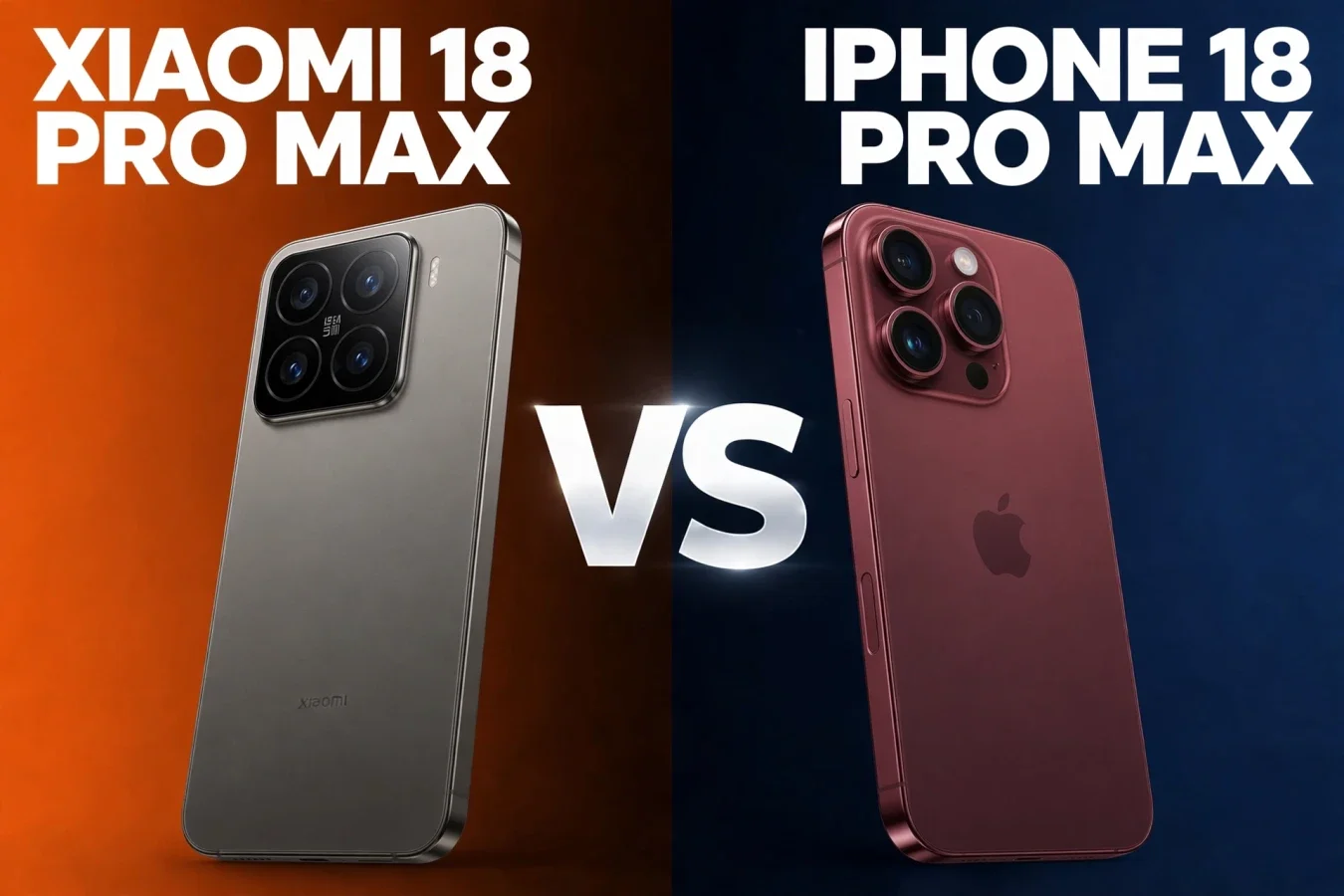
Leica Android flagship vs Apple's variable-aperture flagship — one wait, one buyable today
Xiaomi 18 Pro Max vs iPhone 18 Pro Max is a comparison between a China-first Leica flagship and Apple's officially sold flagship. Xiaomi, launched in China on 23 September 2026, offers a dual 200MP Leica set, a 2.9-inch rear display and an 8,500mAh China battery. iPhone 18 Pro Max, launched on 9 September 2026 and on sale in India from 18 September 2026, offers a triple 48MP set with variable aperture, an A20 Pro chip, iOS 27 and a mature ecosystem. For Indian buyers, the practical question is whether Xiaomi's camera and battery advantages are worth waiting for when iPhone is already on sale with warranty.
At a glance
| Xiaomi 18 Pro Max | iPhone 18 Pro Max | |
|---|---|---|
| Launch / India | China 23 Sep 2026; global later 2026 confirmed; India no date/price | Launched 9 Sep 2026; India sale from 18 Sep 2026 (first wave) |
| Chip | Snapdragon 8 Elite Extreme Gen 6 (2nm) | A20 Pro (2nm) + C2 modem |
| Rear cameras | Dual 200MP Leica: main Light Fusion 960L 1/1.28"; periscope tele 1/1.56", 75mm, 3.2x, 12cm macro + 50MP ultrawide | Triple 48MP: Fusion main with variable aperture f/1.48–f/4.0 per one listing, ultrawide, telephoto |
| Front camera | 50MP | 18MP |
| Video | Leica video (check regional features) | Apple video, ProRes and cinematic modes (check regional features) |
| Display | 6.9-inch LTPO AMOLED, 120Hz, plus 2.9-inch rear display | 6.9-inch Super Retina XDR, 1320 x 2868, ProMotion 120Hz, Always-On |
| Battery | 8,500mAh China — global may be smaller per reports; 100W / 50W | Apple does not disclose mAh; claims up to ~30h general use, 43–45h video depending on variant; 50% in ~15 min wired |
| Software | HyperOS 4 | iOS 27 (Siri AI varies by region — EU/China caveats) |
| India price | No confirmed date/price; estimates ~₹89,999–₹1,50,000; one report says only 18 Pro may come to India | ₹1,79,900 (256GB), ₹2,04,900 (512GB), ₹2,54,900 (1TB), ₹3,29,900 (2TB) |
| Other prices | China CNY 6,999 (12+256) to 9,999 (16+1TB), Transparent Edition 10,999 | US from $1,299 |
| Extras | 2.9-inch rear display | Variable aperture, Apple ecosystem, Face ID |
Cameras: Xiaomi's 200MP Leica set vs iPhone's variable aperture
Xiaomi's camera set is dual 200MP Leica: a main Light Fusion 960L (1/1.28-inch) and a periscope telephoto (1/1.56-inch, 75mm, 3.2x, 12cm macro), plus a 50MP ultrawide. iPhone's camera set is triple 48MP: a Fusion main with variable aperture (f/1.48–f/4.0 per one listing), an ultrawide and a telephoto. Xiaomi wins megapixels and macro capability, iPhone wins variable aperture — which lets the main camera adjust its aperture for depth of field and light, a feature Xiaomi does not highlight.
No controlled side-by-side camera test between these two phones was reviewed, so no photo winner is claimed. On paper, Xiaomi is the better zoom and macro phone, iPhone is the better portrait and low-light phone on aperture flexibility, and Leica colour science vs Apple's computational photography will matter more than a single spec. For a photographer who shoots distant and close subjects, Xiaomi's Leica telephoto and macro are more interesting; for a photographer who shoots portraits and wants consistent, easy results, iPhone's variable aperture and computational pipeline are more interesting. Front cameras: Xiaomi 50MP vs iPhone 18MP — Xiaomi wins on resolution, though iPhone's front camera is optimised for Face ID and Centre Stage video, not just selfies. Ultrawide also matters: Xiaomi offers a 50MP ultrawide, iPhone a 48MP ultrawide, so neither has a clear ultrawide advantage on paper, and the difference will be in distortion correction, low-light performance and colour consistency with the main camera.
Video and ecosystem: Apple's mature video vs Xiaomi's Leica video
Apple's video ecosystem is mature, with ProRes, cinematic modes, tight editing integration and a large accessory market, though exact regional video features should be checked. Xiaomi's video is Leica-branded, with its own colour profiles, but its exact regional video features should be checked — Xiaomi has not highlighted an equivalent professional video workflow in the same way Apple has.
For a creator who edits on a Mac or iPad, iPhone's ecosystem advantage is decisive. For a creator who shoots Leica-coloured video and does not edit in Apple's ecosystem, Xiaomi's Leica video may be enough, and its 200MP main gives it plenty of resolution. For a casual shooter, neither professional video mode will be used much — auto video, stabilisation and colour will matter more. Note also that iPhone's Siri AI varies by region (EU and China caveats), so check AI features for your region before buying on AI claims alone. That regional AI caveat applies to Xiaomi too, whose HyperOS AI features may differ by region, so check both phones' AI features for your exact model before buying on AI claims.
Display, battery and charging: Xiaomi's larger cell vs Apple's efficiency
Both phones offer a 6.9-inch display at 120Hz — Xiaomi LTPO AMOLED plus a 2.9-inch rear display, iPhone Super Retina XDR with ProMotion and Always-On. Xiaomi wins on display size plus rear display, iPhone wins on display calibration and ecosystem integration, though both displays are excellent for HDR video and outdoor use.
Battery: Xiaomi 8,500mAh China (global may be smaller per reports) with 100W wired and 50W wireless charging, vs iPhone, where Apple does not disclose mAh but claims up to around 30 hours general use and 43–45 hours video depending on variant, with 50% in around 15 minutes wired. On paper, Xiaomi's battery is larger and its charging is faster, but Apple's efficiency means its smaller (undisclosed) cell still lasts a full day for most users. Do not rank battery by a China Xiaomi figure for an India buyer — check the regional spec sheet when Xiaomi launches, because a regional battery change can overturn a paper winner.
Software and support: iOS longevity vs HyperOS flexibility
iPhone runs iOS 27 with a long support history, a mature App Store, and tight integration with Mac, iPad, Watch and AirPods. Xiaomi runs HyperOS 4 with its own AI features, customisation and Android flexibility, but its regional support policy for a future India or global version should be checked. For a buyer who keeps a phone for four or five years and owns other Apple devices, iPhone's support and ecosystem give it a longer, more predictable ownership life. For a buyer who wants Android customisation, sideloading and Xiaomi's own AI features, HyperOS offers more flexibility, though its long-term support for a future India model is unconfirmed.
India price and availability: iPhone buyable, Xiaomi estimated
iPhone 18 Pro Max is officially on sale in India from ₹1,79,900 for 256GB, with warranty and service. Xiaomi 18 Pro Max has no confirmed India date or price, with estimates ranging widely from around ₹89,999 to ₹1,50,000, and one report saying only the 18 Pro may come to India. If Xiaomi launches at the lower end of that estimate, it would be significantly cheaper than iPhone, but that estimate should not be treated as a price, and storage and configuration differences should be checked.
For Indian buyers, the choice today is iPhone, because it is the only phone in this comparison you can actually buy. If you can wait for a confirmed Xiaomi launch, Xiaomi may offer a Leica camera flagship with a rear display at a lower price — but that price, battery and warranty are not confirmed until launch.
Verdict
- Buy iPhone 18 Pro Max if: you want triple 48MP cameras with variable aperture, a mature video ecosystem, iOS 27, Apple integration and a long support history, officially on sale in India from ₹1,79,900 (256GB).
- Wait for Xiaomi 18 Pro Max if: you want a dual 200MP Leica set with macro telephoto, a 2.9-inch rear display for rear-camera selfies and a large China battery, with a global launch confirmed for later 2026.
- Do not import Xiaomi on specs alone: regional battery, price, software and warranty may differ from a future India version.
On camera megapixels and battery, Xiaomi wins on paper; on completeness, ecosystem and availability, iPhone wins clearly today. For most Indian buyers, iPhone is the sensible purchase now; Xiaomi is the Leica phone to watch if it launches officially. When Xiaomi launches, compare its India price and battery directly with iPhone's — those two facts will decide whether waiting was worth it.
FAQs
Which has the better main camera?
On paper Xiaomi, with a 200MP Leica main; iPhone offers variable aperture for portraits and low light.
Which has a rear display?
Xiaomi only, with a 2.9-inch rear display for rear-camera selfies.
Which has the bigger battery?
Xiaomi 8,500mAh (China) vs iPhone undisclosed mAh, claimed up to ~30h general use.
Can I buy Xiaomi in India today?
No confirmed India date/price; global later 2026 confirmed, India estimates only.
Which is better for video creators?
iPhone, with a mature ProRes and cinematic ecosystem; Xiaomi offers Leica video.
Which has longer support?
iPhone, with iOS 27 and a long support history; check Xiaomi's regional policy.
Which should I buy in India today?
iPhone, because it is officially on sale; Xiaomi only after a confirmed India launch.
Was this article helpful?

Written By
TechorCoffeeContributing Writer
TechorCoffee is a technology reporter and software creator writing reviews and tutorials for TechOrCoffee.
Comments (0)
Leave a Comment
Read Next

Thu Apr 09 2026
Leaks & Rumors: iPhone 18 Pro Max vs iPhone 17 Pro Max: Full Comparison
The iPhone 17 Pro Max is already a fully matured flagship—top camera, insane battery life, and stable performance. The iPhone 18 Pro Max is expected to refine the experience further, not revolutionize it.
Tue Jun 16 2026
Samsung Galaxy Z Fold 8 vs Galaxy Z Fold 7:Worth to Upgrade?
Samsung Galaxy Z Fold 8 vs Galaxy Z Fold 7: Is it worth the upgrade? Compare specs, battery upgrades, 45W charging, and camera leaks before you buy.

Wed Apr 08 2026
Leaks & Rumors: iPhone 18 Pro Max: Every Leak, Spec and Upgrade Confirmed
The iPhone 18 Pro Max is expected in September 2026 as Apple’s most powerful iPhone yet. It features a 6.9-inch LTPO OLED display, A20 Pro chip, 48MP camera with variable aperture, 5,100–5,200mAh battery, C2 modem with satellite support, and a starting price of $1,199.