Xiaomi 18 Pro vs Xiaomi 18 Pro Max

Published
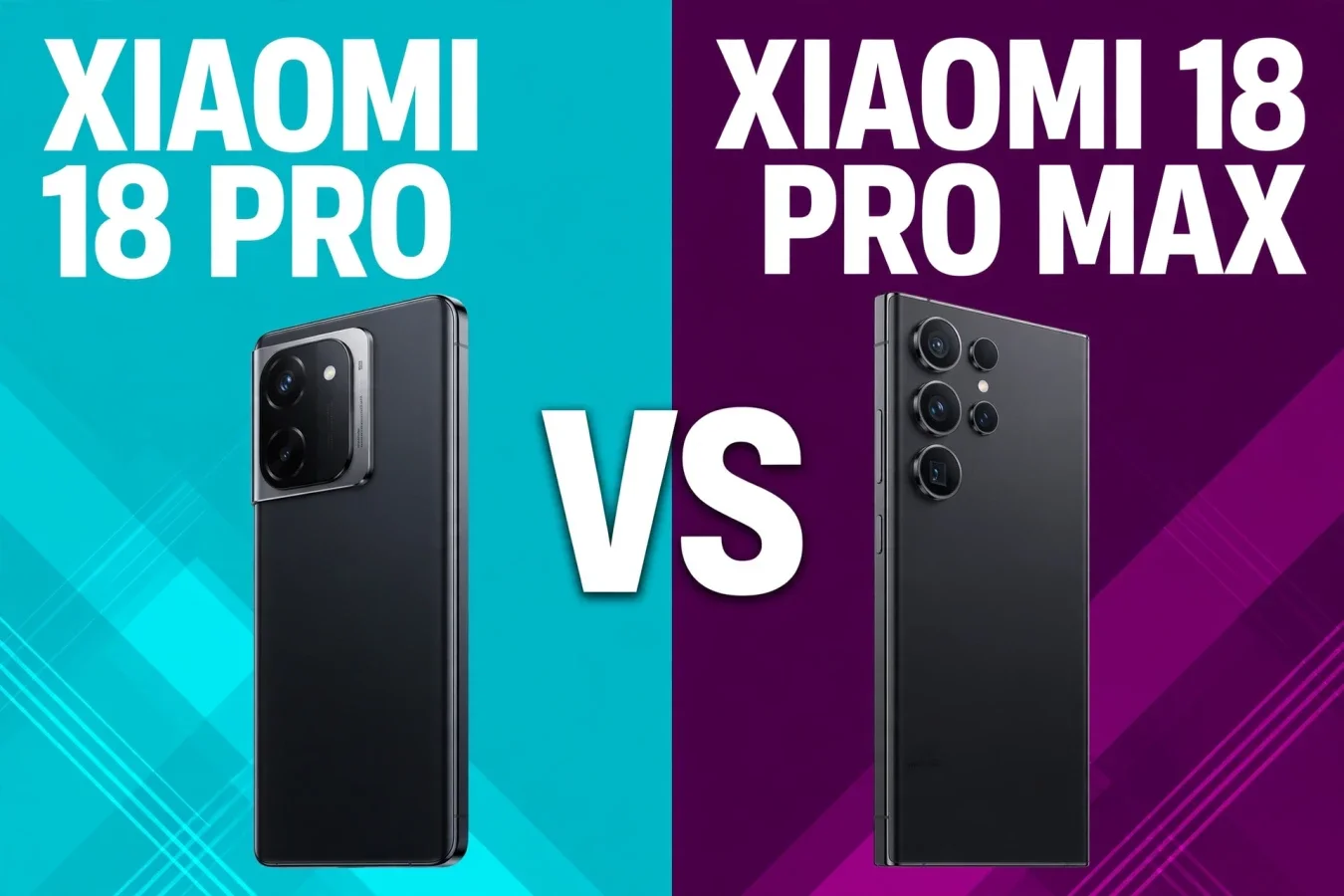
Same cameras, same design — the Max is bigger, longer-lasting and a little faster
Xiaomi 18 Pro vs Xiaomi 18 Pro Max is a comparison within the same series, where the headline cameras are shared but size, battery and chip differ. Xiaomi 18 Pro, launched in China on 23 September 2026, offers a 6.4-inch display, a Snapdragon 8 Elite Gen 6 chip and a 7,000mAh battery. Xiaomi 18 Pro Max, launched in China on the same date, offers a 6.9-inch display, a Snapdragon 8 Elite Extreme Gen 6 chip and an 8,500mAh battery. For Indian buyers, both phones are still unconfirmed here, with a global launch confirmed for later 2026, so this is a wait-and-compare guide, not a buy-now decision.
At a glance
| Xiaomi 18 Pro | Xiaomi 18 Pro Max | |
|---|---|---|
| Launch / India | China 23 Sep 2026, sale from 28 Sep 2026; global launch confirmed for later 2026, India unconfirmed | China 23 Sep 2026, sale from 28 Sep 2026; global launch confirmed for later 2026, India unconfirmed |
| Chip | Snapdragon 8 Elite Gen 6 (2nm) | Snapdragon 8 Elite Extreme Gen 6 (2nm) |
| Rear cameras | 200MP main (Light Fusion 960, 1/1.28-inch, 23mm) + 200MP periscope tele (1/1.56-inch, 75mm, 3.2x, 12cm macro) + 50MP ultrawide (1/2.88-inch, 17mm, 102°) | 200MP main (Light Fusion 960L with LOFIC, 1/1.28-inch, 23mm) + 200MP periscope tele (1/1.56-inch, 75mm, 3.2x, 12cm macro) + 50MP ultrawide (1/2.88-inch, 17mm, 102°) |
| Front camera | 50MP (1/2.88-inch) | 50MP (1/2.88-inch) |
| Display | 6.4-inch LTPO AMOLED, 2K, 1–120Hz, up to 4,000 nits peak, Dragon Crystal Glass 3, hardware privacy display, rear screen 2.7-inch | 6.9-inch LTPO AMOLED, 2K, 1–120Hz, up to 4,000 nits peak, Dragon Crystal Glass 3, hardware privacy display, rear screen 2.9-inch |
| Battery | 7,000mAh China (Europe reported 6,000mAh), 100W wired / 50W wireless / 27W reverse | 8,500mAh China (Europe reported 7,050mAh), 100W wired / 50W wireless / 27W reverse |
| Software | HyperOS 4 (Android 17 in one report) | HyperOS 4 (Android 17 in one report) |
| Extras | IP69, privacy display, rear screen for selfies, Leica optics | IP69, privacy display, rear screen for selfies, Leica optics, larger rear screen |
| India price | Unconfirmed; China CNY 5,999 (12+256, ~₹86,000 converted, not an India price) | Unconfirmed; China CNY 6,999 (12+256, ~₹1,00,000 converted, not an India price) |
| Other prices | China CNY 5,999–8,999 depending on storage; colours black, white, pink, blue | China CNY 6,999–9,999 depending on storage; Transparent Edition 10,999 |
Cameras: shared dual-200MP, one sensor difference
Both phones offer a dual-200MP Leica set, so megapixels are matched, but the main sensors differ on paper: the Pro uses Light Fusion 960, the Pro Max uses Light Fusion 960L with LOFIC support, which one launch report describes as extending dynamic range in high-contrast scenes. Both phones offer a 200MP periscope telephoto at 1/1.56-inch, 75mm, 3.2x, with 12cm macro, and a 50MP ultrawide at 1/2.88-inch, 17mm, with a 102° field of view. Both phones offer a 50MP front camera at 1/2.88-inch, so selfies are close on paper.
On main-camera hardware, the Pro Max wins on paper with LOFIC, while the Pro's main is still a large 1/1.28-inch sensor, and one launch report describes the triple-lens setups as identical, so the real-world gap between the two sensors still needs independent camera testing before it should factor into a purchase decision. On telephoto and ultrawide, both phones are matched, so neither has a clear advantage there. On front cameras, both offer 50MP, so neither has a clear advantage there either.
No controlled side-by-side camera test between these two phones was reviewed, so no photo winner is claimed. On paper, the Pro Max is the better high-contrast phone on its LOFIC main, the Pro is the better compact phone with the same telephoto and ultrawide, and Leica colour science is shared, so the difference will be in main-sensor processing, not in brand alone. For a photographer who shoots high-contrast scenes, the Pro Max's LOFIC main is more interesting; for a photographer who shoots mostly at 1x and wants a compact phone, the Pro's main is adequate, though its dynamic range may be less in extreme contrast. Video: both phones offer 8K at 30fps in their launch coverage, and neither video pipeline can be judged without shooting the same scene on both.
Performance, display and battery: Extreme chip vs standard, larger Max
Performance: Xiaomi 18 Pro Max uses Snapdragon 8 Elite Extreme Gen 6, Xiaomi 18 Pro uses Snapdragon 8 Elite Gen 6, both on 2nm. On paper, the Max's Extreme chip should be faster, though one report notes the real-world performance gap between the two chips is minor, and no retail comparison was reviewed, so no speed winner is claimed. For gaming, both phones offer 120Hz, but the Max's larger 6.9-inch display will be better for gaming and video, while the Pro's compact 6.4-inch display will be better for one-handed use.
Display: Xiaomi 18 Pro 6.4-inch LTPO AMOLED at 2K with 1–120Hz, up to 4,000 nits peak and Dragon Crystal Glass 3, Xiaomi 18 Pro Max 6.9-inch LTPO AMOLED at 2K with 1–120Hz, up to 4,000 nits peak and Dragon Crystal Glass 3. Both displays are matched on resolution, refresh rate and brightness, so neither has a clear display advantage on paper, though size will matter for a buyer who wants a compact phone vs a large phone. Both phones offer a hardware-level privacy display that can switch on for a single app, notification or split-screen pane, and a rear screen for selfies — 2.7 inches on the Pro, 2.9 inches on the Pro Max — which is a feature neither phone's rivals offer in the same way.
Battery: Xiaomi 18 Pro 7,000mAh in China with 100W wired, 50W wireless and 27W reverse charging, Xiaomi 18 Pro Max 8,500mAh in China with 100W wired, 50W wireless and 27W reverse charging. On paper, the Pro Max wins battery capacity by a clear margin, while wired, wireless and reverse charging are matched. For most users, the Pro Max's larger battery will last longer, while the Pro's smaller battery is the trade-off for its compact size. Both batteries are China figures for phones not yet launched globally — and Europe batteries are reported as smaller (6,000mAh for the Pro, 7,050mAh for the Pro Max), so check Xiaomi's regional battery when it launches globally, because a regional battery change can overturn a paper winner.
Software, durability and India availability: both global-awaited
Both phones run HyperOS 4 (Android 17 in one report), offer IP69 water and dust resistance, a privacy display, a rear screen and Leica optics. Both phones offer flagship durability and modern software, and neither software can be judged without using the same apps on both. Colours: both phones come in black, white, pink and blue as standard, with Transparent Editions at higher prices in China.
For Indian buyers, neither phone is officially on sale today, though a global launch later in 2026 is confirmed and one report says only the 18 Pro may come to India — a claim that should be checked against Xiaomi's official announcement, not treated as confirmed. India prices are unconfirmed — China prices of CNY 5,999 for the Pro and CNY 6,999 for the Pro Max (around ₹86,000 and ₹1,00,000 converted) should not be treated as India prices. Do not import either phone on specs alone: warranty, network bands, software and service may differ, and this article does not recommend importing a phone that is not officially sold where you live.
Verdict
- Buy Xiaomi 18 Pro if: you want a compact 6.4-inch display, a Snapdragon 8 Elite Gen 6 chip, a dual-200MP Leica set and a 7,000mAh battery in China, with a global launch confirmed for later 2026.
- Buy Xiaomi 18 Pro Max if: you want a larger 6.9-inch display, a Snapdragon 8 Elite Extreme Gen 6 chip, a LOFIC main, a larger rear screen and an 8,500mAh battery in China, with a global launch confirmed for later 2026.
- Do not buy either on China specs alone: India prices, batteries and warranties are unconfirmed until launch.
On compact size, the Pro wins on paper; on battery, display, chip and LOFIC main, the Pro Max wins on paper. For most buyers, the choice is simple: smaller phone or bigger battery and display — and the price gap in China is only CNY 1,000, which suggests the Max is the better value if you can handle its size. When they launch globally, compare their regional prices and batteries directly — those two facts will decide whether the Max's larger battery is worth its larger size. If the global price gap grows, the Pro becomes the smarter compact buy.
FAQs
Which has the bigger battery?
Pro Max at 8,500mAh in China vs Pro at 7,000mAh.
Which has the faster chip?
Pro Max, with Snapdragon 8 Elite Extreme Gen 6; Pro uses Snapdragon 8 Elite Gen 6.
Which is more compact?
Pro, at 6.4 inches, vs Pro Max at 6.9 inches.
Which has the better main camera?
On paper Pro Max, with LOFIC main; Pro uses Light Fusion 960.
Which has the bigger rear screen?
Pro Max, at 2.9 inches, vs Pro at 2.7 inches.
Can I buy either in India today?
No confirmed India launch yet; global launch confirmed for later 2026.
Which should I wait for?
Pro for compact size, Pro Max for battery, display and LOFIC main.
Was this article helpful?

Written By
TechorCoffeeContributing Writer
TechorCoffee is a technology reporter and software creator writing reviews and tutorials for TechOrCoffee.
Comments (0)
Leave a Comment
Read Next

Thu Apr 09 2026
Leaks & Rumors: iPhone 18 Pro Max vs iPhone 17 Pro Max: Full Comparison
The iPhone 17 Pro Max is already a fully matured flagship—top camera, insane battery life, and stable performance. The iPhone 18 Pro Max is expected to refine the experience further, not revolutionize it.
Tue Jun 16 2026
Samsung Galaxy Z Fold 8 vs Galaxy Z Fold 7:Worth to Upgrade?
Samsung Galaxy Z Fold 8 vs Galaxy Z Fold 7: Is it worth the upgrade? Compare specs, battery upgrades, 45W charging, and camera leaks before you buy.

Wed Apr 08 2026
Leaks & Rumors: iPhone 18 Pro Max: Every Leak, Spec and Upgrade Confirmed
The iPhone 18 Pro Max is expected in September 2026 as Apple’s most powerful iPhone yet. It features a 6.9-inch LTPO OLED display, A20 Pro chip, 48MP camera with variable aperture, 5,100–5,200mAh battery, C2 modem with satellite support, and a starting price of $1,199.