AMD Closes $8.2B World Labs Deal, Li Named Chief Scientist

Published (Updated )
Quick answer
- AMD announced on November 16, 2026 that it has completed its acquisition of World Labs, the spatial AI lab founded by Fei-Fei Li.
- The all-stock deal was valued at approximately $8.2 billion when it was agreed in September 2026.
- The transaction itself closed on November 13, 2026, and AMD issued 14,978,322 shares to World Labs' former stockholders.
- Li joins AMD as executive vice president and chief scientist, reporting directly to chair and CEO Lisa Su.
- World Labs builds "world models" — AI systems that generate, reconstruct and simulate interactive 3D environments.
The deal is done
AMD has closed one of the biggest AI acquisitions of the year. The chipmaker announced on November 16, 2026 that its purchase of World Labs is complete, bringing one of the most respected AI research teams in the world inside AMD. The numbers tell the story of a deal that moved fast:
- Value: approximately $8.2 billion, paid entirely in AMD shares.
- Agreement signed: September 26, 2026, and announced publicly on September 28.
- Closing date: November 13, 2026, according to AMD's amended SEC filing.
- Shares issued: 14,978,322 common shares to World Labs' former stockholders.
- Public confirmation: November 16, 2026, in AMD's newsroom announcement and a Form 8-K/A filing. The $8.2 billion figure is the value AMD put on the deal in September. Because the deal was paid in stock, the final value depends on AMD's share price. The filing says the price was "subject to adjustment," and the share count was set using AMD's daily volume-weighted average share price over ten consecutive trading days ending two trading days before closing. That timing matters. AMD's announcement is dated November 16, but the legal closing happened on Friday, November 13. The November 16 filing simply supplied the final share count, which could not be known in September.
Who is Fei-Fei Li — and why AMD wanted her
Fei-Fei Li is one of the best-known names in AI research. Before founding World Labs, she led Stanford's AI Lab, helped create ImageNet — the dataset that powered the deep learning revolution — and served as chief scientist of AI and machine learning at Google Cloud. At AMD, she takes the title of executive vice president and chief scientist, reporting directly to Lisa Su. That is a senior research leadership role, and it signals that AMD did not buy World Labs just for its technology. It bought the team and the person who leads it. Li was World Labs' chief executive when the deal was announced. She is joined at AMD by co-founders Justin Johnson and Ben Mildenhall, who continue to lead the research team. AMD's announcement frames the acquisition as adding "a world-class model team" to its push into AI infrastructure.
What World Labs actually builds
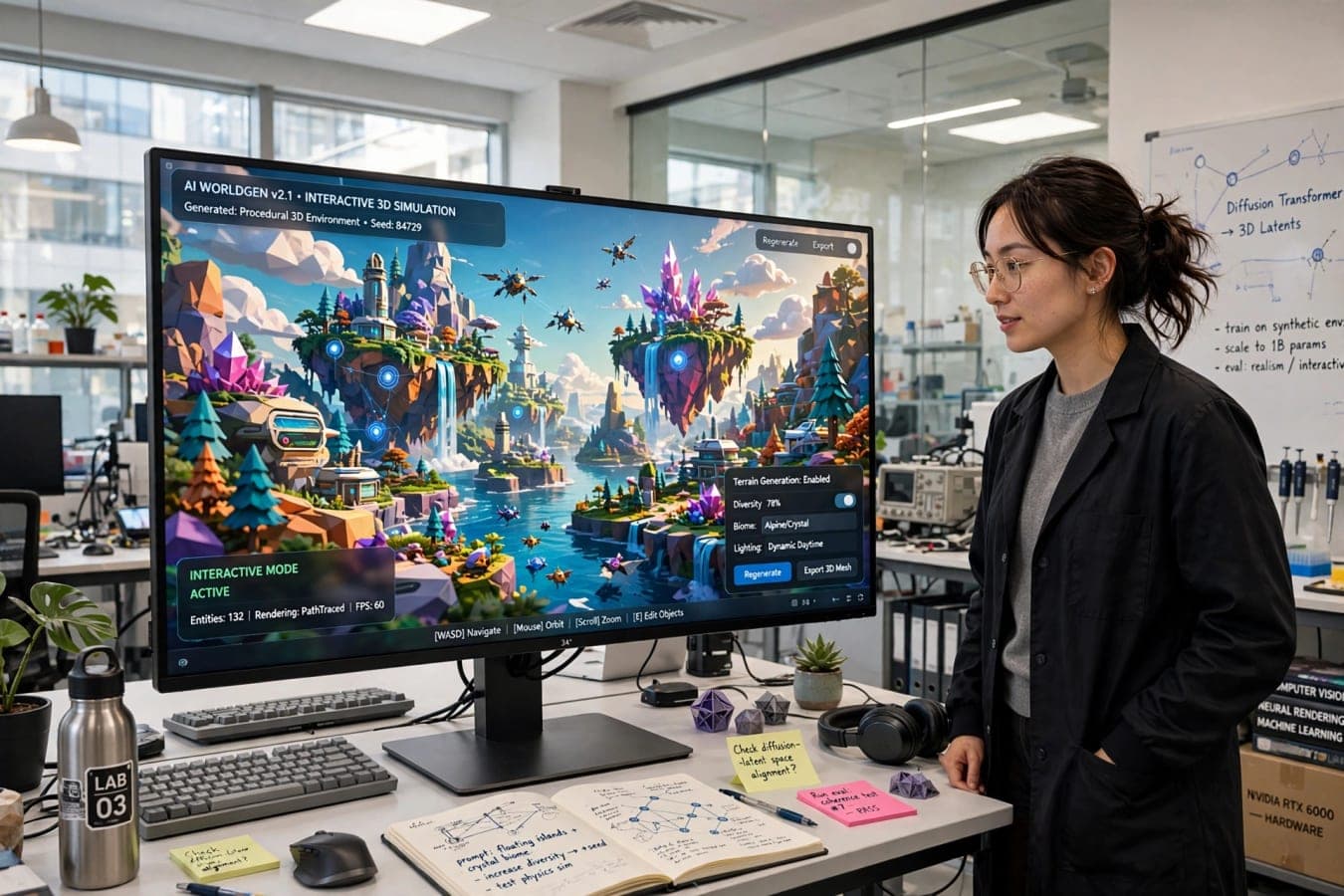
World Labs, based in San Francisco, works on spatial intelligence — AI that understands the three-dimensional world the way humans do. Its models do three things that matter for AMD's plans:
- Generate 3D environments. Given text, an image or a video, a world model can create an interactive 3D scene that a user can move through.
- Reconstruct real spaces. The same technology can rebuild a real place in 3D from photos or video.
- Simulate how things behave. World models can predict how objects, people and robots move and interact inside a virtual space. The lab's flagship system is Atlas, a next-generation world model released on November 12, 2026 — one day before the AMD deal closed. The timing is no coincidence. AMD acquired a lab at the moment its most important product was fresh in the public eye.
Why world models matter for chips
For most people, the link between a 3D world generator and a chip company is not obvious. For AMD, it is the point of the deal. World models are among the most compute-hungry AI systems being built today. Generating and simulating a 3D environment in real time needs enormous amounts of processing power, memory bandwidth and fast connections between chips. That is exactly the hardware AMD sells — its Instinct accelerators for data centers and its Ryzen and EPYC processors. The logic runs in both directions:
- Better models sell more chips. If world models become a major workload, the companies that build them will need more accelerators, and AMD wants those orders.
- Better chips make better models. A research team working inside a chip company can shape the hardware its models run on, and test new ideas on hardware before it reaches customers.
- Software is the gap. AMD's biggest weakness against Nvidia has never been raw silicon. It has been the software ecosystem around it. Buying a model team is a way to close that gap with real research talent. AMD's announcement said the deal brings together "leading AI model researchers and AMD engineers to shape the next generation of AMD hardware, software and systems for the open AI ecosystem." The word "open" is doing deliberate work there — AMD is positioning itself as the open alternative to Nvidia's tightly controlled platform.
How the price grew so fast
World Labs is barely two years old, and its valuation has climbed at remarkable speed.
- In January 2026, Bloomberg reported the company was in funding talks at a valuation of around $5 billion.
- By September, AMD agreed to pay approximately $8.2 billion in stock.
- The final share count, 14,978,322 shares, was fixed only at closing in November. That is a near-doubling in about ten months, and it reflects how competitive the market for frontier AI talent has become. AMD was not the only company that could have bought World Labs. Paying $8.2 billion — AMD's second-largest acquisition after its 2022 purchase of Xilinx — was the price of winning the team outright. For comparison, AMD's revenue in the third quarter of 2026 was about $9.2 billion. The World Labs deal is worth almost an entire quarter of sales. That is a large bet by any measure.
What this means for the AMD vs Nvidia race
Nvidia dominates the market for AI accelerators, and its lead is built on more than hardware. Its CUDA software platform has been the default for AI developers for more than a decade, and its networking, libraries and tools lock customers in. AMD's response has been to attack on three fronts at once: Hardware — Instinct accelerators, including the MI400 series, aimed at data center AI; Software — ROCm, its open software platform, now a major investment priority; Research — World Labs, adding a frontier model team led by Fei-Fei Li. The World Labs deal is the third front. A chip company that also builds frontier models can show customers what its hardware can do, attract developers who want to work with the research team, and feed lessons from real model training back into chip design. It also changes the story AMD tells investors. Instead of being a second-place chip supplier, AMD can present itself as a full-stack AI company — hardware, software and models — in the same conversation as Nvidia, Google and OpenAI.
What changes for World Labs and Atlas
AMD has said little about the day-to-day future of World Labs or its Atlas model. Its closing announcement and the World Labs deal announcement do not describe any changes to Atlas or to the lab's developer APIs. That leaves several open questions:
- Will Atlas stay available to developers? Nothing in the announcements suggests a shutdown, but AMD has not confirmed the product roadmap.
- Will the team keep publishing research? World Labs has been an open research lab. Whether that continues inside a public chip company is not yet clear.
- How will the models run on AMD hardware? The most likely outcome is that Atlas and future world models become showcases for AMD's Instinct accelerators, with optimisations that show off the hardware.
- What happens to existing partnerships? World Labs worked with other companies before the acquisition. AMD has not said which of those relationships continue. For users of Atlas today, the practical answer is that nothing has been announced as changing. The deal is a change of ownership, not a product launch or a shutdown.
The robot connection
There is a second reason AMD wants world-model expertise: robots. World models are becoming the training ground for physical AI — robots that learn to move, grasp and navigate by practising inside simulated worlds before they ever touch the real one. That is a fast-growing market. Robot makers need simulation environments that look and behave like the real world, and they need the compute to run those simulations at scale. AMD's pitch is that it can supply both the models and the machines. Siemens, NVIDIA and other industrial companies made similar points at the SC26 supercomputing conference in Chicago this week, where industrial AI and robot simulation were prominent themes. The industry is converging on the idea that the next big AI workload is not chat — it is machines that move in the physical world.
What to watch next
The deal is closed, but the real test is what AMD does with the team. A few things to watch over the coming months:
- First joint product. Whether AMD announces a world-model demo or service running on Instinct hardware, and how soon.
- Research output. Whether Li's team keeps publishing papers and releasing models, or goes quiet inside AMD.
- Customer wins. Whether data center customers cite world models and spatial AI as a reason to buy AMD accelerators.
- The share price. AMD's stock fell about 2.9% on November 16, the day the deal was confirmed. Investors will want evidence that $8.2 billion bought more than a famous name.
- Nvidia's answer. Nvidia has its own world-model research, and the race in spatial AI is only just starting.
The bottom line
AMD's $8.2 billion acquisition of World Labs is closed, Fei-Fei Li is now AMD's chief scientist, and the chipmaker has bought its way into the world-model race in a single move. The deal is a bet that the next great AI workload is not text on a screen but simulated 3D worlds — and that the company that builds both the models and the chips will win it. Whether that bet pays off depends on execution. For now, AMD has the team, the technology and the headline. The hard part — turning a research lab into a reason to buy AMD hardware — starts now.
FAQs
How much did AMD pay for World Labs?
Approximately $8.2 billion in an all-stock deal announced in September 2026. AMD issued 14,978,322 shares to World Labs' former stockholders at closing, and the final value was subject to adjustment based on AMD's share price.
When did the AMD–World Labs deal close?
The transaction closed on November 13, 2026. AMD publicly confirmed the completion on November 16, 2026, in a newsroom announcement and an amended SEC filing.
What role does Fei-Fei Li have at AMD?
Li joins AMD as executive vice president and chief scientist, reporting directly to chair and CEO Lisa Su. She was previously World Labs' chief executive.
What does World Labs build?
World Labs builds spatial-intelligence "world models" — AI systems that generate, reconstruct and simulate interactive 3D environments from text, image and video inputs. Its latest model, Atlas, was released on November 12, 2026.
Why did AMD buy World Labs?
AMD says the deal adds a world-class model research team to its AI push, helping shape its hardware, software and systems for the open AI ecosystem. It also strengthens AMD against Nvidia, whose lead rests on software and research as well as chips.
Does the deal change Atlas or World Labs' products?
AMD has not announced any changes to Atlas or World Labs' developer APIs. The closing announcement describes a change of ownership, not a product launch or shutdown.
Was this article helpful?

Written By
TechorCoffeeContributing Writer
TechorCoffee is a technology reporter and software creator writing reviews and tutorials for TechOrCoffee.
Comments (0)
Leave a Comment
Read Next
Tue Oct 13 2026
Gemini 4 Argon: Everything You Need to Know
Gemini 4 Argon is Google’s new flagship AI model. See its benchmarks vs GPT-6 Astra and Claude, pricing, 1M-token output, safety features and how to get access.
Fri Oct 30 2026
GPU and RAM Prices 2026: Why AI Ate Your Upgrade
GPU and RAM prices in 2026 explained: AI memory shortage, DDR5 and RTX 50 price rises, RTX 50 Super delay, and when relief may come.
Sat Oct 31 2026
Intel Next-Generation Core Ultra vs AMD Ryzen AI
Intel Next-Gen Core Ultra vs AMD Ryzen AI preview: rumours, cores, AI, GPU, power and price for buyers in 2026 today, all unconfirmed.