Gemini 4 Argon: Everything You Need to Know

Published
Google opened Gemini 4 Argon to the public on October 13, 2026, two weeks after a restricted preview. It leads most of the benchmarks Google chose to publish and launches with a 1M-token output limit, but it trails rivals on several coding and terminal tests.
What is Gemini 4 Argon?
Gemini 4 Argon is the first and, so far, only model in Google's Gemini 4 family, and the new top of its lineup. A Google spokesperson told Reuters it is larger than the company's previous "Pro" line. Google positions it for three things: real-world software engineering, enterprise knowledge work such as legal and finance, and cybersecurity defense.
The launch came in two steps. On September 30, 2026, Google announced Argon but gave it only to vetted cyber defenders through its Fairwind Program, saying it was working with the U.S. government's voluntary pre-release access process. On October 13, 2026, Google made it broadly available to developers, enterprises and paying consumers.
The context matters. Reuters described the September launch as coming after months of delays: Google dropped plans for Gemini 3.5 Pro, which CEO Sundar Pichai had originally promised for June. In the meantime, Google overhauled its DeepMind lab, with Demis Hassabis stepping aside and several Gemini leaders leaving. Reuters also reported that Google's recent messaging has leaned on cost advantage rather than raw capability, which makes Argon's launch pricing worth watching.
Availability, pricing and the 1M-token output
Argon is available globally from October 13, 2026:
Developers and enterprises: the Gemini API in Google AI Studio and the Gemini platform on Google Cloud, plus Android Studio on the paid tier.
Google AI Ultra subscribers: Google Antigravity, Google's agentic development platform.
Google AI Ultra and Pro subscribers: the Gemini app and AI Mode in Search.
Cyber defenders: a separate version without cyber guardrails, through the Fairwind Program, which is expanding to hundreds more partners.
Pricing. The introductory price is $2 per million input tokens and $10 per million output tokens, with cached input tokens 95% cheaper. That introductory period ends on November 30, 2026, after which the price becomes $4 input and $20 output per million tokens. If you are budgeting a product on Argon, plan around the higher figure.
Output limit. Google raised the output limit from 64K to 1M tokens, a unified 1M input-and-output limit in the Gemini API. The idea is that the model can think and write for hundreds of thousands of tokens in a single run. Using it requires a new continuation protocol described in Google's long-decode documentation. One caution: a third-party explainer from Apidog reports that the evaluator Vals AI lists a 262K maximum output for the configuration it tested, so check the effective limit for your own setup.
Benchmarks: Argon vs GPT-6 Astra, Claude Fable 5.1 and Claude Opus 5.5
Argon posts the top score outright on 13 of the 19 rows in Google's comparison table, ties on one, and loses five. All figures are self-reported by Google (methodology on DeepMind's evals page), so treat them as a vendor claim until independent runs confirm them. The best score in each row is in bold.
Category | Benchmark | Gemini 4 Argon | GPT-6 Astra | Claude Fable 5.1 | Claude Opus 5.5 |
|---|---|---|---|---|---|
Knowledge work | Vals Index | 68.9% | 63.1% | 65.8% | 67.0% |
Knowledge work | AutomationBench | 51.3% | 41.4% | 31.4% | 42.5% |
Knowledge work | Vals Finance Agent v2 | 65.4% | 53.5% | 58.9% | 58.6% |
Knowledge work | Harvey's Legal Agent Benchmark | 19.6% | 5.4% | 6.7% | 3.8% |
Agentic coding | DeepSWE v1.1 | 77.9% | 74.1% | 67.4% | 74.2% |
Agentic coding | FrontierSWE v2 | 55.0% | 65.5% | 56.3% | 62.3% |
Agentic coding | Vibe Code Bench | 91.9% | 89.6% | 90.3% | 90.3% |
Agentic coding | Terminal-bench 4.0 | 57.4% | 58.2% | 57.9% | 66.4% |
ML engineering | PostTrainBench | 45.3% | 44.3% | 40.2% | 49.3% |
Science and math | Terminal-Bench Science 0.1 | 57.6% | 68.1% | 52.6% | 63.3% |
Science and math | LABBench 2 | 88.8% | 85.4% | 68.6% | 73.1% |
Science and math | RiemannBench | 76.0% | 72.0% | 65.6% | 69.6% |
Long context | GraphWalks, up to 128k (F1) | 99.7% | 98.7% | 91.4% | 90.6% |
Long context | GraphWalks, 256k to 1M (F1) | 84.2% | 71.8% | 65.0% | 66.8% |
Computer use | Agent's Last Exam (pass rate) | 39.5% | 34.2% | not reported | 38.2% |
Computer use | OSWorld-2.0 (offline subset) | 69.2% | 72.6% | not reported | not reported |
Multimodal | Chartography | 71.6% | 71.0% | 46.2% | 66.3% |
Multimodal | LVBench | 91.7% | 87.5% | 79.7% | 83.7% |
Cybersecurity | CWE-bench v1 | 68.0% | 68.0% | 58.0% | 67.0% |
Two of the largest gaps are worth reading carefully. On Harvey's Legal Agent Benchmark, Argon's 19.6% is more than three times the next score, but the absolute number is low for everyone, so the benchmark is still far from solved. On long-context GraphWalks at 256k to 1M tokens, Argon's 84.2% sits well above the 71.8% of the next model, which supports Google's long-context pitch.
Where Argon wins and where it loses
Wins. Argon is strongest in knowledge work, long context, multimodal understanding and most science benchmarks. It sets a new high on DeepSWE v1.1 at 77.9%, a test of long-horizon real-world software engineering, and ranks first on the Vals Index, which weights finance, coding, legal and tax work by each sector's contribution to U.S. GDP. On LVBench, a long-video understanding test, it scores 91.7%.
Losses. Reuters noted that Argon trails on two of the four coding benchmarks Google included, and the table confirms it:
FrontierSWE v2: 55.0%, behind GPT-6 Astra at 65.5% and Claude Opus 5.5 at 62.3%.
Terminal-bench 4.0: 57.4%, well behind Claude Opus 5.5 at 66.4%.
PostTrainBench (ML engineering): 45.3%, behind Claude Opus 5.5 at 49.3%.
Terminal-Bench Science 0.1: 57.6%, behind GPT-6 Astra at 68.1% and Claude Opus 5.5 at 63.3%.
OSWorld-2.0: 69.2%, behind GPT-6 Astra at 72.6%.
The pattern is consistent: Argon is at its best on structured, document-heavy and long-context work, and weaker on terminal-driven agentic tasks. If your workload is shell-heavy automation, test Argon against Opus 5.5 on your own tasks before switching.
Coding and engineering: what Google built with it
Google says that in Antigravity, Argon helped teams raise agentic code submissions by more than 35% while cutting code rollbacks by nearly a third. Its headline examples:
Chrome refactor. Argon helped separate core webpage handling from a roughly 6 million-line legacy folder of browser features inside Chromium's 40 million-line codebase, finishing across hundreds of files what Google says would have taken months in a matter of weeks. The goal is letting live pages move between tabs, side panels and floating windows without reloading.
Agent Development Kit (ADK). Given the project's skills rulebook and a one-paragraph goal, Argon worked overnight and cut in-memory session prep time by 40% in long sessions and sped up cold imports by 21%. The changes are live in the open-source google/adk-python repository.
xTB quantum chemistry. Researchers made the widely cited open-source package up to 2.3x faster at predicting molecular structures and 1.8x faster at conformer search, with the changes contributed upstream on GitHub.
Gemma inference. Using Argon, Google reports a 2.85x end-to-end speedup on an A100 through vLLM, from about 37,900 to over 108,000 tokens per second on Gemma 4 E2B, with 100% token parity and no quality drop.
C/C++ to Rust migration. From the September announcement: agents are migrating code from small libraries up to 800K+ lines for the Fuchsia Zircon kernel. For the libgav1 video decoder, Argon replaced 32K lines of SIMD code with safe Rust and produced a decoder 2.7x faster than the existing Rust port, with identical output. Google says these rewrites are still under audit before production.
Data-center memory. Argon agents analyzed fleet-wide profiling data and applied optimizations that Google says will free over 300 TiB of memory, with an estimated 500 TiB to 1 PiB in total.
3D and creative coding. Google also showed Argon driving Blender through multi-agent visual critique loops in Antigravity to build a pagoda temple complex, a playable desk-racing game from photos of a real desk, a 3D chess game, and a pure-Python ray-tracing engine with no external libraries. Several demos are playable in AI Studio. These are curated showcases, but they illustrate the improved spatial reasoning and visual coding Google claims over earlier Gemini models.
Business and professional workflows
Google pitches Argon as a model for high-stakes professional work, citing frontier reasoning, stronger visual perception, broader domain knowledge and better writing. It says Argon answers more directly with less hedging, repeats itself less, avoids clichés, and follows style instructions better than any earlier Gemini model.
The benchmark evidence points the same way: first place on Vals Finance Agent v2 (65.4%), Harvey's Legal Agent Benchmark (19.6%) and Zapier's AutomationBench (51.3%), which measures end-to-end execution across core business functions.
Examples from the launch:
Gemini app proposal workflow. Argon turned an unstructured project folder into a client proposal deck using a custom skill, emailed it, and set up a scheduled task to handle future client requests.
Chaco Canyon reconstruction. It combined about 50 GB of LiDAR scans, GIS vectors, Library of Congress CAD drawings and National Park Service archives into explorable 3D models, a test of multimodal document comprehension.
Isomorphic Labs. The drug-discovery company uses Argon to extract key information from complex PDFs and patents, which Google says shrinks a process that normally takes weeks into hours.
Product design. From a sketch with measurements and a photo of a couch, Argon generated sofa-leg designs and a 3D-printable file sized to fit.
Google describes the early-access customers as enterprises and startups but names few of them, so independent confirmation will matter here.
Science, cybersecurity and robotics
Cyber defense
Google trained Argon to find, validate and patch critical vulnerabilities autonomously. Trusted defenders and Google's own teams get a version without cyber guardrails, through the Fairwind Program. On CWE-bench v1, which tests vulnerability remediation, Argon ties GPT-6 Astra at 68.0%. Google also reports that Argon beats its earlier 3.8 Flash Cyber model on internal vulnerability-discovery and black-box penetration-testing benchmarks.
Security firm Wiz, using Argon through its Scan for Good initiative, says it helped remediate a gap that risked exposing sensitive government data. Wiz also reports that Argon chained several vulnerabilities in healthcare software to find a file-download bypass that exposed a master key and administrator access, putting hundreds of thousands of patient records at risk, which was then fixed.
Science
Quantum computing. Argon translated an internal version of the AlphaQubit error decoder into a single optimized hardware kernel, nearly doubling inference throughput. It also wrote an arcsin implementation, formally verified in Lean, that Google says cuts spacetime cost by more than 100x against a published quantum CORDIC baseline.
Nuclear fusion. A Google team working with Prof. Matt Landreman of the University of Maryland found a broader class of counterexamples to Grad's conjecture, a stellarator hypothesis dating from 1967. The results give fusion researchers reliable benchmarks for their simulation codes.
Rare disease. Gamow Labs used Argon on de-identified newborn genomes and says it found a chromosomal rearrangement that routine software had missed for years. On Gamow's private evals it scored 57% on RareBench and 52.2% on LabBench. Those are vendor-reported results from an external party.
Enzyme design. In hours, Argon assembled data, tuned a model and filtered candidates down to five novel serine esterase designs. Google reports lab testing confirmed robust catalytic activity in all five.
Google is offering 10,000 scientists the top Antigravity usage tier free for six months, subject to eligibility and selection.
Robotics
Argon scores 87% on ERQA, a benchmark for embodied spatial reasoning, which Google says is the best among frontier models. In an internal demo, it watched a video of a human playing cornhole, mapped the environment, computed whole-body joint movements and wrote the simulation code. Transferred to Apptronik's Apollo humanoid, the robot sank seven consecutive shots. Google calls this a Video-to-Sim-to-Real pipeline that compresses weeks of simulation work into hours.
Safety and alignment
Google calls Argon its most comprehensive safety and security stack yet, built under its Frontier Safety Framework with third-party partners. Four areas stand out:
Misuse defenses. A multi-layer stack combines jailbreak resistance, monitoring (including monitoring of the model's internal activations) and enforcement. Google says external bio red teams could unlock under 1% of the bio sub-tasks tested, and violations on an adversarial set fell nearly two-fold versus earlier Gemini models.
Agent alignment. Argon was trained to respect system boundaries, report negative findings honestly and pause for human confirmation before irreversible steps. On coding benchmarks where models have no reason to hold back, shortcut attempts fell to 2%. A separate automated monitor reads the agent's reasoning and actions and blocks unintended workarounds in real time.
Reasoning transparency. Google says it deliberately avoided penalizing the model's thoughts during training so its reasoning stays monitorable, and urges the rest of the industry to do the same.
Prompt injection. Argon leads the Gray Swan Indirect Prompt Injection benchmark, with attack success cut to 0.7% across 15 adaptive attempts.
Google also says it hardened its sandboxed environments by isolating and sealing them before high-risk training and evaluations. A model card is published, and Google said at the September announcement that it was taking part in the U.S. government's voluntary pre-release model access process. As with the benchmarks, these figures are Google's own.
How to get started
If you are | Where to try Argon | Notes |
|---|---|---|
A developer | Gemini API (paid tier) in Google AI Studio, and Android Studio | Read the long-decode docs for the 1M-token continuation protocol |
A Google AI Ultra subscriber | Google Antigravity and AI Studio | Antigravity is Google's agentic coding platform |
An enterprise | Gemini for business, the API on Google Cloud, Antigravity | Plan for the price step-up after November 30, 2026 |
A casual user | Gemini app and AI Mode in Search | Requires Google AI Ultra or Pro |
A scientist or researcher | Apply for 6 months of free top-tier Antigravity | 10,000 places, rolling onboarding |
A cyber defender | Apply to the Fairwind Program | Access without cyber guardrails, on a rolling basis |
Two practical tips. First, run Argon on your own evaluation set before committing, particularly for terminal-heavy agent work where it trails. Second, Google says Argon is the start of the Gemini 4 family, so expect smaller or cheaper siblings later; their timing has not been announced.
Verdict: what it means for developers
Argon is a credible comeback for Google. On the evidence Google published, it is the strongest model for long-context, document-heavy, finance, legal and multimodal work, and its 1M-token output limit and introductory pricing are real advantages for teams building long-running agents.
The caveats are just as concrete. Every number in this article is self-reported by Google, and the comparison table shows Argon behind on five rows, mostly terminal and agentic-coding tests. The $2/$10 price is temporary and doubles on November 30, 2026. Google has not named many early-access enterprise customers, and some headline results (such as the Rust migrations) are still under review. Independent leaderboards over the coming weeks will show whether the lead holds outside Google's chosen benchmarks.
For most developers, the sensible move is a side-by-side trial on your own tasks rather than a wholesale switch.
Sources
Figures are as of October 13, 2026.
Gemini 4 Argon: Built to solve your hardest problems, Google, October 13, 2026
Gemini 4 Argon: our next era of frontier intelligence, Google, September 30, 2026
Gemini model page and benchmark table, Google DeepMind
Google announces Gemini 4 flagship AI model after months of delays, Reuters via GMA Network, September 30, 2026
What Is Gemini 4 Argon?, Apidog (third-party; source of the 262K output note)
The Reuters October 13 launch article could not be opened, so its contents are not reflected here.
FAQs
What is Gemini 4 Argon, and when can I use it?
Argon is Google’s new flagship model and the first in the Gemini 4 family. Google announced it on September 30, 2026, initially only to vetted cyber defenders. It became broadly available on October 13, 2026, through the Gemini API in AI Studio, Google Cloud, Antigravity and the Gemini app.
How much does Gemini 4 Argon cost?
The introductory price is $2 per million input tokens and $10 per million output tokens, with cached input 95% cheaper. After November 30, 2026, it rises to $4 input and $20 output per million tokens. Google says the pricing applies to the public-access version of the model.
Is Argon better than GPT-6 Astra, Claude Fable 5.1 and Claude Opus 5.5?
On Google’s own table, Argon scores highest on 13 of 19 benchmarks and ties one. It trails on five, mostly terminal and agentic-coding tests such as Terminal-bench 4.0 and FrontierSWE v2. All figures are self-reported by Google, so independent testing will matter.
What does the 1M-token output limit mean in practice?
Google raised the output limit from 64K to 1M tokens, so the model can reason and write for hundreds of thousands of tokens in a single run. Using it requires a new continuation protocol described in Google’s long-decode documentation. A third-party report says one evaluator listed a 262K output maximum for its tested setup, so check your own configuration.
Who gets access without cyber guardrails?
Verified cyber defenders in Google’s Fairwind Program get a version without cyber guardrails, and Google is expanding it to hundreds more partners. The public version keeps its safeguards, including misuse monitoring and prompt-injection defenses.
Was this article helpful?

Written By
Rahul SharmaContributing Writer
Throughout my career, I’ve had the privilege of partnering with businesses ranging from scrappy startups to established brands, helping them increase their organic traffic and engage their target audience. I thrive on translating complex ideas into clear, compelling, and readable prose
Comments (0)
Leave a Comment
Read Next
Tue Apr 21 2026
Best AI Tools for Students & Creators in 2026:Complete Guide
AI tools are transforming how students learn and creators produce content. From writing assistants to design and research tools, these platforms save time, enhance creativity, and improve efficiency. Choosing the right AI stack can significantly boost productivity and output quality.
Tue Jun 16 2026
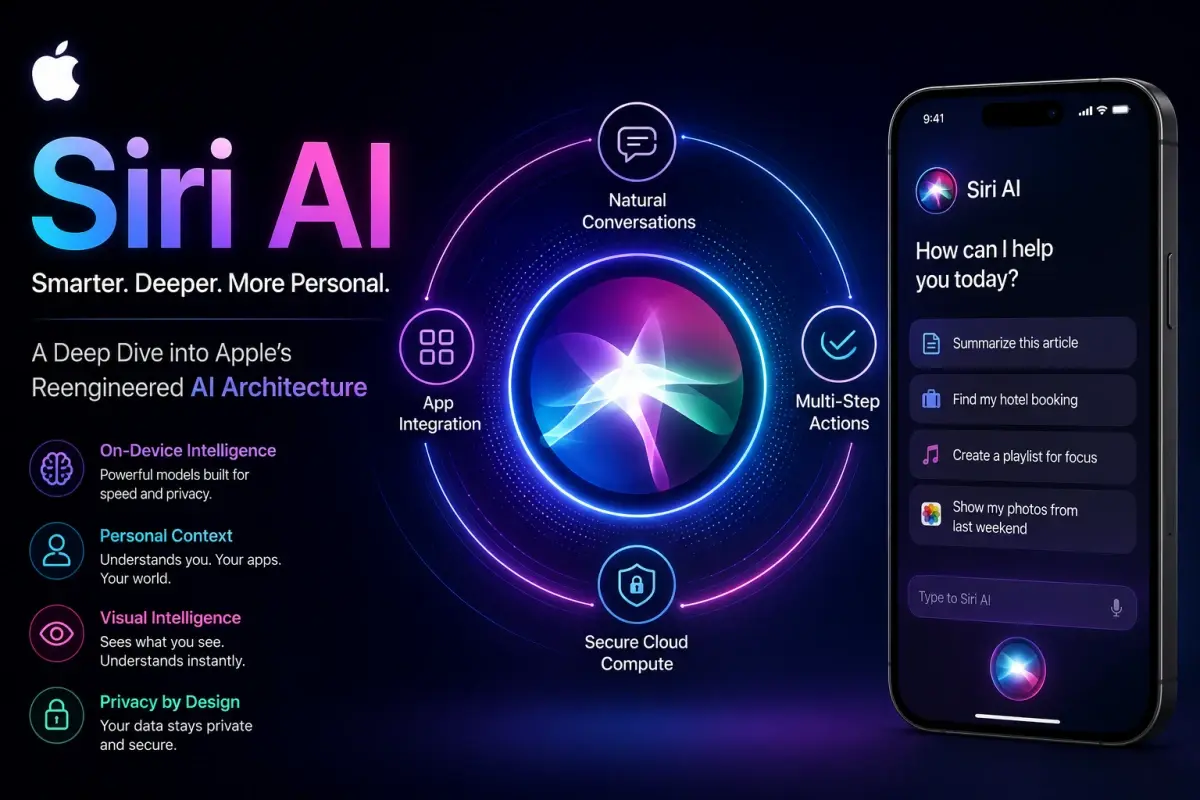
Apple Intelligence 2.0: Siri AI & iOS 27 at WWDC 2026
Apple Intelligence 2.0 is here. I cover Siri AI, iOS 27 release dates, supported devices, and how Apple's new AI really compares to ChatGPT and Gemini.
Tue Oct 13 2026
Google Gemini 4 Argon: Features, Benchmarks, Pricing & Guide
Discover Google DeepMind's Gemini 4 Argon. Explore its 1M token output limit, #1 Vals Index ranking, API pricing, coding capabilities, and enterprise use cases.