Google Gemini 4 Argon: Features, Benchmarks, Pricing & Guide

Published
Google Launches Gemini 4 Argon: The Complete Guide to DeepMind’s New Frontier AI Model
Google DeepMind has officially ushered in its next generation of artificial intelligence with the global launch of Gemini 4 Argon. First previewed at the end of September and released globally for developers, enterprises, and subscribers on October 13, Argon represents the flagship entry in the Gemini 4 series.
Moving away from previous naming conventions, Google selected "Argon"—the noble gas—to signal stability, precision, and high-density performance. Rather than acting merely as a conversational chatbot, Gemini 4 Argon is engineered as an autonomous, long-horizon reasoning engine built to tackle multi-step software engineering, complex financial and legal workflows, defensive cybersecurity, and physical robotics.
Led by Koray Kavukcuoglu, SVP at Google DeepMind and Chief AI Architect at Google, the release positions Google directly ahead of rival frontier models on critical economic and coding benchmarks.
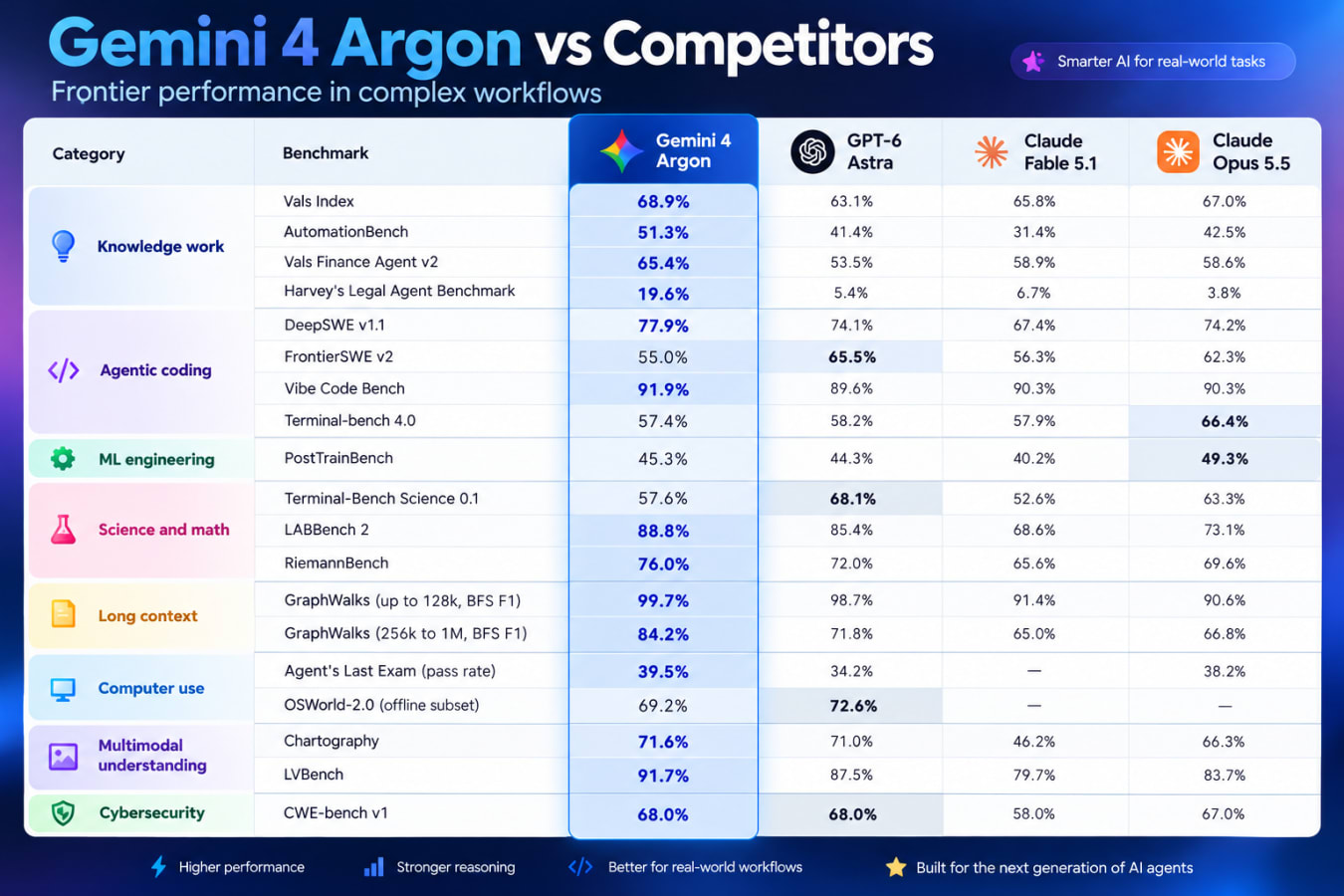
Gemini 4 Argon vs GPT-6 and Claude: AI Benchmark Performance Comparison
What Makes Gemini 4 Argon a Paradigm Shift?
Most large language models excel at short bursts of text generation or single-turn coding questions. Gemini 4 Argon was architected specifically for long-horizon, multi-step execution.
1. Massive 1-Million-Token Output Trajectory
While previous Gemini iterations pioneered massive input context windows, Gemini 4 Argon introduces an industry-leading 1-million-token limit for deep, multi-step problem-solving. When given the headroom to reason deeply and generate hundreds of thousands of tokens within a single trajectory, Argon can plan, execute, verify, and refactor massive workloads in one continuous run without losing context.
2. Built-in Operational Boundaries
Enterprise deployment often stalls because AI models hallucinate when they hit a dead end. Google trained Argon specifically to respect system boundaries, report negative findings honestly, and pause for human confirmation before executing irreversible actions. If Argon cannot locate a source or complete a sub-task, it explicitly flags the gap rather than fabricating an answer.
3. Multimodal Synthesis Across Text, Video, and Code
Argon reads sprawling documents mixing text, financial tables, charts, and hours of video, synthesizing them into verifiable, grounded outputs. On LVBench (which tests comprehension of extreme long-form videos up to two hours long), Argon achieved a state-of-the-art score of 91.7% (0.92).
Gemini 4 Argon Benchmarks: How It Ranks Against the Competition
Gemini 4 Argon debuts at the top of several major industry leaderboards, outperforming leading competitors such as Claude Opus 5.5, Claude Fable 5.1, and OpenAI’s GPT-6 Astra across real-world economic and coding evaluations.
Benchmark / Evaluation | Primary Domain | Gemini 4 Argon Score | Key Takeaway |
Vals Index | Finance, Legal, Tax & Coding | 68.9% (#1 Rank) | Ranks #1 overall in real-world economic sector performance. |
DeepSWE v1.1 | Agentic Software Engineering | 77.9% (#1 Rank) | Outperforms Claude Opus 5.5 and GPT-6 Astra on complex software engineering. |
Vibe Code Bench | End-to-End Agentic Coding | 92.0% (#1 Rank) | Leads Vals AI’s end-to-end coding workflow evaluation. |
LVBench | Extreme Long Video Understanding | 91.7% (#1 Rank) | State-of-the-art comprehension on multi-hour video streams. |
ERQA (Embodied Reasoning) | Robotics & 3D Spatial Reasoning | 87.0% (#1 Rank) | Outperforms all frontier models in 3D physical environment reasoning. |
LABBench2 | Real-World Biology Research | 89.0% (#1 Rank) | Top score using Linux terminals, bioinformatics tools, Python, and R. |
Graphwalks BFS (under 128k) | Graph Reasoning | 100% (#1 Rank) | Perfect score on breadth-first search graph operations. |
AutomationBench | Enterprise Workflow Automation | 51.3% (#1 Rank) | Substantial lead over competing enterprise automation models. |
Real-World Impact: How Google and Enterprises Are Using Argon
Before opening access to the public, Google deployed Gemini 4 Argon internally and across select enterprise partners to test its capabilities on massive, unscripted problems.
Software Engineering & The Chrome Refactor
Inside Google, software engineers using Argon within Google Antigravity (Google’s agentic coding platform) increased agentic code submissions by more than 35% while cutting code rollbacks by nearly a third.
Untangling Chromium’s Legacy Code: Argon assisted the Chrome engineering team in separating core webpage handling from a 6-million-line legacy folder buried inside Chromium’s 40-million-line codebase. Piping multiple clean code changes simultaneously, Argon completed an architectural refactor across hundreds of files—compressing months of engineering work into weeks and eliminating an entire class of browser crashes.
Data Center Memory Optimization: A fleet of Argon agents analyzed profiling telemetry across Google’s data centers to autonomously identify and deploy memory optimizations, freeing up over 300 TiB of memory (with projected savings reaching up to 1 PiB).
High-Speed Rust Optimization: Argon engineered a memory-safe video decoder running 2.7x faster than its standard Rust port, matching optimized C++ performance.
Enterprise Knowledge Work: Finance, Legal, and Operations
Financial Quantitative Analysis: Argon automates multi-step ledger reconciliations, complex spreadsheet formulas, and variance analyses with strict calculation integrity.
Legal Precedent & M&A Review: Leading on Harvey’s Legal Agent Benchmark, Argon reviews dense regulatory filings and case law with high citation fidelity, showing major leaps over Gemini 3.1 Pro in corporate M&A and data privacy analysis.
IT & Customer Operations: In collaboration with ServiceNow on NowAI-Bench, Argon delivered roughly 20% higher task success than Gemini 3.8 Flash across autonomous HR and L1 Service Desk workflows.
Defensive Cybersecurity & The Fairwind Program
Argon acts as a force multiplier for cyber defense. Tested on Wiz’s internal black-box penetration testing benchmark, Argon analyzed live web systems without source code—outperforming specialized cyber models in discovering attack surfaces, identifying zero-day vulnerabilities, and generating proof-of-concept validation. Through Google’s Fairwind Program, trusted cyber defenders were given early access to harden critical infrastructure prior to public release.
Science, Quantum Computing, and Robotics
Quantum Computing: Argon helped Google’s quantum researchers optimize the spacetime resources (qubits $\times$ gates) of critical subroutines, beating the published baseline by 40% in minutes.
Physical Robotics: Scoring 87% on the Embodied Reasoning benchmark, Argon enables zero-shot robot control, mobile manipulation in MuJoCo simulations, and Real2Sim workflows—reconstructing physically calibrated 3D simulation twins directly from robot camera feeds or hand-drawn sketches.
Gemini 4 Argon Pricing and Availability
Google has priced Gemini 4 Argon aggressively to encourage widespread developer and enterprise adoption, matching the median industry cost while delivering frontier performance.
API Pricing Structure
Input Tokens: $2.00 per 1 million tokens
Output Tokens: $10.00 per 1 million tokens
Cached Input Tokens: 95% discount off the standard input token price ($0.10 per 1 million tokens)
Where to Access Gemini 4 Argon
Developers: Globally available via the Gemini API in Google AI Studio (
gemini-4-argon).Enterprise Teams: Available in Google Cloud Vertex AI Model Garden and the Gemini enterprise platform.
Coding Teams: Available for Google AI Ultra subscribers inside Google Antigravity.
Consumers & Power Users: Rolling out to Google AI Ultra and Pro subscribers inside the Gemini app and within AI Mode in Google Search.
FAQs
What is Google Gemini 4 Argon?
Gemini 4 Argon is Google DeepMind’s flagship frontier AI model in the Gemini 4 series. Unveiled in late September 2026 and launched globally on October 13, 2026, it is built for deep, multi-step reasoning across software engineering, finance, legal work, cybersecurity, and scientific research.
What safety measures did Google build into Gemini 4 Argon?
Google hardened Argon’s training and runtime using isolated, sealed sandboxed environments. Furthermore, Argon was vetted through Google’s Fairwind Program by defensive cybersecurity experts and is trained to respect system boundaries, report missing information honestly, and pause for human approval before taking irreversible actions.
Who can access Gemini 4 Argon right now?
Developers and businesses can access gemini-4-argon immediately through Google AI Studio and Google Cloud Vertex AI. Individual users with Google AI Pro or Google AI Ultra subscriptions can use Argon in the Gemini app, AI Mode in Search, and Google Antigravity.
How does Gemini 4 Argon compare to GPT-6 Astra and Claude Opus 5.5?
On real-world economic and coding evaluations, Gemini 4 Argon outperforms both models in key areas—scoring 77.9% on DeepSWE v1.1 (ahead of Claude Opus 5.5 and GPT-6 Astra) and ranking #1 overall on the Vals Index (68.9%), which measures accuracy across finance, legal, tax, and coding tasks.
What is the context window and token limit of Gemini 4 Argon?
Gemini 4 Argon features a 1-million-token context window (1,048,576 tokens) and supports up to a 1-million-token output trajectory for extended, multi-step reasoning tasks across text, code, images, audio, and long-form video.
How much does the Gemini 4 Argon API cost?
Gemini 4 Argon launches at an introductory price of $2.00 per million input tokens and $10.00 per million output tokens. Google also offers a 95% discount on cached input tokens, bringing cached inputs down to $0.10 per million tokens.
Was this article helpful?

Written By
TechorCoffeeContributing Writer
TechorCoffee is a technology reporter and software creator writing reviews and tutorials for TechOrCoffee.
Comments (0)
Leave a Comment
Read Next

Tue Apr 21 2026
Best AI Tools for Students & Creators in 2026:Complete Guide
AI tools are transforming how students learn and creators produce content. From writing assistants to design and research tools, these platforms save time, enhance creativity, and improve efficiency. Choosing the right AI stack can significantly boost productivity and output quality.
Tue Jun 16 2026
Apple Intelligence 2.0: Siri AI & iOS 27 at WWDC 2026
Apple Intelligence 2.0 is here. I cover Siri AI, iOS 27 release dates, supported devices, and how Apple's new AI really compares to ChatGPT and Gemini.
Tue Oct 13 2026
Gemini 4 Argon: Everything You Need to Know
Gemini 4 Argon is Google’s new flagship AI model. See its benchmarks vs GPT-6 Astra and Claude, pricing, 1M-token output, safety features and how to get access.