Apple M6 vs M5: Complete Performance & Efficiency Guide

Published
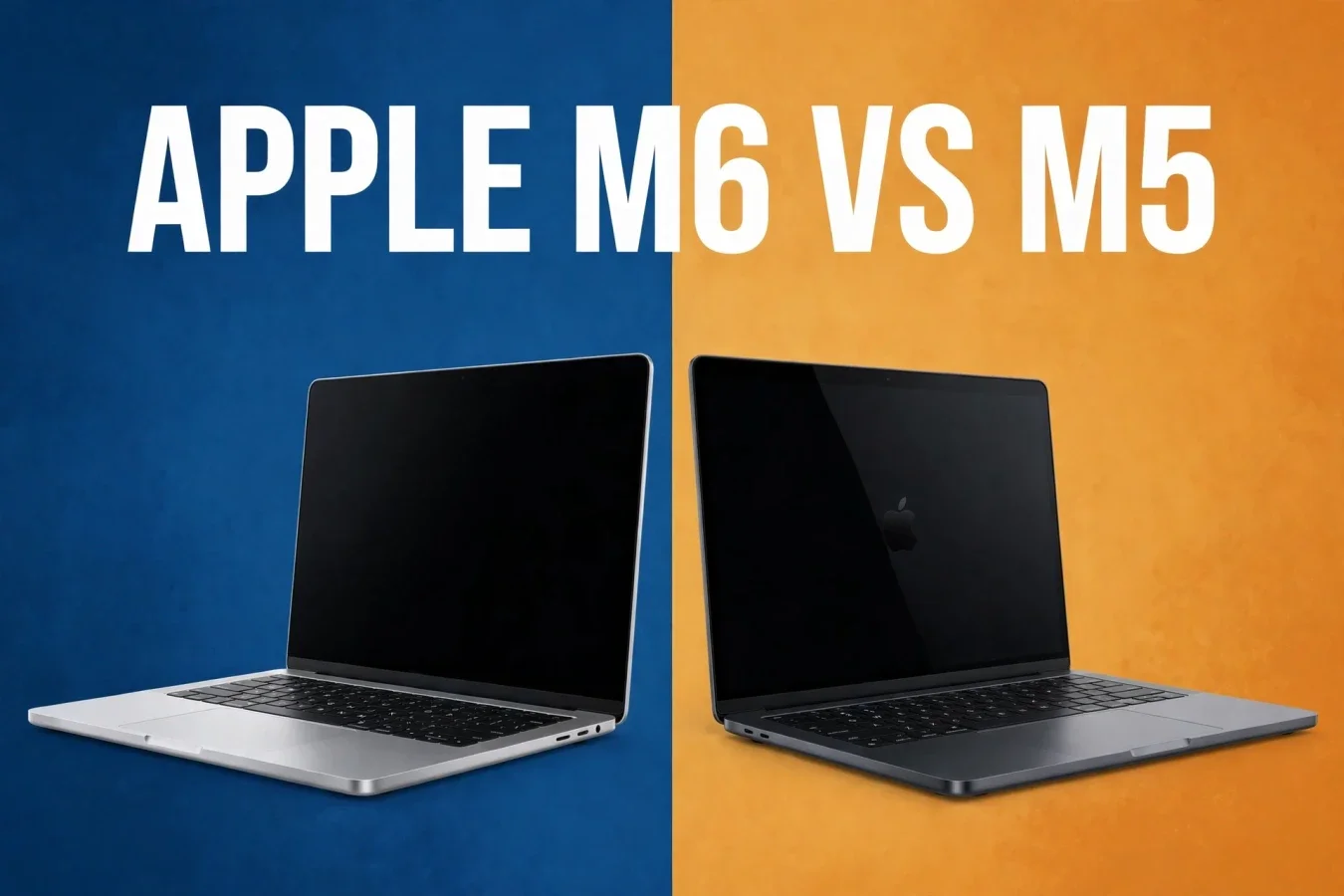
Two Apple chips — one 2nm step, one proven 3nm design
Apple M6 vs M5 compares Apple's base M-series chips by CPU, GPU, AI, battery and price, with a clear warning: most M6 numbers here are Apple's claims or early Mac mini benchmarks, not a controlled MacBook Pro head-to-head test. On paper, M6 wins on CPU cores, GPU cores and Neural Engine, while M5 wins on proven availability and lower entry configurations. For buyers, the M6 MacBook Pro is a 14-inch model only in this launch, while M5 Pro and M5 Max models remain the higher-tier MacBook Pro options.
| Chip | Process | CPU | GPU | Neural Engine | Memory bandwidth |
|---|---|---|---|---|---|
| Apple M5 | TSMC 3nm, third generation | 10-core: 4 super, 6 efficiency | 10-core, Neural Accelerator in every core | 16-core | 153GB/s |
| Apple M6 | TSMC 2nm, first generation | 12-core: 2 super, 4 performance, 6 efficiency | 12-core, Neural Accelerator in every core | Dual 16-core, 32 cores total | Up to 170GB/s |
Specifications
M5 was launched in October 2025 on TSMC's third-generation 3nm process, with FinFET transistors. M6 was introduced on August 25, 2026 in the Mac mini, which went on sale September 22, and is Apple's first 2nm chip, with gate-all-around nanosheet transistors. M5 has 10 CPU cores, while M6 has 12, adding a third tier: two super cores for single-threaded speed, four performance cores and six efficiency cores. M5 has a 10-core GPU, while M6 has a 12-core GPU, with updated shader architecture and third-generation Dynamic Caching, against second-generation on M5. Both chips top out at 32GB of unified memory on the base tier.
The memory catch matters: Apple's faster 170GB/s bandwidth applies only to the 24GB and 32GB M6 configurations, so the base 16GB M6 model runs at the same 153GB/s as M5. If you buy the base model, you do not get the full bandwidth gain. If you buy 24GB or 32GB, you do. For most buyers, that detail is more important than the headline bandwidth number.
Performance
Apple claims up to 1.2x faster multithreaded CPU performance for M6 against M5, nearly 30% higher peak GPU compute for AI, up to 2x peak Neural Engine compute and 50% higher geometry rates for complex graphics. Independent Geekbench 7 results from the M6 Mac mini, reported in a 9to5Mac review, scored 4,074 single-core and 22,632 multi-core, against MacRumors averages of 3,641 single-core and 17,948 multi-core for M5 in the 14-inch MacBook Pro. That works out to about 12% more single-core speed and about 26% more multi-core speed.
Those are Mac mini results, so treat them as a guide rather than a MacBook Pro measurement, but the pattern fits Apple's claims: a modest single-core bump and a bigger multi-core gain from two extra cores. Early engineering-sample Geekbench 6 results gave a smaller gap, about 5% single-core and 19% multi-core, so the exact gap depends on the benchmark and configuration. For everyday work, both chips are fast; for heavy multitasking, rendering and compilation, M6's extra cores should show more clearly.
Gaming
Apple claims up to 30% faster graphics for M6 against M5, with 50% higher geometry rates for complex 3D scenes. That is a GPU claim, not a frame-rate promise for a specific game at a specific setting. No controlled side-by-side MacBook Pro gaming test between M6 and M5 was reviewed, so no FPS winner is claimed beyond Apple's graphics claim. Apple's 2x ray-tracing gaming claim for Cyberpunk 2077 was against M4, not M5, so do not read it as an M6-versus-M5 result.
For casual and indie games, both chips are more than enough. For demanding 3D work and ray-traced titles, M6's 12-core GPU and updated shader architecture should help, but thermal headroom in the 14-inch chassis will still matter. If gaming is your priority, a Windows gaming laptop with a dedicated GPU remains the stronger choice; if you want a Mac that also plays games, M6 is the better Mac chip on paper.
AI performance
AI is where M6 makes its biggest paper jump. M5 has a 16-core Neural Engine, while M6 has a Dual 16-core Neural Engine that system frameworks can run simultaneously, which Apple rates at up to 1.9x faster than M5. Apple also claims up to 25% faster AI workloads on the M6 MacBook Pro against M5, and up to 1.3x faster time-to-first-token when processing an LLM prompt. Time-to-first-token is prefill, the phase where the model reads your prompt before writing a word, which matters for local agent loops that resend context on every turn.
For local AI models, memory is still the ceiling: both base chips top out at 32GB, so larger models will be limited by memory, not just compute. If local AI is your priority, consider M5 Pro or M5 Max with 64GB or 128GB, or M5 Ultra on desktop, rather than assuming base M6 wins every AI workload. For everyday Apple Intelligence tasks, both chips are fast, with M6 faster on paper.
Display
Both the M5 and M6 14-inch MacBook Pro models use the same 14.2-inch Liquid Retina XDR display at 3024 x 1964, with the same chassis, ports and design. The M6 update is a chip update, not a display update, so display quality, brightness and colour should not decide between M5 and M6. If you want a touchscreen or tandem OLED panel, that is a separate MacBook Pro model with M5 Pro or M5 Max, announced October 28, 2026, not the base M6 model.
For creators, the display is already excellent on both models. For developers and students, the display is not a reason to upgrade from M5 to M6. For buyers choosing between M6 and a Windows laptop, display refresh rate and brightness will vary by model, so check the exact Windows configuration before comparing.
Battery
Apple claims up to 24 hours of battery life for the M6 MacBook Pro, per its announcement. That is Apple's own test claim, so real-world results will depend on apps, settings and tasks. No controlled side-by-side battery test between M6 and M5 MacBook Pro models was reviewed, so no battery winner is claimed beyond Apple's claim. In practice, M6's 2nm process should help efficiency, but the larger CPU and GPU could offset some of that gain under heavy load.
For light work, both models should last a full day. For heavy compilation, rendering and AI workloads, expect shorter battery life on both, with M6 finishing heavy tasks faster on paper. For travel, both models are excellent; for all-day heavy work, carry a charger regardless of chip.
Thermals
No controlled side-by-side thermal or fan-noise test between M6 and M5 MacBook Pro models was reviewed, so no temperature or noise winner is claimed. TSMC says its 2nm process can offer 10–15% more speed at the same power, or 25–30% lower power at the same speed, compared with its earlier 3nm process, but M5 uses the newer 3nm process, not the older one, so the actual M5-to-M6 efficiency gain is likely to be smaller than those figures suggest. The 14-inch MacBook Pro chassis is the same, so cooling headroom should be similar.
For sustained workloads, expect both models to stay quiet for light work and to spin up under heavy rendering. For silent work, both models are strong. For sustained heavy work, a larger 16-inch model or a desktop will cool better than either 14-inch model.
Price
| Model | US | India | UK / Germany |
|---|---|---|---|
| 14-inch MacBook Pro M6, 16GB, 1TB | $1,999, education $1,899 | ₹2,39,900, education ₹2,27,900 | £1,999 UK, €2,299 Germany |
| 14-inch MacBook Pro M5, launch | $1,599, 512GB | ₹1,69,900, 512GB | Not confirmed in this article |
| 14-inch MacBook Pro M5, later 1TB | $1,999 after June 2026 price rise | Not confirmed in this article | Not confirmed in this article |
Apple announced the 14-inch MacBook Pro with M6 on October 27, 2026, with pre-orders from October 28 and deliveries from November 6, 2026, in 35 countries and regions. The M6 model keeps the $1,999 US price that the late M5 1TB model had already reached after a $300 rise in June 2026, so M6 does not raise the entry price again, but it does not bring back a cheaper way in either. US prices exclude sales tax, while India prices include GST, so headline numbers are not directly comparable.
Verdict
Buy the M6 MacBook Pro if you want the newest base chip, with 12 CPU cores, 12 GPU cores and a Dual Neural Engine, from $1,999 in the US or ₹2,39,900 in India. Buy an M5 MacBook Pro if you find it cheaper, or if you want M5 Pro or M5 Max with more memory and GPU cores. For most buyers, M6 is the better base chip on paper, but not a must-upgrade from M5. For professionals, M5 Pro and M5 Max remain the higher-tier options, with 64GB or 128GB of memory and far more GPU cores.
FAQs
Which is faster, M6 or M5?
M6 on paper, with about 12% higher single-core and 26% higher multi-core in early Mac mini Geekbench 7 results.
Which has more cores?
M6, with 12 CPU cores and 12 GPU cores, against 10 and 10 on M5.
Which has better AI?
M6 on paper, with a Dual 16-core Neural Engine rated up to 1.9x faster than M5.
Which has better battery?
Apple claims up to 24 hours for M6; no controlled side-by-side battery test was reviewed.
Which should I buy?
M6 for the newest base chip, M5 for a cheaper deal, M5 Pro or Max for professional work.
What is the M6 MacBook Pro price?
From $1,999 in the US and ₹2,39,900 in India, 16GB and 1TB.
Is M6 worth upgrading from M5?
No, not as a must-upgrade; M6 is a solid step, not a giant leap, from M5.
Was this article helpful?

Written By
TechorCoffeeContributing Writer
TechorCoffee is a technology reporter and software creator writing reviews and tutorials for TechOrCoffee.
Comments (0)
Leave a Comment
Read Next

Tue Apr 21 2026
Leaks & Rumors: Apple MacBook M6 with Touch Screen: My 2026 Leaks Expectations
As a tech journalist with 15+ years testing Apple gear, I break down the buzz around the Apple MacBook M6 with touch screen. Expect OLED touch displays, M6 chip leaps in AI tasks, and pricing from $1,099. I compare it to MacBook Air M6 and Pro M6, share my insights on battery life and workflows

Tue Mar 03 2026
MacBook Air M5: Apple's Game-Changing 2026 Launch Review
Apple unveils the MacBook Air M5 with revolutionary 3nm chip technology, enhanced AI capabilities, improved battery life, and stunning display upgrades. This comprehensive analysis covers specifications, performance benchmarks, pricing, and this new release justifies upgrading from previous models.
Fri Jun 05 2026
MacBook Pro M6 & OLED Screen: Full 2026 Guide (WWDC 26)
Everything you need to know about the MacBook Pro M6 in 2026 — OLED display, touchscreen, M6 chip specs, release date, and whether it's worth the wait.