MacBook Pro M6 & OLED Screen: Full 2026 Guide (WWDC 26)

Published
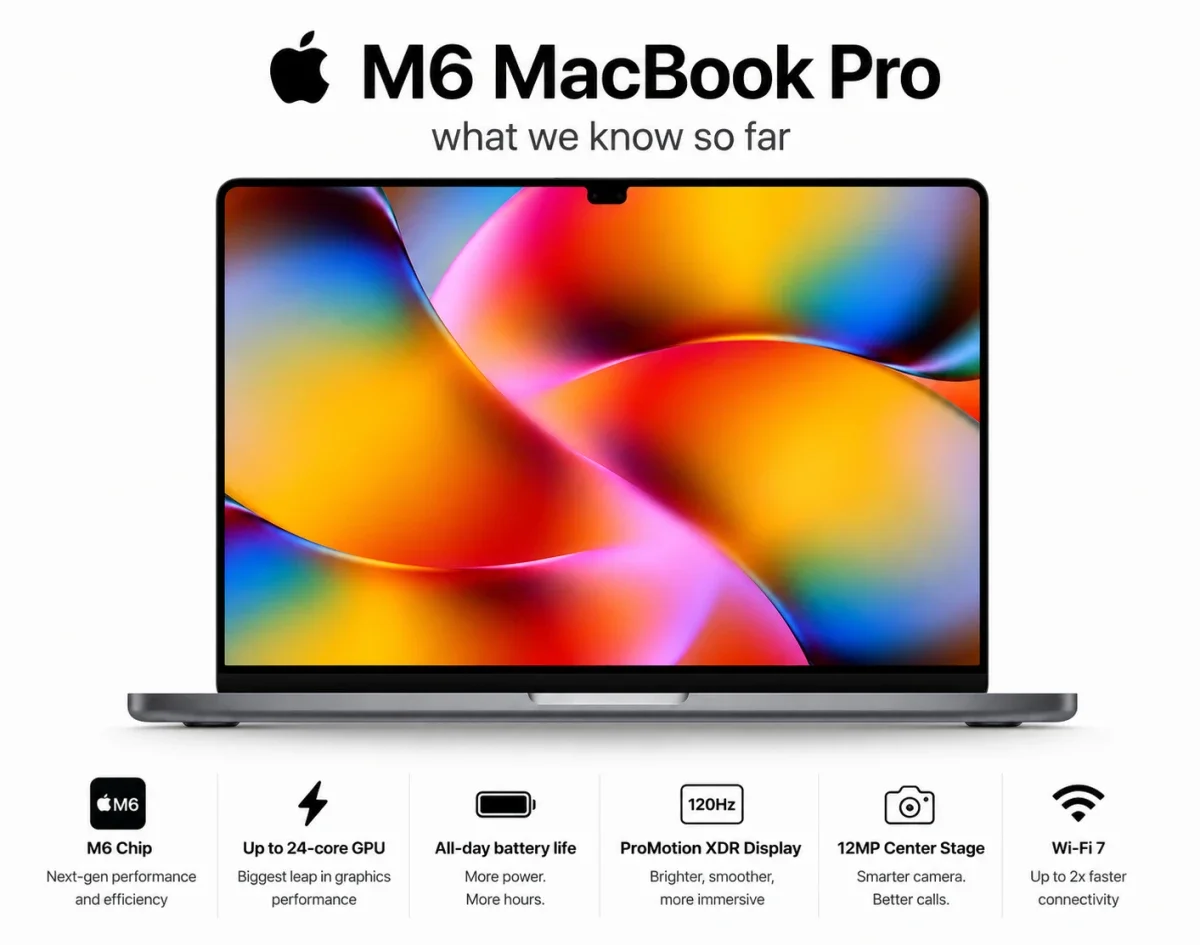
Quick Facts: MacBook Pro M6 at a Glance
MacBook Pro M6 – Quick Facts
14.3-inch and 16.3-inch display sizes
Tandem OLED display technology
First-ever touchscreen MacBook Pro
Punch-hole camera cutout (replacing the notch)
Powered by M6 Pro and M6 Max chips
Built on advanced TSMC 2nm process
Thinner and lighter design
5G cellular connectivity support
Expected launch: Q3/Q4 2026 or early 2027
Estimated starting price:
14-inch model: ~$2,499
16-inch model: ~$2,999
Current generation on sale: MacBook Pro with M5 Pro and M5 Max chips
Expected Upgrades Over Current MacBook Pro
Tandem OLED replaces Mini-LED display
Touchscreen support added for the first time
Punch-hole camera replaces display notch
Faster and more efficient M6 chip
Optional 5G connectivity
Thinner and lighter chassis
Potentially improved battery life due to OLED efficiency
Why WWDC 26 Has Every Mac Fan Paying Attention
Apple's Worldwide Developers Conference 2026 runs from June 8 to June 12, and the software announcements alone — iOS 27, macOS 27, a smarter Siri — would have made it a big event. But the hardware conversation running in parallel is even louder.
The MacBook Pro M6, which multiple credible sources suggest Apple may call the MacBook Ultra, is shaping up to be the most significant Mac redesign since 2021. I have been following Apple leaks and hardware cycles for years, and this particular machine is the one that genuinely has me reassessing what a laptop is supposed to be.
The device brings together three firsts for the Mac lineup: a touchscreen, an OLED display, and built-in cellular connectivity. Combine that with a next-generation chip built on TSMC's 2nm process, and you have a laptop that could redefine what professionals expect from a portable Mac.
In this guide, I break down every confirmed rumor, explain what the specs actually mean for everyday use, and tell you honestly whether this machine is worth waiting for — or whether you should pick up an M5 MacBook Pro today.
The MacBook Ultra: A New Tier, Not Just a New Model
One of the most important things to understand about the MacBook Pro M6 is that it may not actually be called the MacBook Pro at all.
Bloomberg's Mark Gurman — the most reliable Apple reporter in the business — first floated the "MacBook Ultra" name in early 2026. The idea is that Apple wants to position this OLED, touchscreen machine as something above the MacBook Pro, not a replacement for it. Think of it the way Apple Watch Ultra sits above Apple Watch Series: same DNA, different tier.
According to reporting from MacRumors, the M5 Pro and M5 Max MacBook Pro models released in March 2026 will remain on sale alongside the new Ultra. Apple is deliberately running two premium laptop lines, which makes strategic sense. The Ultra satisfies the "give me everything" buyer. The MacBook Pro satisfies the professional who wants proven performance at a slightly lower entry point.
From my perspective, this is smart positioning. If Apple had replaced the MacBook Pro entirely with the Ultra, it would have forced every professional buyer to pay a steep premium for features — touchscreen, OLED — they may not need. Keeping both alive gives buyers a real choice.
► MY POV: I think calling it the MacBook Ultra is the right call for Apple. The "Pro" branding has been stretched thin for years. A distinct Ultra tier signals that this machine is in a different conversation entirely — closer to a workstation-in-a-laptop than a premium notebook. If Apple prices it correctly, this could become the machine that finally pulls serious creative professionals away from Windows alternatives.
MacBook OLED Screen: What "Tandem OLED" Actually Means
The display is the centerpiece of the whole redesign, and it deserves a proper explanation — not just a spec sheet entry.
Apple's current MacBook Pro models use mini-LED displays, branded as Liquid Retina XDR. These are excellent panels. But OLED is a fundamentally different technology, and the specific type Apple is using — Tandem OLED — is the most advanced variant available.
In a standard OLED screen, each pixel generates its own light. That gives you perfect blacks and stunning contrast. The limitation is brightness: pushing a single OLED layer too hard reduces lifespan. Tandem OLED stacks two OLED panels on top of each other, effectively doubling the light output while keeping each individual layer running at a safe intensity.
Apple already uses Tandem OLED in the M4 iPad Pro, where the display delivers 1,000 nits of sustained brightness and a 2,000,000:1 contrast ratio. The MacBook Pro M6 is expected to use the same architecture, according to Macworld's reporting.
A new industry report from research firm Omdia, published this week, added a significant detail: Apple is actually targeting a more advanced "hybrid OLED" architecture — combining oxide TFT with RGB tandem OLED technology. The goal is better power efficiency than even standard tandem OLED. In practical terms, that means an exceptional display that does not punish your battery life.
Samsung Display is reportedly manufacturing the panels. Production is said to have begun in May 2026, with panel sizes confirmed at 14.3 inches and 16.3 inches — slightly larger than the current 14.1 and 16.2-inch MacBook Pro screens.
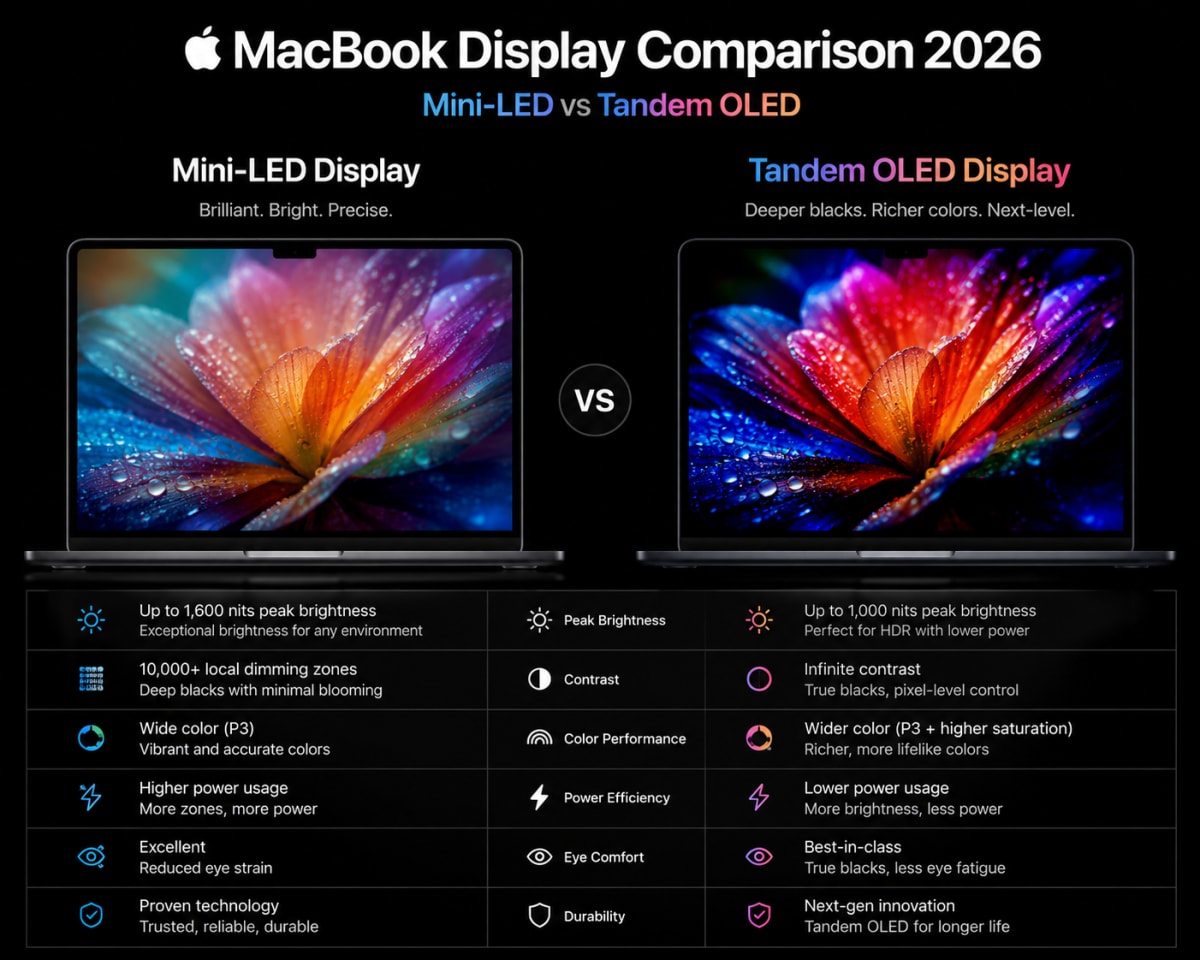
[IMAGE 2: Side-by-side comparison of mini-LED vs tandem OLED display technology | ALT TEXT: MacBook OLED screen vs mini-LED display comparison 2026]
What Others Miss About the OLED Upgrade
Most articles focus on the visual improvement of OLED — the better blacks, the richer colors. What they tend to skip is the structural benefit.
OLED panels are significantly thinner than LCD or mini-LED assemblies. The removal of the backlight layer alone reduces panel thickness considerably. This is a major reason why the MacBook Ultra is expected to have a thinner and lighter chassis than the current MacBook Pro — the display itself is physically slimmer. It is not just a spec improvement; it is what makes the redesign possible.
Touch Screen MacBook: Apple Finally Changes Its Mind
For over a decade, Apple's official position was clear: touchscreens do not belong on laptops. Former Apple executive Phil Schiller famously called the concept "ergonomically terrible" in 2010. The company held that line through every MacBook generation, while the rest of the industry moved toward hybrid touch-enabled machines.
That position is now officially over.
Multiple sourced reports confirm that the MacBook Pro M6 (MacBook Ultra) will be the first Mac in history with a touchscreen. And critically, macOS 27 — announced at WWDC 26 — is expected to include native touch support, with a dynamic interface that shifts between touch-optimized and pointer-optimized modes depending on how you interact with the screen.
This is not a half-measure. Apple is not bolting a touch layer onto an unchanged OS. The software and hardware are designed together.
From a practical standpoint, the touchscreen adds the most obvious value for:
Creative professionals doing illustration or photo retouching, who currently need a separate iPad or Wacom tablet.
Presenters and educators who want to annotate directly on screen during a session.
Anyone who has ever instinctively reached for a laptop screen, which, honestly, is most of us at some point.
The Dynamic Island replaces the current display notch — bringing the iPhone's familiar pill-shaped cutout to the Mac for the first time. This houses the front camera and associated sensors in a smaller, less obtrusive package.
► MY POV: I was genuinely skeptical about a MacBook touchscreen for years. My concern was always that reaching up to touch a laptop screen gets tiring fast — what's called "gorilla arm" fatigue. But Apple's approach of building macOS touch support natively, rather than shoehorning it in, changes the calculus. If the software is designed around touch as a secondary input — not the primary one — it could actually work beautifully. I am cautiously optimistic.
The M6 Chip: What TSMC's 2nm Process Really Delivers
The chip powering all of this is the M6, and its foundation is TSMC's 2-nanometer process node — a full node shrink from the 3nm process used in the M5.
Here is why that matters in plain terms. "2nm" does not literally refer to a 2-nanometer transistor size; the number is more of a generation label. What it means in practice is that TSMC can pack more transistors into the same physical space while running them at lower power. More transistors means more performance. Lower power means better battery life and less heat.
Independent analysts estimate the M6 will deliver approximately 15 to 20 percent better CPU performance and around 30 percent improved power efficiency compared to the M5, based on the die shrink alone — before any architectural improvements Apple adds on top.
The MacBook Ultra is expected to ship with the M6 Pro and M6 Max variants. A base M6 configuration is reportedly not planned for the OLED model; that chip may appear in a separate, more affordable MacBook Pro without the touchscreen and OLED. This is consistent with how Apple has tiered its chip lineup in previous generations.
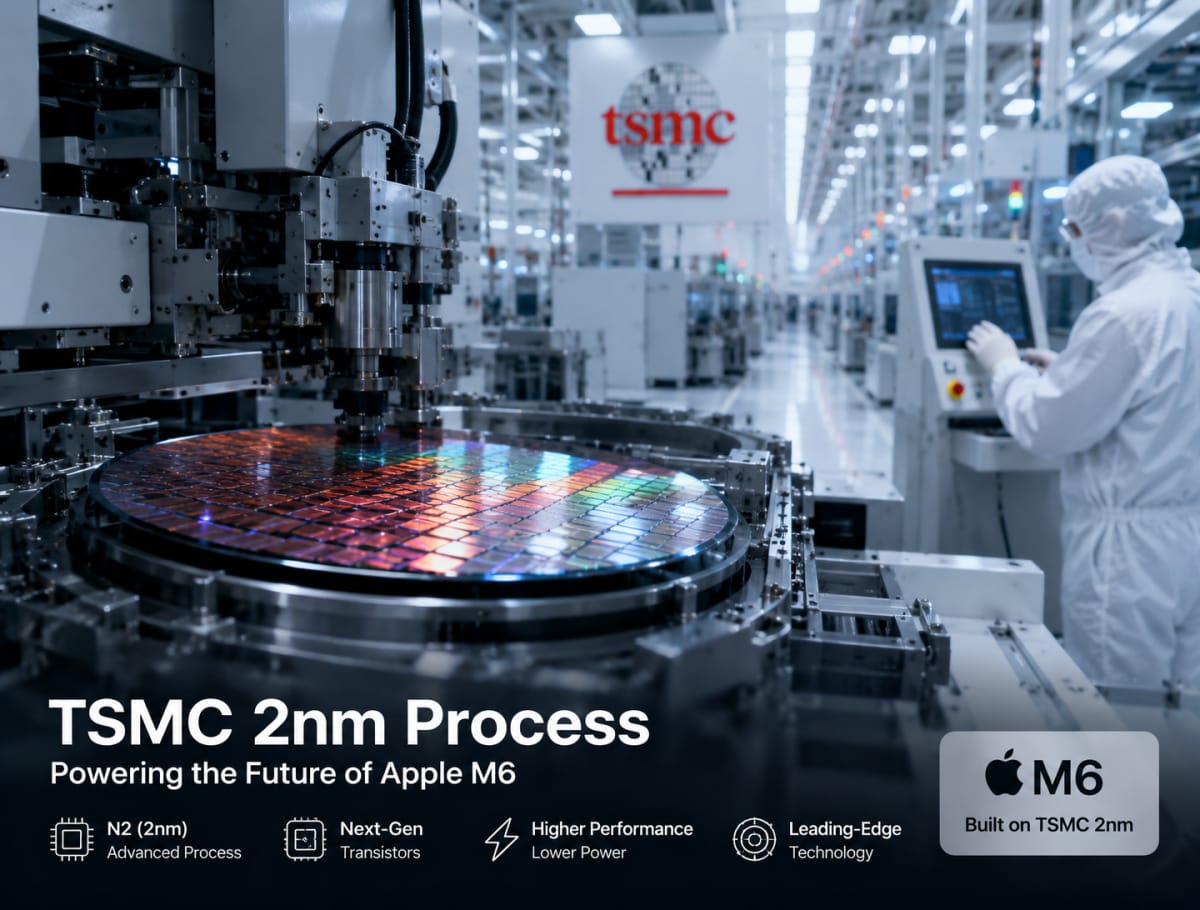
[IMAGE 3: TSMC 2nm chip wafer manufacturing facility | ALT TEXT: TSMC 2nm process chip production for Apple M6]
The M6 chip architecture is also expected to feature tightly integrated CPU, GPU, DRAM, and Neural Engine components in a single package — a refinement of Apple's existing unified memory architecture that should further reduce latency between components.
Built-In 5G: The Feature No One Is Talking About Enough
Cellular connectivity on a MacBook is not entirely new as a concept — it has been rumored for years — but the MacBook Ultra appears to be the machine where Apple actually ships it.
According to multiple reports, the device will include built-in 5G and LTE via Apple's own C2 modem. Apple spent years developing its own modem technology, and it already ships in recent iPhone models. Bringing that modem to the Mac makes the MacBook Ultra genuinely untethered: no hotspot needed, no carrier adapter dongle, just a SIM or eSIM and an always-on connection.
For remote workers, frequent travelers, and anyone who has ever scrambled to find reliable Wi-Fi before a video call, this is a real quality-of-life upgrade. The cellular connection does not replace Wi-Fi when it is available, but it provides a seamless fallback that the current MacBook lineup simply cannot offer.
MacBook Pro M6 vs MacBook Pro M5: Should You Wait or Buy Now?
This is the question I get asked most often, so let me answer it directly.
MacBook Pro M5 (Current) | MacBook Ultra M6 (Upcoming) | |
|---|---|---|
Display | Mini-LED (Liquid Retina XDR) | Tandem OLED |
Touchscreen | No | Yes |
Chip | 3nm M5 Pro / M5 Max | 2nm M6 Pro / M6 Max |
Cellular | No | 5G / LTE |
Dynamic Island | No (notch) | Yes |
Available Now | Yes | Q3/Q4 2026 or early 2027 |
Starting Price | ~$1,999 | ~$2,499 (est.) |
Design | 2021 chassis (unchanged) | Fully redesigned, thinner |
The M5 MacBook Pro is genuinely excellent. If you need a machine now — for a job, a project, or because your current Mac is failing — buy the M5 without hesitation. It is fast, it has outstanding battery life, and its mini-LED display is among the best panels on any laptop.
But if you can wait six to twelve months and your current machine is functional, the MacBook Ultra offers a generational leap that is harder to justify skipping. The OLED display alone would be worth the wait for anyone doing color-critical work. The touchscreen and 5G add two entirely new use-case dimensions.
Release Date and Pricing: What the Supply Chain Tells Us
The release timeline has shifted a few times, and it is worth being transparent about why.
The original expectation was a late 2026 launch — specifically October or November, possibly alongside the iPhone 18. A supply chain report from Omdia, published this week, suggested Q3 2026 is possible, with Samsung beginning to ship display panels as early as July.
However, Bloomberg's Gurman injected uncertainty earlier this year: a global memory chip shortage has constrained Apple's supply of RAM, and early 2027 is now a realistic alternative timeline. Gurman has said the shortage could push the launch to "late January" of next year.
My read: plan for a Q4 2026 announcement with Q1 2027 shipping. That is the most defensible position given the conflicting signals.
On pricing, the pattern is consistent across sources. Apple raised prices roughly 20 percent when it introduced OLED to the iPhone X in 2017 and the iPad Pro in 2024. Apply that math to the current MacBook Pro:
14-inch MacBook Ultra: estimated ~$2,499
16-inch MacBook Ultra: estimated ~$2,999
Fully configured 16-inch: potentially $5,000 or more
For context, the current 16-inch MacBook Pro with M5 Max starts at around $3,999.
Common Mistakes to Avoid Before Buying
Mistake 1: Assuming the MacBook Ultra replaces the MacBook Pro. It does not. Apple will sell both. If you do not need OLED or touch, the M5 MacBook Pro remains a top-tier choice.
Mistake 2: Expecting the base M6 MacBook Pro to have all these features. Early reports suggest the standard M6 chip will appear in a conventional MacBook Pro without OLED or touchscreen. Only the M6 Pro and M6 Max Ultra models get the full redesign.
Mistake 3: Buying an M4 MacBook Pro right now. The M5 models launched in March 2026 and represent the current generation. The M4 is a step behind. If you are buying today, go M5.
Mistake 4: Treating the launch timeline as fixed. Memory chip shortages are real and ongoing. Do not make financial decisions — selling your current machine, delaying a work purchase — based on a Q3 2026 date that may slip.
Mistake 5: Overlooking the MacBook Air M5 if budget matters. The MacBook Air with M5 also launched in 2026 and is an exceptional machine for most users who do not need Pro-level performance. The Ultra is not for everyone.
Key Takeaways
The MacBook Pro M6 is expected to be rebranded as the MacBook Ultra, positioned above the MacBook Pro rather than replacing it.
It will be the first Mac with a touchscreen and the first with an OLED display — powered by Samsung's tandem OLED panels in 14.3-inch and 16.3-inch sizes.
The M6 chip on TSMC's 2nm process is estimated to bring 15 to 20 percent better CPU performance and 30 percent improved efficiency over M5.
5G connectivity via Apple's C2 modem makes this the first fully untethered MacBook.
The Dynamic Island replaces the notch, matching the iPhone design language.
Pricing starts around $2,499, reflecting roughly a 20 percent premium over the current M5 MacBook Pro.
Launch timing is Q3/Q4 2026 at best, early 2027 if memory chip supply remains constrained.
Conclusion: Is the MacBook Pro M6 Worth Waiting For?
For most people who need a laptop now, the answer is to buy the M5 MacBook Pro today. It is an outstanding machine that will serve you well for years.
But for those who can hold on — creative professionals, power users, anyone doing video editing, 3D work, or color-critical design — the MacBook Ultra with M6 represents a genuine step change. The OLED display alone is a reason to wait. The touchscreen and cellular connectivity are bonuses that make this machine fundamentally more versatile than anything Apple has shipped in a MacBook before.
This is the first time in years I have felt that waiting is the objectively correct advice for a significant portion of Mac buyers. If your current machine can hold out through the end of 2026, I would strongly encourage you to do so.
Want to stay updated on the MacBook Ultra launch? Bookmark this page — I will update it as new information comes in from WWDC 26 and beyond.
FAQs
What is the MacBook Pro M6 release date?
The most likely window is Q3 or Q4 2026, with a possible slip to early 2027. Bloomberg's Mark Gurman cited the global memory chip shortage as the key variable. Samsung is reportedly already producing OLED panels, so the display supply is not the bottleneck.
Does the MacBook Pro M6 have 5G?
Yes, built-in 5G and LTE via Apple's C2 modem is one of the confirmed expected features of the MacBook Ultra. This would make it the first MacBook with native cellular connectivity.
Should I buy an M5 MacBook Pro now or wait for M6?
If you need a machine urgently, buy the M5 MacBook Pro — it is excellent. If your current Mac is functional and can last through late 2026 or into 2027, waiting for the MacBook Ultra makes sense for anyone doing color-critical work, creative design, video editing, or anyone who wants cellular connectivity and a touchscreen.
How much will the MacBook Pro M6 (MacBook Ultra) cost?
Estimated pricing starts around $2,499 for the 14-inch and $2,999 for the 16-inch. Fully configured models will cost significantly more. Apple historically raises prices by roughly 20 percent when it introduces major display upgrades, which explains the premium over current models.
Is the MacBook Ultra the same as the MacBook Pro M6?
It appears to be a rebrand and repositioning rather than a straight replacement. The MacBook Ultra is expected to sit above the MacBook Pro in Apple's lineup, with the M5 MacBook Pro remaining on sale as the more affordable professional option.
What is the MacBook OLED screen like?
It uses a tandem OLED architecture — the same type used in the M4 iPad Pro — delivering perfect blacks, exceptional contrast, and high sustained brightness. Apple is reportedly using an advanced hybrid OLED variant designed for improved power efficiency. Sizes are 14.3 and 16.3 inches.
Will the MacBook Pro M6 have a touchscreen?
Yes, according to multiple sourced reports. The MacBook Ultra (the M6 Pro / M6 Max model) will be the first Mac ever to include a touchscreen. macOS 27 is expected to include native touch input support.
Was this article helpful?

Written By
Rahul SharmaContributing Writer
Throughout my career, I’ve had the privilege of partnering with businesses ranging from scrappy startups to established brands, helping them increase their organic traffic and engage their target audience. I thrive on translating complex ideas into clear, compelling, and readable prose
Comments (0)
Leave a Comment
Read Next

Tue Apr 21 2026
Leaks & Rumors: Apple MacBook M6 with Touch Screen: My 2026 Leaks Expectations
As a tech journalist with 15+ years testing Apple gear, I break down the buzz around the Apple MacBook M6 with touch screen. Expect OLED touch displays, M6 chip leaps in AI tasks, and pricing from $1,099. I compare it to MacBook Air M6 and Pro M6, share my insights on battery life and workflows
Fri Apr 03 2026
Leaks & Rumors: MacBook Neo vs MacBook Air M5: Which One Should You Buy ?
Apple launched two MacBooks in March 2026. The Neo starts at $599 with an A18 Pro chip great for light users. The Air M5 starts at $1,099 with M5, 16GB RAM, and Thunderbolt 4 built for serious work. One is a smart buy. The other is a smarter one.
Tue Apr 07 2026
Leaks & Rumors: Macbook Neo Rumors : 3 Months Later - Honest Expectations
I have been using the MacBook Neo for three months now. The MacBook Neo is really good for things I do every day. It is perfect for people who do not need a lot of power. The MacBook Neo has some problems though. For example the MacBook Neo charges slowly & the MacBook Neo doesn't have a keyboard.