California Subpoenas Nvidia Over Huang and China Chips

Published (Updated )
The quick answer
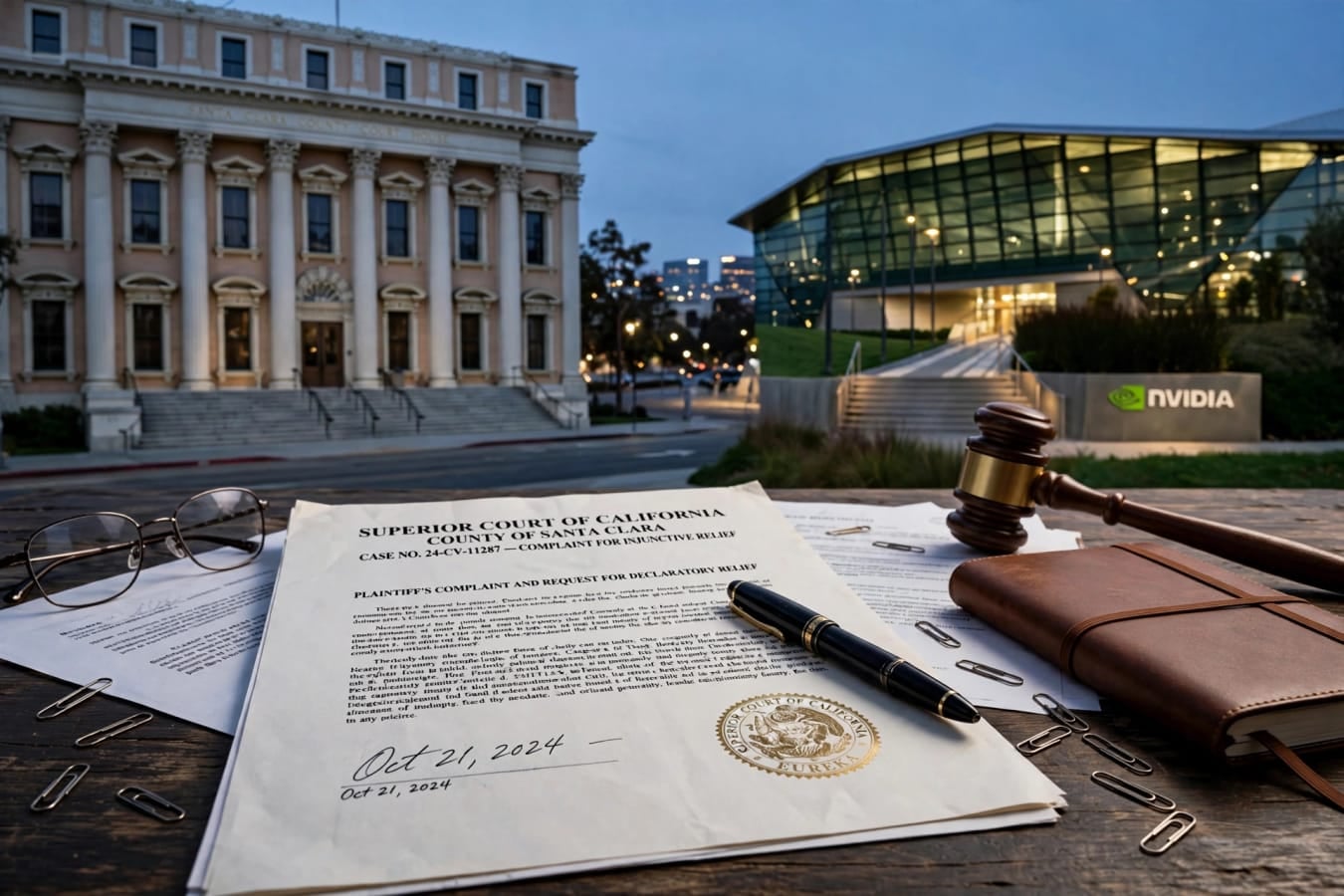
- California Attorney General Rob Bonta has served Nvidia with an investigative subpoena, the state Department of Justice announced on Thursday, November 19, 2026.
- The probe asks two questions: did Nvidia's advanced chips, or confidential information, reach China, and did Nvidia mislead investors and the public about that risk?
- The investigation follows reports about former chief executive Jensen Huang and a businesswoman US authorities suspect of working for Chinese intelligence.
- No charges have been filed. A subpoena is a demand for documents and information, not a finding of wrongdoing, and Nvidia has not been accused of a crime at this stage.
- Huang is due to appear before congressional committees on December 1, and Nvidia's general counsel Tim Teter is due on December 2. The detail matters here, because this case sits at the intersection of three of the biggest stories in technology right now: the export of America's most powerful AI chips, the sudden fall of one of the industry's most famous chief executives, and a stock market that has spent the past week sliding.
What California is actually investigating
The California Department of Justice said its investigation centres on whether Nvidia or Jensen Huang's actions resulted in China obtaining advanced chips or confidential information. It also examines whether Nvidia misled investors and the public about that risk, in violation of California corporate securities law. Bonta put it directly in the announcement:
- "My office is investigating whether Nvidia or Jensen Huang's actions resulted in China obtaining advanced chips or confidential information — and if Nvidia misled investors and the public about this risk, in violation of the law." There are two distinct strands to that sentence, and it is worth keeping them separate.
- The first is about the chips themselves: did advanced Nvidia hardware, or sensitive company information, end up in China in ways that should not have happened?
- The second is about disclosure: did Nvidia tell investors and the public the truth about the risk that it might? The second strand is the one that carries the legal weight under California corporate securities law. Companies are not only judged on what they did, but on whether they were straight with shareholders about the risks they faced. A probe of this kind typically starts with demands for internal documents, emails, board minutes and sales records, and it can take months before investigators decide whether any law was broken. A subpoena does not require the state to prove anything first. It is the tool investigators use to gather evidence, and an investigation is not a charge.
Why this happened now
The subpoena did not come out of nowhere. It follows a remarkable two weeks for Nvidia, in which the world's most valuable chipmaker lost its founder-chief executive, saw its board open an independent investigation, and watched its shares slide alongside the wider market. The sequence of events, as reported, runs like this:
- November 8, 2026: Nvidia's board launches an independent investigation.
- November 12, 2026: Jensen Huang resigns as chief executive.
- November 17, 2026: On Nvidia's earnings call, interim chief executive Colette Kress confirms that the company has halted licensed H200 chip sales to China.
- November 17-18, 2026: Reports emerge that the US Securities and Exchange Commission is probing Nvidia's disclosures.
- November 19, 2026: California serves its investigative subpoena on Nvidia.
- December 1, 2026: Huang is due to appear before congressional committees.
- December 2, 2026: Nvidia general counsel Tim Teter is due before Congress. The thread connecting the board investigation and Huang's resignation to the subpoena is a reported affair between Huang and Alice Huang, a businesswoman who US authorities suspect of working for Chinese intelligence. That suspicion is an allegation made by US authorities, not a proven fact, and it is important to say so plainly. What has not been established publicly is the precise link, if any, between that relationship and the movement of Nvidia chips or information to China. That is what investigators in California and Washington are now trying to find out. Board chair Harvey Jones has said the board does not intend to reinstate Huang as chief executive. Kress, formerly Nvidia's chief financial officer, is running the company on an interim basis while the board decides on a permanent successor.
The China chip question
At the heart of the California probe is a question that has dogged the entire American chip industry for years: how do you stop the world's most powerful AI hardware from reaching a country the US government does not want to have it?
Nvidia's chips are the engines of the artificial intelligence boom. Its data-centre graphics processors train the large language models behind chatbots, coding assistants and image generators, and they power the cloud services that sell that computing power by the hour. The US government has spent years tightening the rules on which chips can be sold to China, and under what conditions. The numbers involved are large:
- Nvidia reported about $2.4 billion in licensed Hopper chip sales to China in the quarter that ended October 25, 2026.
- Roughly 600,000 H200 chips are reported to be held in Hong Kong, waiting for permission to enter China.
- Kress confirmed on the November 17 earnings call that licensed H200 sales to China have now been halted.
- Nvidia's guidance for the current quarter assumes zero revenue from Hopper sales to China. Those figures explain why the stakes are so high. China has been one of Nvidia's biggest markets, and at the same time one of its most restricted. Licensed sales were permitted under a deal struck between the Trump administration and Huang, under which the US government takes a cut of the revenue. But the rules have kept shifting, Beijing has been restricting imports and pushing domestic chipmakers, and Nvidia has now stopped the licensed H200 shipments altogether. Investigators will want to know whether any chips reached China outside the licensed channels, and whether the company's public statements kept pace with what it knew privately. Those are the kinds of questions that document requests and interviews are designed to answer. It is also worth noting what the subpoena is not. It is not, on the information available, an accusation that Nvidia deliberately shipped banned chips to China. It is an investigation into whether that happened, and whether investors were misled about the risk.
How this differs from the SEC probe
Readers who have followed the Nvidia story may feel a sense of déjà vu. That is because a separate federal probe was reported only days earlier.
- The Securities and Exchange Commission was reported on November 17-18 to be examining Nvidia's disclosures in the wake of Huang's exit.
- The California subpoena, announced November 19, is a separate, state-level investigation.
- The two probes can run in parallel, and they can look at overlapping facts under different laws.
- The SEC enforces federal securities law. California's attorney general enforces state corporate securities law. This article is about the California subpoena as a new and distinct development. The SEC probe is context, not the story here, and it has already been covered in a separate TechOrCoffee article. The fact that two regulators are now looking at Nvidia's disclosures at the same time raises the pressure on the company, but it does not by itself prove that either investigation will lead to charges. Regulators frequently open parallel inquiries after a high-profile corporate crisis, and many of them close without action. Bonta has also told Politico that more subpoenas could follow. That suggests the California investigation may widen beyond Nvidia itself, although it is not yet clear who else might receive one.
What Nvidia has said, and what it has not
Nvidia did not immediately respond to requests for comment on the California subpoena. That is not unusual in the first hours after a regulatory announcement, and silence at this stage should not be read as an admission of anything. What the company has said publicly in recent days has come mainly through its earnings call and through the board:
- Kress confirmed the halt to licensed H200 sales to China on the November 17 earnings call.
- The board has created a new committee focused on national security and export controls.
- Board chair Harvey Jones has said the board does not intend to bring Huang back as chief executive.
- The company has not commented publicly on the specifics of the California investigation. The new board committee on national security and export controls signals that Nvidia's directors now treat export compliance as a board-level issue.
The congressional dates to watch
Huang is due to appear before congressional committees on December 1, and general counsel Tim Teter is due on December 2. Those hearings are likely to be the next big public moment in this story. Congressional hearings are not courtrooms, and lawmakers cannot file charges. But they can put executives under oath, demand documents, and create a public record that regulators and investors will read closely. For Huang, who built Nvidia from a graphics-chip startup into the most valuable company in the world, the appearance will be his first major public outing since his resignation. What lawmakers ask, and what Huang and Teter say in response, could shape the direction of both the California and federal investigations. It could also shape how the public understands the affair allegations and the chip-export questions that now surround them. For now, the key dates are:
- December 1: Huang appears before congressional committees.
- December 2: General counsel Tim Teter appears before Congress.
- Ongoing: California's investigation continues, with further subpoenas possible.
A rough week for the market
The subpoena landed in a market already under pressure. On Friday, November 20, the Nasdaq fell roughly 3.7 to 4.5 percent, wiping out its gains for 2026, according to market reports. The S&P 500 fell roughly 2.3 to 3 percent in its seventh straight down day. The Dow had dropped about 1,100 points the day before, falling below 50,000 for the first time since June. Nvidia is not the only reason markets fell. Investors have been worried for weeks about high valuations in AI stocks, about the cost of building data centres, and about whether the returns on AI investment will arrive as quickly as the spending. Anthropic's shares also fell sharply on Friday. But Nvidia, as the company most closely associated with the AI boom, sits at the centre of that anxiety, and a regulatory subpoena aimed at its former chief executive is not the kind of news that calms it.
What this means for investors
For investors, the California subpoena adds a new layer of risk to a stock that already had plenty of it. There are a few things worth keeping in mind:
- Investigations take time. A subpoena is the beginning of a process, not the end. California's inquiry could run for months, and it may end with no action at all.
- Disclosure is the legal issue. The securities-law question is not only about chips, but about what Nvidia told investors and when. That is a narrower question than the headlines sometimes suggest, and it will turn on documents and timelines.
- China revenue is already written down. Nvidia's own guidance assumes no Hopper revenue from China in the current quarter, so the market has already adjusted to a world in which that business is effectively paused.
- Leadership is the open question. Kress is interim chief executive, and the board has not named a permanent successor. Whoever takes the job will inherit both the investigations and the export-control headaches.
- Congress comes first. The December 1 and 2 hearings will give investors their first detailed public account of what happened, and the market will be watching closely. None of this is investment advice, and none of it predicts the outcome of the investigations.
What this means for the wider chip industry
Nvidia is not the only company caught between Washington's export rules and Beijing's ambitions, but it is the most prominent. What happens to Nvidia will be read as a signal by every other chipmaker that sells into China, or wants to.
A few wider points stand out:
- Export controls are getting tighter, not looser. The US Commerce Department has moved in recent weeks to close loopholes that let advanced chips reach Chinese customers through foreign data centres. That trend is unlikely to reverse.
- Licensed sales are fragile. The H200 episode shows that a licence to sell does not guarantee the chips will actually ship. Political pressure, import restrictions in Beijing, and corporate caution can all stop a deal that was approved on paper.
- Boards are getting involved. Nvidia's new national-security committee is part of a broader pattern in which chip company boards are treating export compliance as a top-level governance issue.
- The US-China chip rivalry is now personal. The Huang affair allegations have turned a policy debate about export controls into a story about an individual executive and his relationships. That makes the story more dramatic, but it also makes it harder to separate fact from speculation — which is precisely why investigators are involved. For consumers, the direct impact is limited: the chips at issue are data-centre processors, not gaming graphics cards, and the subpoena does not affect product availability.
What happens next
The story will move quickly in the next two weeks. Here is what to watch:
- December 1: Huang's congressional appearance. Expect questions about the affair allegations, about chip exports to China, and about what the board knew and when.
- December 2: Teter's appearance. As general counsel, he is likely to face questions about Nvidia's disclosures and its compliance systems.
- Further subpoenas: Bonta has said more could follow. Watch for whether other individuals or companies receive them.
- Nvidia's response: The company has not yet commented on the subpoena in detail. A formal statement, or a filing with the SEC, would be the next signal of how it intends to handle the investigation.
- The board investigation: The independent inquiry launched on November 8 is still running. Its findings, when they emerge, could be significant.
- The SEC probe: The federal investigation reported on November 17-18 is separate, but its progress will be watched alongside California's. For now, the facts are these: California has subpoenaed Nvidia, the investigation covers whether advanced chips or confidential information reached China and whether investors were misled, no charges have been filed, and the company's former chief executive is due before Congress in less than two weeks. Everything else — including the question of what actually happened — is still to be established.
FAQs
What has California accused Nvidia of?
Nothing yet. California has served an investigative subpoena, which is a demand for documents and information. No charges have been filed, and an investigation is not a finding of wrongdoing.
What is the California investigation about?
It asks whether Nvidia's advanced chips or confidential information reached China, and whether Nvidia misled investors and the public about that risk, in violation of California corporate securities law.
Who is Alice Huang, and what is alleged?
Alice Huang is a businesswoman reported to have had an affair with former Nvidia chief executive Jensen Huang. US authorities suspect her of working for Chinese intelligence. That suspicion is an allegation, not a proven fact, and the link, if any, to Nvidia chips is what investigators are examining.
How is this different from the SEC probe?
The SEC probe, reported on November 17-18, is a federal investigation into Nvidia's disclosures. The California subpoena, announced November 19, is a separate state-level investigation under California corporate securities law. The two can run in parallel.
When will Jensen Huang appear before Congress?
Huang is due to appear before congressional committees on December 1, 2026. Nvidia general counsel Tim Teter is due on December 2, 2026.
Does the subpoena affect Nvidia's products or share price?
The subpoena does not affect the availability of Nvidia's consumer products. Nvidia's shares have fallen along with the wider market, but a subpoena alone does not prove wrongdoing, and the investigations could take months to conclude.
Was this article helpful?

Written By
TechorCoffeeContributing Writer
TechorCoffee is a technology reporter and software creator writing reviews and tutorials for TechOrCoffee.
Comments (0)
Leave a Comment
Read Next
Fri Oct 30 2026
GPU and RAM Prices 2026: Why AI Ate Your Upgrade
GPU and RAM prices in 2026 explained: AI memory shortage, DDR5 and RTX 50 price rises, RTX 50 Super delay, and when relief may come.
Thu Nov 12 2026
Jensen Huang Resigns as NVIDIA CEO: Colette Kress Takes Over
Jensen Huang resigns as NVIDIA CEO, with CFO Colette Kress named interim chief as the company faces an investigation and leadership transition.
Thu Nov 12 2026
Jensen Huang Resigns as Nvidia CEO
Jensen Huang has resigned as Nvidia CEO after 33 years. Here is the full timeline, who Colette Kress is, how the stock reacted, and AI industry.