ChatGPT Down 3.5 Hours as 75% of Requests Failed Saturday

Published (Updated )
The quick answer
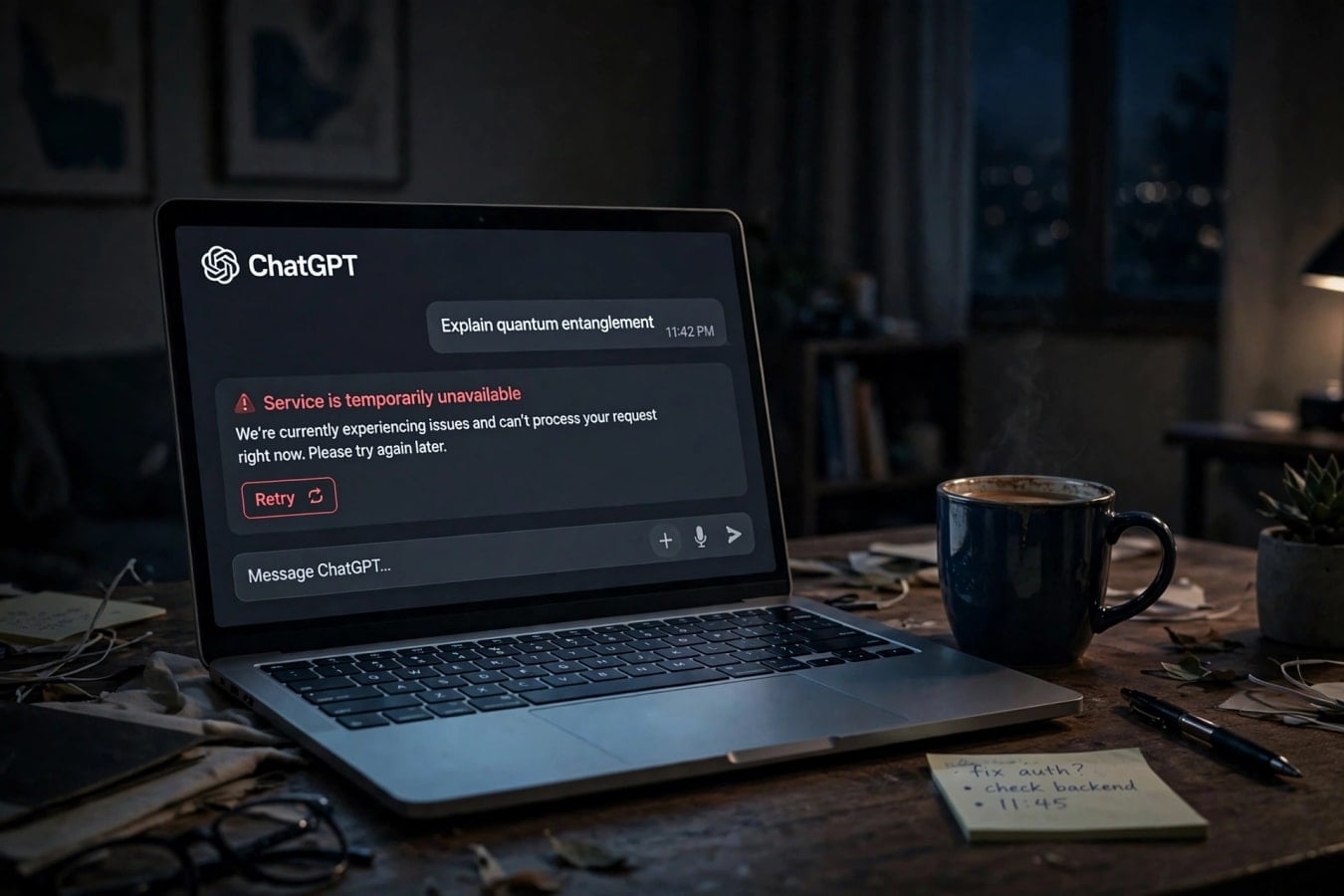
- ChatGPT went down on Saturday, Nov 21, 2026, for about 3.5 hours.
- Requests to ChatGPT and OpenAI's API failed at rates peaking at 75%.
- The outage ran from 1:48 p.m. to 5:21 p.m. Pacific time — 211 minutes in total.
- Both free and paid ChatGPT users were affected.
- The cause was routine database maintenance, not a cyberattack.
- A PostgresDB service used by OpenAI's Primary API service lost both of its read replicas at the same time.
- OpenAI brought two new replicas online and all systems were back to normal by Saturday evening.
- OpenAI published its own post-incident write-up the same day, Nov 21.
What happened on Saturday
- The problems started at 1:48 p.m. Pacific time on Saturday, Nov 21, 2026.
- Users trying to open ChatGPT found they could not sign in or load their conversations.
- Messages sent to the chatbot failed, and the app kept showing errors.
- Developers using OpenAI's API saw their requests fail too.
- At the worst point of the outage, 75% of requests were failing.
- That means three out of every four requests did not go through.
- The outage lasted 211 minutes — just over three and a half hours.
- Errors finally ended at 5:21 p.m. Pacific time.
- By Saturday evening in the US, and Sunday morning in the UK, everything was back to normal.
- OpenAI confirmed the recovery on its status page, status.openai.com.
- The company published a full post-incident write-up the same day, Nov 21.
What the outage times mean where you live
- The outage ran from 1:48 p.m. to 5:21 p.m. Pacific time.
- That is 4:48 p.m. to 8:21 p.m. Eastern time in the US.
- In the UK, it was 9:48 p.m. on Saturday night to 1:21 a.m. on Sunday morning.
- Most of Europe was affected during the late evening and early hours.
- The outage hit the US during a Saturday afternoon.
- That is prime time for weekend users catching up on work, homework and side projects.
- In the UK and Europe, it struck late on a Saturday night.
- Many people there would have been winding down for the evening.
- But developers and night owls across Europe still ran into errors.
- The timing meant the outage was felt on both sides of the Atlantic.
What broke inside ChatGPT
- The outage hit ChatGPT hard, for both free and paid users.
- Many users could not sign in at all.
- Others got in but could not load their past conversations.
- New chats failed to send, and replies never arrived.
- Search inside ChatGPT stopped working.
- File uploads failed during the outage window.
- Voice mode was affected too, so spoken conversations broke off.
- In short, the core of the product was unusable for hours.
- Paid subscribers got no better service than free users.
- The problem was in shared infrastructure, so paying did not help.
- That is one reason the outage frustrated so many people.
- ChatGPT has hundreds of millions of users, and many rely on it daily.
- A Saturday afternoon outage lands right in the middle of real work.

What broke on the API side
- The damage was not limited to the ChatGPT app and website.
- OpenAI's API, used by developers and businesses, was hit just as hard.
- These are the API services OpenAI said were affected:
- Chat Completions
- Fine-tuning
- Embeddings
- Images
- Batch
- Audio
- Moderations
- Realtime
- Files endpoint
- Chat Completions is the service that powers most AI apps built on OpenAI.
- Embeddings and Images sit behind search tools and image generators.
- The Realtime service powers live voice apps.
- Moderations is the safety filter many apps run before showing AI output.
- When all of these failed together, thousands of apps went dark at once.
- Any app that depends on OpenAI would have shown errors to its own users.
- That is why a single OpenAI outage can ripple across the internet.
Why it happened
- OpenAI says the outage was triggered by maintenance on a PostgresDB service.
- PostgresDB is a widely used open-source database system.
- The database service in question is used by OpenAI's Primary API service.
- The Primary API service handles user authentication.
- It also handles service-to-service authentication across OpenAI's whole stack.
- In plain terms, it is the gatekeeper that checks who you are and what you can use.
- The maintenance caused both read replicas of the database to fail at the same time.
- A read replica is a copy of a database that handles read requests.
- Replicas take load off the main database so it can keep up with demand.
- Normally, losing one replica is survivable — the other picks up the slack.
- Losing both at once is a different story.
- OpenAI said the replicas were "load-bearing".
- That means requests depended on them so heavily that their failure brought the service down.
- The primary database itself was not affected.
- But so many requests needed the replicas that the outage happened anyway.
- It is a reminder that a backup system can quietly become a single point of failure.
- OpenAI confirmed the diagnosis in a simple, decisive way.
- Engineers directed 100% of queries to the primary database instance.
- When the errors stopped following that change, the diagnosis was confirmed.
How OpenAI fixed it
- OpenAI worked with its database provider to bring new replicas into service.
- The company has not named the database provider involved.
- Two new read replicas were brought online in the same region.
- Once the new replicas were serving traffic, the errors ended.
- That happened at 5:21 p.m. Pacific time, 211 minutes after the outage began.
- OpenAI then watched the systems to make sure the recovery held.
- By Saturday evening, all systems were back to normal.
- The fix was a replacement, not a repair of the failed replicas.
- That is a common approach in cloud outages: swap in fresh capacity.
- It is faster than diagnosing and reviving broken database copies.
- The write-up does not say how long the new replicas took to build.
- But the total outage time suggests the recovery was not instant.
- Setting up database replicas involves copying large amounts of data.
- That copy has to finish before the replica can safely serve traffic.
What OpenAI is changing
- OpenAI says it has put a moratorium on similar maintenance until further notice.
- No maintenance of this kind will go ahead while the review is under way.
- The company also retuned its database settings.
- The aim is to reduce connection churn — the constant opening and closing of database connections.
- High connection churn can put extra strain on a database during maintenance.
- OpenAI has shipped a new feature flag as well.
- A feature flag is a switch that lets engineers change behaviour without new code.
- This one lets OpenAI shift traffic away from read replicas by percentage.
- That gives engineers a dial they can turn gradually instead of all at once.
- If replicas start struggling, traffic can be moved off them in stages.
- OpenAI is also adding a pre-maintenance review process.
- Every maintenance job will now need a review before it goes ahead.
- That review will include a rapid recovery plan.
- The plan spells out what to do if the maintenance goes wrong.
- Together, these changes target the exact chain of events that caused the outage.
- The moratorium stops a repeat in the short term.
- The feature flag and review process are meant to stop one in the long term.
Was it a cyberattack?
- No. OpenAI says this outage was caused by routine maintenance.
- There is no evidence of a cyberattack in OpenAI's write-up.
- The company published its account the same day, Nov 21.
- That speed is unusual for a major outage, and it helps rule out speculation.
- The timing may still raise eyebrows, because November 2026 has seen a run of big outages.
- Microsoft 365 suffered a major outage from Nov 12 to Nov 14.
- JPMorgan Chase was hit by an outage on Nov 16.
- Three major outages in ten days is a striking pattern.
- But a pattern is not proof of a common cause.
- OpenAI's explanation is specific, technical and checkable.
- A maintenance job, two failed replicas and a load-bearing database fit the evidence.
- Readers should not treat this outage as part of an attack campaign.
- What it does show is how fragile shared infrastructure can be.
- A single database service, maintained at the wrong moment, can take down one of the world's most used AI products.
- That is a reliability story, not a security story.
What users could do during the outage
- During the outage, there was no workaround inside ChatGPT itself.
- Signing out and back in did not help, because login was one of the broken services.
- Refreshing the page or restarting the app did not help either.
- The failure was on OpenAI's servers, not on users' devices.
- The best move was to check OpenAI's status page, status.openai.com.
- It carried live updates while the incident was under way.
- Users with urgent work had to switch to another tool.
- Rival chatbots such as Google Gemini, Anthropic Claude and Microsoft Copilot were unaffected.
- Developers could fall back to another AI provider if their apps supported it.
- Many apps do not, because they are built around one provider.
- That is the trade-off of building on a single platform.
- For most people, the practical answer was simply to wait.
- The outage ended after 3.5 hours, and conversations were intact afterwards.
- Chat history was not lost, because the primary database was never affected.

Why this outage matters
- ChatGPT is no longer a novelty — it is daily infrastructure for millions of people.
- Students use it for homework, workers for drafts and code, and businesses for customer service.
- An outage of 3.5 hours is a real disruption, not a minor glitch.
- A 75% failure rate means the service was effectively down, not just slow.
- The outage also shows how much of the AI economy runs through one company.
- Thousands of apps depend on OpenAI's API, and they all failed together.
- That concentration of risk is worth thinking about for anyone building on AI.
- The cause is a familiar one in the tech world: a routine job with an outsized blast radius.
- Maintenance is supposed to be safe, boring and reversible.
- This time it took down authentication for the whole stack.
- OpenAI's response has been unusually open and fast.
- A same-day write-up with a clear cause and a list of fixes is good practice.
- The test now is whether the promised changes actually prevent a repeat.
- Users will be watching the next maintenance window closely.
- For now, ChatGPT is back, and the lesson is clear: even the biggest AI service can be knocked offline by its own database.
FAQs
How long was ChatGPT down on Nov 21, 2026?
ChatGPT was down for about 3.5 hours, from 1:48 p.m. to 5:21 p.m. Pacific time — a total of 211 minutes. Requests failed at rates peaking at 75% during the outage.
What caused the ChatGPT outage on Nov 21, 2026?
Routine maintenance on a PostgresDB service used by OpenAI's Primary API service caused both of its read replicas to fail at the same time. The replicas were "load-bearing", so requests depending on them failed even though the primary database was not affected.
Was the ChatGPT outage a cyberattack?
No. OpenAI says the outage was triggered by routine database maintenance, not a cyberattack. The company published its post-incident write-up the same day, Nov 21, 2026.
Was the OpenAI API affected too?
Yes. Chat Completions, Fine-tuning, Embeddings, Images, Batch, Audio, Moderations, Realtime and the Files endpoint were all affected, along with ChatGPT features including login, conversations, search, file uploads and Voice mode.
What time was the ChatGPT outage in the US and UK?
The outage ran from 1:48 p.m. to 5:21 p.m. Pacific time, which is 4:48 p.m. to 8:21 p.m. Eastern time in the US, and 9:48 p.m. Saturday to 1:21 a.m. Sunday in the UK.
What is OpenAI doing to stop it happening again?
OpenAI has paused similar maintenance until further notice, retuned its database settings to reduce connection churn, shipped a feature flag to shift traffic away from replicas by percentage, and added a pre-maintenance review process with a rapid recovery plan.
Was this article helpful?
Explore Specs, Comparisons & Related Topics

Written By
TechorCoffeeEditorial Team
The TechOrCoffee Editorial Team covers consumer hardware, artificial intelligence, software engineering, and regional smartphone & laptop market analysis.
Comments (0)
Leave a Comment
Read Next
Tue Oct 13 2026
Gemini 4 Argon: Everything You Need to Know
Gemini 4 Argon is Google’s new flagship AI model. See its benchmarks vs GPT-6 Astra and Claude, pricing, 1M-token output, safety features and how to get access.

Fri Oct 30 2026
GPT-6.1 Terra: Faster Agents at Half the Price
OpenAI GPT-6.1 Terra explained: half-price API, faster computer use, 1.05M-token context, Codex and ChatGPT Work availability, benchmarks and safety limits.

Fri Oct 30 2026
Drupal Commerce Attack Puts Online Stores at Risk
Why attackers target e-commerce, what a Drupal Commerce attack costs merchants and customers, and what to watch next.