Devin Maker Cognition in Talks for $75 Billion Round

Published (Updated )

Quick answer
- Cognition, the startup behind AI coding agent Devin, is in talks to raise $2 billion or more at a $75 billion valuation, Bloomberg reported on November 20, 2026.
- The talks come about two months after Cognition raised more than $2 billion in a Series E round at a $48 billion valuation in September 2026.
- If completed, it would be Cognition's third funding round of 2026 and would lift the company's valuation by about 56% in two months.
- Existing investors are leading the interest, with Avenir, Accel, Lightspeed Venture Partners, Lux Capital and Bessemer Venture Partners in talks to contribute, according to people familiar with the matter.
- Cognition said in September it was on track to reach $1 billion in annualized revenue, roughly double its run rate from four months earlier.
- The deal is not done. The talks are ongoing, details could change, and the round could still fall apart or close at a different price.
- Cognition did not immediately respond to a request for comment on the report.
What Bloomberg reported
Bloomberg reported on Friday, November 20, 2026 that Cognition AI is in funding talks at a $75 billion valuation, citing people familiar with the matter who asked not to be identified because the discussions are private. Reuters carried the same report the same day.
The company is considering raising $2 billion or more in the financing, the people said. The efforts are ongoing, and details could change. Interest in the round has been dominated by existing investors, with Avenir, Accel, Lightspeed Venture Partners, Lux Capital and Bessemer Venture Partners in talks to contribute.
The speed of the sequence is the story. Cognition announced its most recent funding round in September 2026 — more than $2 billion at a $48 billion valuation, led by new investors Andreessen Horowitz and Accel alongside existing backers Founders Fund, General Catalyst and Avenir. Two months later, the company is back in the market at a valuation about 56% higher.
Cognition has now raised more than $3 billion in 2026 so far, according to Bloomberg's reporting. If the new round closes at the reported size, the total for the year would pass $5 billion — an extraordinary sum for a company founded in 2023.
What Cognition is, and why investors keep paying up
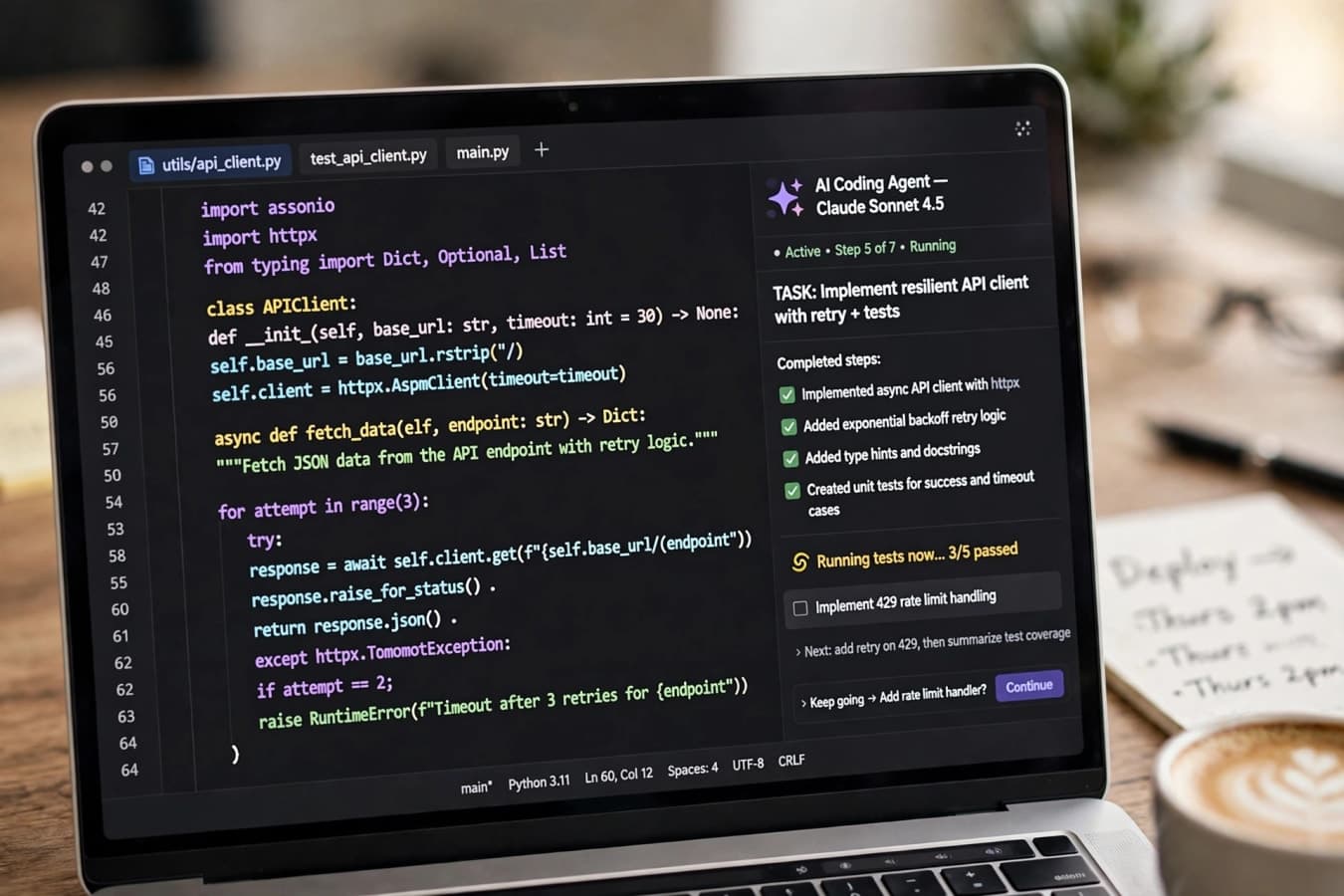
Cognition's flagship product is Devin, an AI engineering agent that can take a software task, plan the work, write the code, run tests and fix its own errors with limited human input. Where a coding assistant suggests the next few lines, Devin is sold as a teammate that takes on whole tickets: a bug report, a feature request, a migration.
The pitch has moved fast from demo to deployment. Cognition says it sells to companies including Citigroup and Nvidia, two customers named in Bloomberg's coverage. In September, the company said it was on track to reach $1 billion in annualized revenue, roughly doubling its run rate from four months prior. That pace — doubling revenue in about four months — is the number investors are really paying for.
The valuation arithmetic tells the same story. At $75 billion, Cognition would be valued at roughly 75 times that $1 billion annualized revenue figure. That is a rich multiple by any normal standard, and it only makes sense if investors believe the revenue line keeps doubling. In September, the same math at $48 billion was about 48 times revenue. The market has decided, twice in two months, that the growth is worth paying more for.
Devin's appeal is easy to see for a buyer. Software engineering is one of the largest cost centres in any technology company, and a tool that genuinely takes on whole engineering tasks — not just autocomplete — promises to change how many engineers a team needs and how fast it ships. Cognition's claim is that Devin does that work end to end, and its customer list now includes some of the most demanding engineering organisations in the world.
A market that keeps repricing itself
Cognition is not raising in a vacuum. The AI coding market has been one of the fastest-repriced corners of the whole AI boom, and the numbers around it keep moving in the same direction: up.
- Cursor, the rival. Cognition's most direct competitor is Cursor, the AI coding tool from Anysphere. SpaceX acquired Cursor earlier this year for $60 billion, according to Bloomberg. That deal set a benchmark for what a leading AI coding company is worth — and Cognition's reported $75 billion valuation would put it above that benchmark.
- Anthropic's record IPO. Anthropic priced its Nasdaq IPO at $83 a share on November 18, 2026, raising about $81.3 billion at a valuation near $1.5 trillion — the largest IPO on record. Its shares then plunged in the first days of trading as the wider AI sell-off hit, a reminder that public-market investors are less forgiving than private ones.
- The wider AI sell-off. The Nasdaq 100 had its worst week since the pandemic in the week ending November 20, 2026, with Nvidia falling 14% in a single day. Cognition's reported talks are happening in the middle of that turbulence, which makes the $75 billion figure more striking, not less.
- Amazon and Decart. Amazon is reported to be in advanced talks to buy Decart, a real-time video AI startup, for about $7.5 billion. Anthropic had earlier discussed a deal near $6 billion for Decart before walking away.
The pattern across all of these is the same: the biggest AI companies and the investors backing them are still willing to pay record prices for the teams and products they believe will define the next stage of the market. Cognition is now the latest test of that willingness.

The revenue question
The $1 billion annualized revenue figure is the anchor for the whole story, and it deserves a close look. Annualized revenue is not the same as annual revenue. It takes the company's revenue in a recent period — usually a month — and multiplies it to a yearly figure. It assumes the current pace holds for a full year, which it may not.
What is known is the direction. Cognition said in September that its run rate had roughly doubled in four months. If that pace continued, the company would be well past $1 billion by now. If it slowed, the figure would be lower. The company has not published audited financials, and as a private company it does not have to.
The customer names help. Citigroup is one of the largest banks in the world, with enormous software engineering needs and strict security requirements. Nvidia is the most valuable chip company in the world and one of the most demanding engineering organisations in technology. Selling to both suggests Devin is not a toy for hobbyists. It is a product that large, cautious buyers are willing to deploy.
But the revenue mix matters too, and it is not public. How much of that $1 billion comes from a few large enterprise contracts, and how much from thousands of smaller customers? How much is recurring, and how much is one-off? How much does it cost Cognition to serve each dollar of revenue, given the compute bills for running AI agents? None of that is public, and none of it will be until the company files to go public — if it ever does.
What the money would be for
Cognition has not said what it would do with another $2 billion. But the company's needs are not hard to guess.
- Compute. Running AI coding agents is expensive. Every task Devin takes on burns GPU time, and the more customers use it, the bigger the bill. Owning or reserving compute capacity is a major reason AI companies raise large rounds.
- Talent. The market for AI engineers is the most competitive in technology. Cognition competes for the same people as OpenAI, Anthropic, Google and Meta, and it pays in cash and equity.
- Enterprise sales. Selling to banks, chip companies and other large enterprises means building a sales organisation, security certifications and support teams. That is slow, expensive work.
- Product. Devin is still early. The company needs to keep improving the agent, adding models, tools and integrations, and proving it can handle harder tasks reliably.
The September round was led by Andreessen Horowitz and Accel. The new round, according to Bloomberg, is dominated by existing investors. That is a telling detail. When new investors lead a round, they are pricing the company from the outside. When existing investors dominate, they are doubling down on what they already own — a vote of confidence, but also a sign that the company may not need to shop the round widely.
The risks investors are accepting
A $75 billion valuation for a three-year-old company carries obvious risks, and the market has given investors plenty of reasons to think about them this month.
- The valuation could be wrong. Anthropic's IPO is the cautionary tale of the week. It priced at $83 a share on November 18, 2026 and raised about $81.3 billion at a valuation near $1.5 trillion. Within a day, the shares had given back nearly all their IPO gains as the AI sell-off hit. Private valuations do not face that test until a company lists, and Cognition's $75 billion figure has not been tested by public markets.
- Competition is fierce. Cursor, backed by SpaceX's $60 billion acquisition, is the direct rival. OpenAI, Anthropic and Google all ship coding products of their own, and they have far larger distribution. GitHub Copilot remains the default for many developers. Devin has to keep winning against all of them.
- The AI market is volatile. The Nasdaq 100 fell into bear market territory in the week ending November 20, 2026, with Nvidia down 14% in a day and Anthropic losing nearly all its IPO gains. If that mood persists, private valuations will eventually feel it too.
- The technology could commoditise. Coding agents are improving fast across the whole industry. METR, the AI evaluation nonprofit, reported on November 20, 2026 that frontier models now complete 40-hour expert tasks half the time, with capability doubling roughly every 3.6 months. If every model can do what Devin does, the advantage shifts from the agent to the distribution — and Cognition's distribution is smaller than its rivals'.
- The deal is not done. The talks are ongoing and the details could change. Bloomberg's sources were clear about that. A $75 billion valuation in a headline is not a $75 billion valuation in a signed term sheet.
None of these risks means the round will fail. But they are the reasons a $75 billion valuation for a company founded in 2023 deserves scrutiny, even in a market that has rewarded Cognition twice in two months.
Why this matters for developers
For the people who actually write code, the Cognition story matters in a different way. Devin's pitch is not that it replaces developers, but that it changes what developers do. The agent takes on the tickets that would otherwise eat a day — the bug that needs tracing through five files, the migration that touches a hundred — and the developer reviews, directs and checks the work.
If Cognition is right, and if the $75 billion valuation is right, then the market believes that model of working is the future of software engineering. The company is not selling a better autocomplete. It is selling a different way of building software, and investors are paying a record price for it.
The test will come in the next few months. The round, if it closes, will give Cognition the money to scale. The question is whether the product scales with it — whether Devin can handle harder tasks, for more customers, without the quality dropping or the compute bill eating the margin. The $1 billion revenue figure suggests it is working so far. The $75 billion valuation suggests investors think it will keep working.
What to watch next
- Whether the funding round closes, and at what valuation. Bloomberg's sources said the talks are ongoing and details could change.
- Whether Cognition confirms the round, or the $1 billion annualized revenue figure, in its own words.
- Whether the company's customer list grows beyond Citigroup and Nvidia, and whether it publishes any retention or usage numbers.
- How Cursor responds under SpaceX ownership, and whether the two companies' valuations keep tracking each other.
- Whether the wider AI sell-off reaches private valuations, or whether Cognition's round proves that the best AI companies can still raise at record prices in a falling market.
FAQs
What is Cognition?
Cognition is an AI startup founded in 2023, best known for Devin, an AI engineering agent that can take on whole software tasks — planning the work, writing code, running tests and fixing errors — with limited human input.
What valuation is Cognition in talks for?
Bloomberg reported on November 20, 2026 that Cognition is in funding talks at a $75 billion valuation, citing people familiar with the matter. The company is considering raising $2 billion or more. The talks are ongoing and details could change.
How much did Cognition raise in September 2026?
Cognition raised more than $2 billion in a Series E round at a $48 billion valuation in September 2026, led by Andreessen Horowitz and Accel. The new reported valuation is about 56% higher.
How much revenue does Cognition make?
Cognition said in September 2026 that it was on track to reach $1 billion in annualized revenue, roughly double its run rate from four months earlier. Annualized revenue extrapolates a recent period to a full year, so it is not the same as audited annual revenue.
What is Devin?
Devin is Cognition's flagship AI engineering agent. Unlike a coding assistant that suggests lines of code, Devin takes on whole tasks — a bug report, a feature request, a migration — plans the work, writes the code, runs tests and fixes its own errors.
Who are Cognition's customers?
Cognition says it sells to companies including Citigroup and Nvidia, according to Bloomberg's coverage. The company has not published a full customer list.
Was this article helpful?

Written By
TechorCoffeeContributing Writer
TechorCoffee is a technology reporter and software creator writing reviews and tutorials for TechOrCoffee.
Comments (0)
Leave a Comment
Read Next
Tue Oct 13 2026
Gemini 4 Argon: Everything You Need to Know
Gemini 4 Argon is Google’s new flagship AI model. See its benchmarks vs GPT-6 Astra and Claude, pricing, 1M-token output, safety features and how to get access.

Fri Oct 30 2026
Best AI Coding Tools 2026: Cursor, Copilot, Claude Code
Best AI coding tools 2026 compared: Cursor, GitHub Copilot, Claude Code, Codex, models, prices, and which tool fits your workflow.

Fri Oct 30 2026
DeepSeek V4.1 Flash 1017: Cheap Coding AI Explained
DeepSeek V4.1 Flash 1017 explained for developers: 77.0 DeepSWE score, faster shorter outputs, Search and Fetch APIs, MIT open weights, and off-peak pricing.