MacBook Air M5 vs Dell XPS 13: Which Ultraportable Wins?

Published
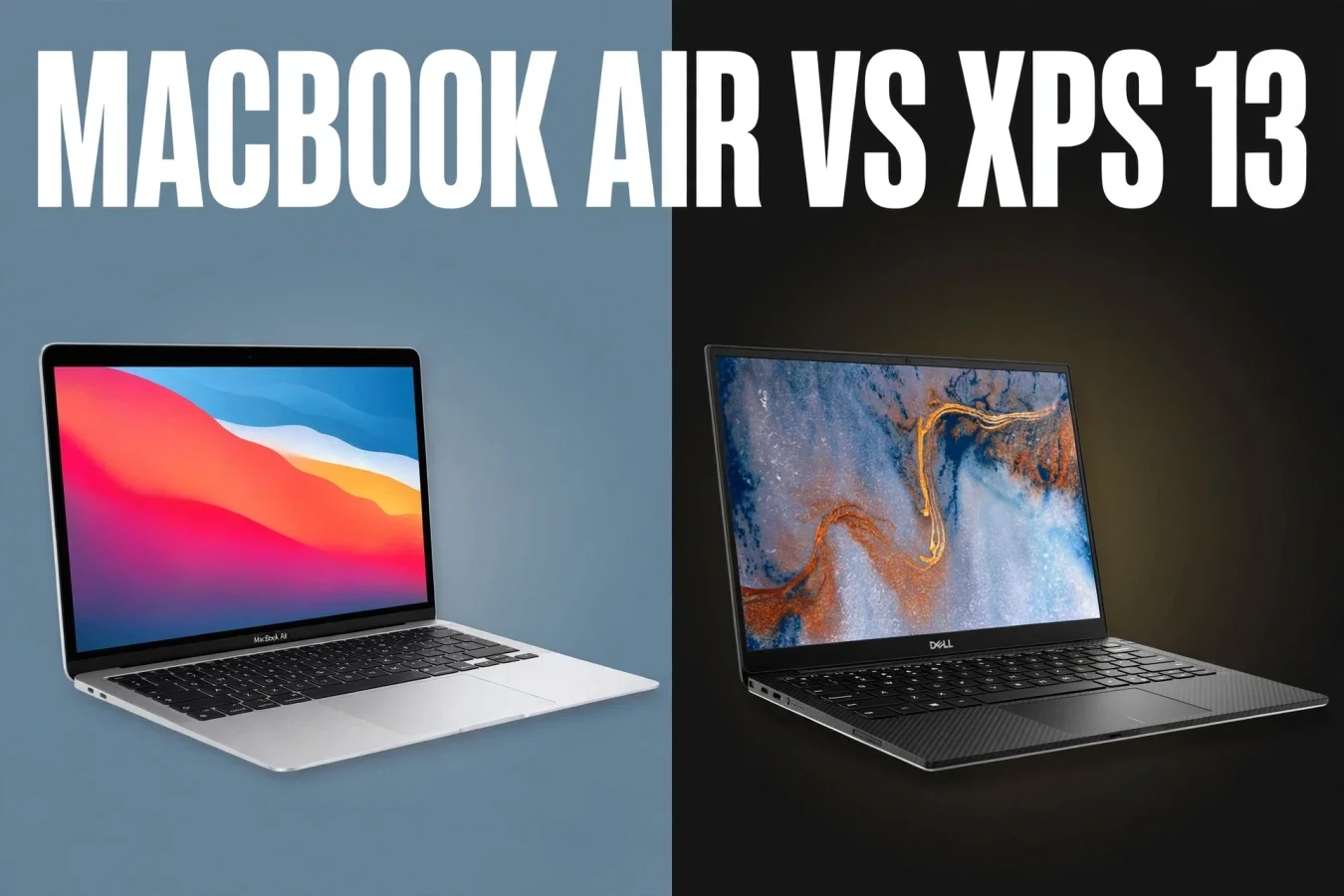
Two thin laptops — one fanless, one Windows touch
MacBook Air M5 vs Dell XPS 13 compares Apple's 13.6-inch MacBook Air with M5 against Dell's 13.4-inch XPS 13 with Intel Core Ultra 7 Series 3, in the 2026 configurations now sold in India. Both laptops are built for students and professionals who travel light. On paper, MacBook wins on battery life and value in India, while XPS 13 wins on touchscreen, refresh rate and Windows software. For most buyers, the choice is macOS versus Windows first, and chip versus chip second.
| Laptop | Chip / CPU | GPU | Display | Battery | Weight |
|---|---|---|---|---|---|
| MacBook Air 13, M5 | Apple M5: 10-core CPU, up to 10-core GPU, 16-core Neural Engine | Up to 10-core Apple GPU | 13.6-inch Liquid Retina, 2560 x 1664, 60Hz, 500 nits | 53.8Wh, up to 18 hours, Apple claim | 1.23kg |
| Dell XPS 13, 2026 | Intel Core Ultra 7 355: 8 cores, up to 4.7GHz | Integrated Intel Graphics | 13.4-inch 2.5K touchscreen, 2560 x 1600, 30-120Hz, 500 nits | 52Wh, up to 17 hours streaming, Dell claim | About 1.0kg |
Specifications
MacBook Air M5 uses Apple's M5 chip, with a 10-core CPU and up to a 10-core GPU, 153GB/s of memory bandwidth, and up to 32GB of unified memory in higher configurations. XPS 13 uses Intel's Core Ultra 7 355, with 8 cores and up to 4.7GHz, integrated Intel Graphics, and up to 32GB of LPDDR5X RAM and 1TB of PCIe Gen4 SSD in the higher configurations. MacBook Air starts with 16GB of RAM and 512GB of SSD, while XPS 13 starts with 16GB of RAM and 512GB of SSD in its Core Ultra 7 Series 3 models in India.
For everyday work, both laptops are fast. For coding and photo work, both should handle large projects, with MacBook's unified memory helping more in memory-heavy tasks. For Windows-only apps, XPS 13 is the only choice, because MacBook cannot run them natively. For Apple-only apps, MacBook is the only choice, because those features are macOS-only.
Performance
Apple claims up to 1.5x faster 3D rendering for M5 against M4 MacBook Air, with higher memory bandwidth of 153GB/s, about 28% higher than M4. No controlled side-by-side CPU test between M5 MacBook Air and Core Ultra 7 355 XPS 13 was reviewed, so no CPU winner is claimed beyond the core counts and vendor claims. XPS 13's Core Ultra 7 355 is an 8-core Panther Lake chip, focused on efficiency and everyday performance, with Intel Graphics for light graphics work.
For students, both laptops should handle notes, browsing, documents and light coding easily. For creators, MacBook's M5 GPU should help more in photo and video work, while XPS 13's integrated graphics should handle light editing only. For heavy rendering, neither laptop is a workstation, so check a larger laptop with a dedicated GPU instead.
Gaming
For gaming, neither laptop is a gaming laptop, because both use integrated graphics. MacBook Air M5 has up to a 10-core Apple GPU, with a third-generation ray tracing engine, while XPS 13 has integrated Intel Graphics. No controlled side-by-side gaming test between these two laptops was reviewed, so no FPS winner is claimed beyond the GPU gap. MacBook can play casual and indie games well, and some demanding titles with ray tracing, but Windows gaming laptops remain the stronger gaming choice.
For students who also game, XPS 13's Windows library is larger, but its integrated graphics still limit demanding titles. For creators who do not game, gaming should not decide the purchase. For light gaming, both laptops are fine, with MacBook's GPU likely ahead on paper.
AI performance
MacBook M5 has a 16-core Neural Engine, with higher memory bandwidth of 153GB/s, and Wi-Fi 7 and Bluetooth 6 via Apple's N1 wireless chip. XPS 13 has Intel Core Ultra 7 Series 3, with an NPU for on-device AI, and Wi-Fi 7, but no TOPS figure for the Core Ultra 7 355 configuration was confirmed in this article, so no AI score is claimed. For everyday AI features, both laptops are fast. For local AI models, memory matters: both laptops go to 32GB, so larger models fit on either, but MacBook's unified memory should help more.
For Apple Intelligence tasks, MacBook is the only choice, because those features are macOS-only. For Windows AI features, XPS 13 is the only choice, because those features are Windows-only. For local LLM research, neither laptop is a workstation, so check a larger laptop with a dedicated GPU instead.
Display
MacBook Air uses a 13.6-inch Liquid Retina display at 2560 x 1664, with 60Hz refresh rate, 500 nits brightness, support for 1 billion colours, Wide colour P3 and True Tone. XPS 13 uses a 13.4-inch 2.5K InfinityEdge touchscreen at 2560 x 1600, with an adaptive refresh rate of 30Hz to 120Hz, 500 nits peak brightness, 100% DCI-P3 colour and Eyesafe technology. XPS 13 also has a glass touchpad and a capacitive touch function row above the keyboard.
For smooth scrolling, XPS 13 wins, with 120Hz against MacBook's 60Hz. For touch and stylus work, XPS 13 wins, because the standard MacBook Air does not have a touchscreen. For colour work, both displays are excellent, with P3 and DCI-P3 coverage. For portability, both displays are similar in size, with XPS 13 slightly smaller and lighter.
Battery
Apple claims up to 18 hours of battery life for the M5 MacBook Air, per its announcement. That is Apple's own test claim, so real-world results will depend on apps, settings and tasks. Dell claims up to 17 hours of streaming battery life for XPS 13, from a 52Wh battery, with a 65W USB-C GaN slim adapter. No controlled side-by-side battery test between these two laptops was reviewed, so no battery winner is claimed beyond the vendor claims and battery capacities.
In practice, MacBook Air should last longer for light work, because it is fanless and has no dedicated GPU to power. XPS 13 should last a full workday for light work, but heavy tasks will drain it faster. For travel, MacBook wins on battery; for desk work, battery matters less.
Thermals
MacBook Air M5 is fanless, so it stays silent, but it will throttle under sustained heavy loads, because it has no fan to cool the chip. XPS 13 uses a dual-fan thermal design, with a CNC-machined aluminium chassis measuring 12.7mm thick and weighing about 1kg. No controlled thermal or fan-noise test between these two laptops was reviewed, so no temperature or noise winner is claimed. MacBook should be quieter for light work, while XPS 13's fans should help more under sustained loads.
For silent work, MacBook wins clearly. For sustained coding and editing, XPS 13's fans should help more. For desk work, thermals matter less than CPU cores and memory.
Price
MacBook Air M5 prices below are for the 13-inch model with 16GB and 512GB, after Apple's June 2026 price rise. XPS 13 prices below are for the Core Ultra 7 Series 3 models in India, with a 13.4-inch 2.5K touchscreen.
| Model | US | India | UK / Europe |
|---|---|---|---|
| MacBook Air 13, M5, 16GB, 512GB | $1,299, after June 2026 rise, launched at $1,099 | ₹1,19,900 | £1,099 UK, launch price, current price not confirmed |
| Dell XPS 13, Core Ultra 7 355, 16GB, 512GB | $1,499 | ₹1,80,990 | £1,449 UK, €1,599 Europe |
| Dell XPS 13, Core Ultra 7 355, 16GB, 1TB | $1,699 | ₹2,00,990 | £1,549 UK, €1,749 Europe |
| Dell XPS 13, Core Ultra 7 355, 32GB, 1TB | $2,099, per Notebookcheck | ₹2,41,990 | £1,949 UK, €2,199 Europe |
US prices exclude sales tax, while India prices include GST and UK/Europe prices include VAT, so headline numbers are not directly comparable. For a like-for-like 16GB and 512GB configuration, MacBook Air M5 is cheaper in India and the US than XPS 13 Core Ultra 7 355, but XPS 13 offers a touchscreen and 120Hz display that MacBook does not.
Verdict
Buy the MacBook Air M5 if you want macOS, silence and battery life, from $1,299 in the US or ₹1,19,900 in India. Buy the Dell XPS 13 if you want Windows, a touchscreen and 120Hz display, from $1,499 in the US or ₹1,80,990 in India. For most students, the choice is macOS versus Windows first, and chip versus chip second.
FAQs
Which is better for students, Air M5 or XPS 13?
Air for battery and value, XPS 13 for touchscreen and Windows.
Which has better battery?
Air on Apple's claim, up to 18 hours, against XPS 13's 17 hours streaming claim.
Which has touchscreen?
XPS 13 only; the standard MacBook Air does not have a touchscreen.
Which is lighter?
XPS 13, about 1.0kg, against Air's 1.23kg.
Which is better for gaming?
Neither is a gaming laptop; both use integrated graphics.
What is the Air M5 price?
From $1,299 in the US and ₹1,19,900 in India, 16GB and 512GB.
What is the XPS 13 price?
From $1,499 in the US and ₹1,80,990 in India, Core Ultra 7 355, 16GB and 512GB.
Was this article helpful?

Written By
TechorCoffeeContributing Writer
TechorCoffee is a technology reporter and software creator writing reviews and tutorials for TechOrCoffee.
Comments (0)
Leave a Comment
Read Next

Tue Apr 21 2026
Leaks & Rumors: Apple MacBook M6 with Touch Screen: My 2026 Leaks Expectations
As a tech journalist with 15+ years testing Apple gear, I break down the buzz around the Apple MacBook M6 with touch screen. Expect OLED touch displays, M6 chip leaps in AI tasks, and pricing from $1,099. I compare it to MacBook Air M6 and Pro M6, share my insights on battery life and workflows

Tue Mar 03 2026
MacBook Air M5: Apple's Game-Changing 2026 Launch Review
Apple unveils the MacBook Air M5 with revolutionary 3nm chip technology, enhanced AI capabilities, improved battery life, and stunning display upgrades. This comprehensive analysis covers specifications, performance benchmarks, pricing, and this new release justifies upgrading from previous models.
Fri Jun 05 2026
MacBook Pro M6 & OLED Screen: Full 2026 Guide (WWDC 26)
Everything you need to know about the MacBook Pro M6 in 2026 — OLED display, touchscreen, M6 chip specs, release date, and whether it's worth the wait.