Neuralink Patient Plays GTA 6 With His Thoughts Alone

Published (Updated )
The quick answer
- A man with paralysis played GTA 6 using only his thoughts, with no controller in his hands.
- Neuralink posted the two-minute video on X on November 20, 2026, one day after GTA 6 launched worldwide.
- He steered a speedboat, flew a seaplane, drove, fought and shot as Jason, one of the game's two main characters.
- A brain implant called Telepathy reads the electrical signals in the part of his brain that controls movement.
- Imagined movements become game commands. Thinking about tapping his ring finger, for example, triggers the punch button.
- This is a clinical trial, not a product you can buy. The implants are still investigational and have not been approved by the US FDA or other regulators.
- The video was edited by Neuralink itself. It has not been independently verified.
What happened on November 20
- Neuralink shared a two-minute video on X with a simple caption: "Playing GTA VI with a Neuralink".
- The timing was no accident. GTA 6 had launched worldwide the day before, on November 19, 2026, for PlayStation 5 and Xbox Series X|S.
- The game was already the biggest entertainment launch in history. Take-Two reported $3.79 billion in day-one sales and 32.5 million copies sold in the first 24 hours.
- Independent estimates put the launch even higher. Alinea Analytics estimates around 44.9 million copies and more than $4 billion in revenue in the first four days. Those are estimates, not official figures from Take-Two or Rockstar.
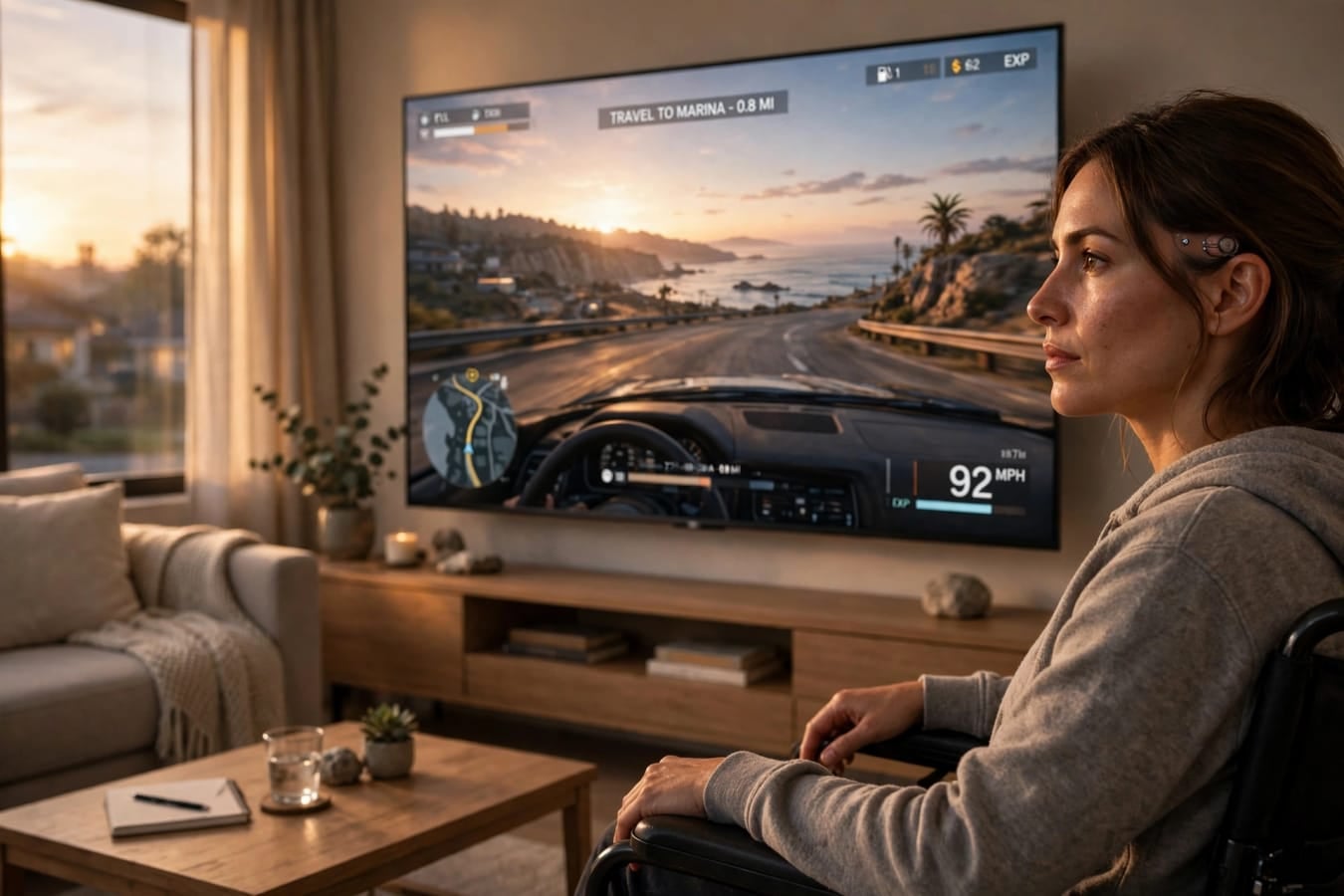
- Against that backdrop, Neuralink's video showed something no launch trailer could. A player with no working use of his arms or legs was playing the biggest game on the planet, with nothing but his mind.
Who is the player
- Neuralink has not named the man in the video. He is a participant in the company's clinical trial and lives with paralysis, described as quadriplegia.
- Quadriplegia means paralysis affecting all four limbs, usually after a spinal cord injury. It leaves a person unable to hold a controller, press buttons or move a joystick.
- Before receiving the implant, he played games with a mouth stick and an iPad. That is how many people with severe paralysis game today, and it is slow and tiring compared with a standard controller.
- The video is the first time Neuralink has shown one of its trial participants playing a modern console blockbuster in this way.
- It is also a reminder of who this technology is built for first. The audience for brain-computer interfaces is not healthy gamers looking for a new gadget. It is people who have lost the ability to move, speak or use a computer at all.
What he played in the video

- The clip opens with the player steering a speedboat under a bridge and into a narrow, tree-lined channel to collect a package.
- It is a tight, fast sequence. The boat threads between bridge supports and banks, and the player keeps it on course without touching a controller.
- The video then cuts to him flying a seaplane over the coast, banking and climbing as the scenery rolls past below.
- Later scenes show him driving through the streets, fighting and shooting as Jason, one of GTA 6's two protagonists.
- Jason Duval shares the lead role with Lucia Caminos in Rockstar's return to Vice City. The game is set in the fictional state of Leonida, a sun-soaked version of Florida.
- The action shown covers the full range of what a modern open-world game demands. Steering, flying, driving, combat and shooting all need fast, precise inputs, and the video shows them all happening through thought alone.
How it works: from thought to button press
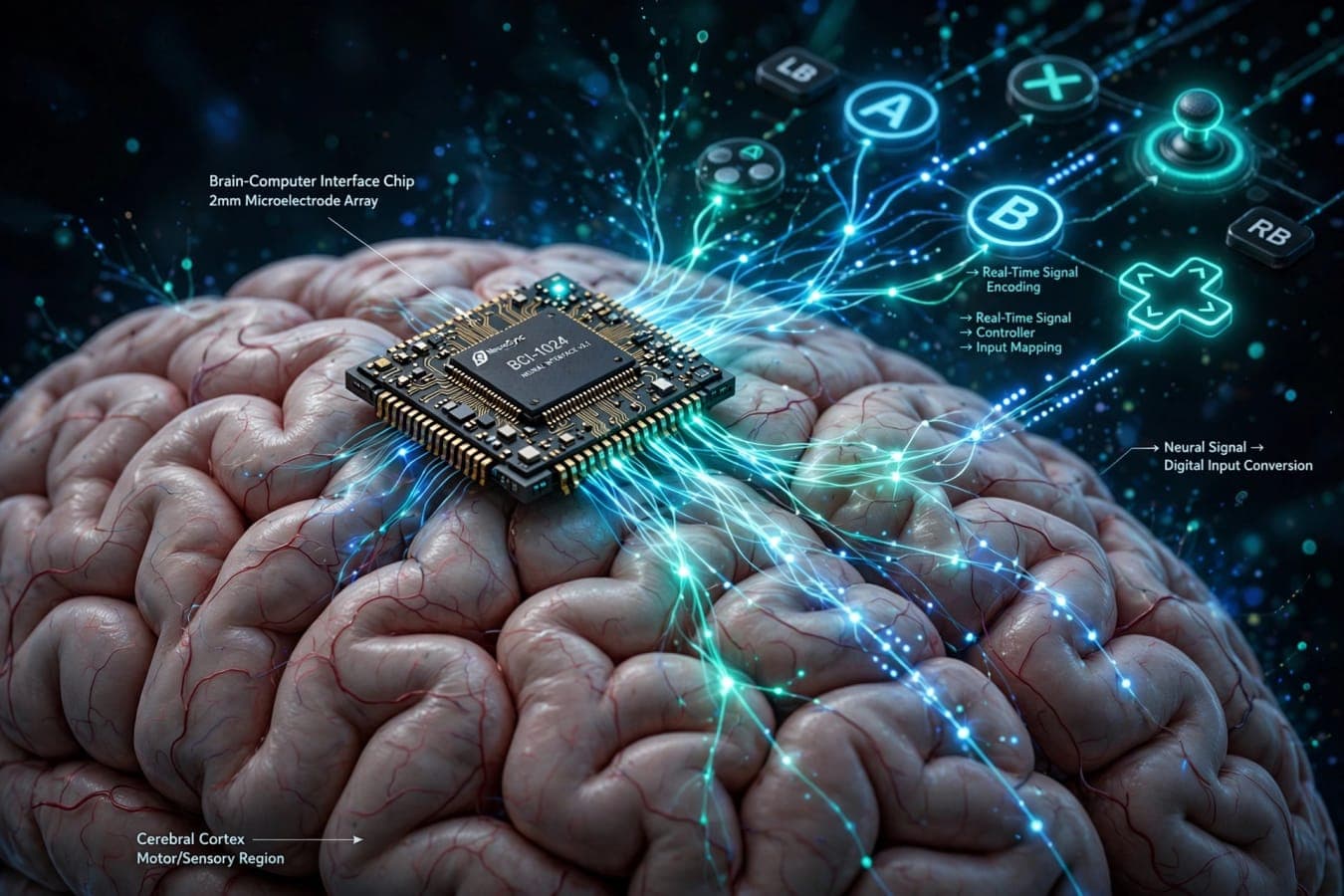
- The implant is called Telepathy. It is Neuralink's brain-computer interface, a small device placed in the brain that records electrical activity.
- It focuses on the region of the brain that governs movement. When a person imagines moving, that region fires in recognisable patterns, even if the body cannot carry the movement out.
- Telepathy reads those patterns and converts them into digital commands. The commands are then sent to a device, in this case through controller-adapter technology that lets the implant talk to a games console.
- A Neuralink employee said the team had worked on controlling devices including a PlayStation 5 using that controller-adapter technology.
- Neuralink has not said which console was used for this demo. The on-screen graphic shows a PlayStation DualSense controller, but the company has not confirmed the hardware behind the footage.
- The mapping between thoughts and buttons is personal to each user. Here is how it worked for this player:
- Imagining tapping his ring finger triggers the Square button, which throws a punch in the game.
- Imagining sliding his right hand forward pulls the plane's nose up.
- Foot movements are mapped to extra inputs, giving him more commands than his hands alone could provide.
- The player trains the system by imagining movements again and again until the software learns to recognise each pattern reliably.
- The result is a kind of virtual controller that lives entirely in the brain. There is no physical device to hold, no switch to press and no eye tracker to aim.
What you see on screen
- The video is laid out like a tech demo, with three elements on screen at once.
- In one corner is the player's webcam. You can see him watching the game, with no controller in his hands and no visible effort to move.
- Next to it is a dashboard labelled "Live neural decoding". It shows the implant's signals being read and translated in real time.
- The third element is a graphic of a PlayStation DualSense controller. Its buttons light up as each command registers, so viewers can match a thought to an action.
- That controller graphic is doing important work. It makes an invisible process visible. Without it, viewers would only see a man sitting still while a game plays itself.
- But it also raises a question the video does not answer. The footage is edited by Neuralink, and the company has not released unedited recordings or invited independent experts to verify the demo in person.
Why this matters for accessibility
- Gaming is one of the hardest everyday activities to make accessible. Modern games demand dozens of inputs, split-second timing and constant camera control.
- Adapted controllers exist, and they help many players. Microsoft's Xbox Adaptive Controller and Sony's PlayStation Access controller are both built for people with limited mobility.
- Even so, those devices still need some physical movement. A sip-and-puff switch, a head switch or a foot pedal all assume the player can move something reliably.
- For people with the most severe paralysis, that assumption fails. A brain-computer interface skips the body entirely and reads the intention to move instead.
- That is why the GTA 6 demo matters beyond the headline. It is not about playing a game hands-free for fun. It is about whether someone who cannot move at all can still take part in the biggest shared cultural event of the year.
- The same technology has wider uses. Neuralink's trial also covers using a computer, browsing the web and controlling other devices, all through thought.
This is not the first time
- The first Neuralink participant, Noland Arbaugh, showed what the implant could do back in 2024.
- Arbaugh, who was paralysed after a diving accident, used the implant to play Civilization VI and Mario Kart, and to move a computer cursor with his mind.
- His demos were a milestone. They proved a brain-computer interface could handle real games, not just laboratory tests.
- The GTA 6 demo is a step up in difficulty. Civilization VI is turn-based and forgiving. Mario Kart is fast but simple. GTA 6 is a sprawling open world that asks the player to drive, fly, fight and shoot, often at the same time.
- Neuralink says around 20 participants had received implants by the start of 2026. The company is recruiting people with spinal cord injury or ALS for its trials.
- ALS, or amyotrophic lateral sclerosis, is a progressive disease that gradually takes away the ability to move, speak and eventually breathe. Brain-computer interfaces are one of the few technologies that could give people with ALS a way to communicate and control devices as the disease advances.
What Neuralink has not said
- The demo leaves several important questions unanswered, and readers should know what they are.
- Neuralink has not said which console was used. The DualSense graphic suggests PlayStation, but that is not a confirmation.
- The company has not disclosed the latency, the delay between a thought and the action on screen. In a fast game, even a small delay matters, and no figures have been published.
- There is no word on how long the player trained before the recording, or how many takes the video needed. A two-minute edited clip can hide a lot of practice and failed attempts.
- The footage has not been independently verified. No outside researchers have confirmed the setup, the signals or the gameplay in an unedited session.
- None of that means the demo is fake. It means the evidence so far is a company-produced video, and the strongest proof would be an independent test or a peer-reviewed study.
- The implants themselves remain investigational. They are not approved by the US FDA or other regulators, and individual results vary from person to person.
GTA 6 is the perfect stage
- Neuralink could hardly have picked a bigger game for this demo. GTA 6 is the most anticipated launch in gaming history, and its first days have smashed every record.
- The game costs $79.99 in the US and £69.99 in the UK. It is available on PlayStation 5 and Xbox Series X|S, with no PC version announced yet.
- Take-Two's day-one figures of $3.79 billion and 32.5 million copies already make it the biggest entertainment launch ever, ahead of any film, album or game before it.
- The Alinea Analytics estimates of 44.9 million copies and more than $4 billion in four days, if accurate, would push the launch even further ahead. Treat those as estimates, not official numbers.
- The timing also lands days before Black Friday on November 27, 2026, when consoles, games and accessories traditionally go on sale.
- For readers thinking about buying the game, the two deals below use our affiliate link. Prices can change, so check the listing before you buy.
- Buy GTA 6 on Amazon – Huge Black Friday Discount
- Get GTA 6 for PS5 – Huge Black Friday Discount
What happens next
- Neuralink's next step is to move from demos to data. Regulators will want clinical evidence, not videos, before any brain-computer interface reaches the wider market.
- That means larger trials, longer follow-up and published results showing the implants are safe and that the benefits last.
- The company is also likely to show more everyday uses. Gaming is eye-catching, but typing, browsing and controlling a home are the tasks that matter most to people with paralysis.
- Other companies are working on similar technology. Synchron, for example, has a less invasive implant that reaches the brain through a blood vessel, and it has shown patients sending texts and controlling devices.
- Competition should speed things up. It also means regulators and researchers will be able to compare different approaches and pick the safest, most reliable ones.
- For now, the GTA 6 video is best read as a glimpse of what is possible, not a promise of what is coming soon. A person with paralysis played one of the biggest games ever made with his thoughts alone, and that alone is worth paying attention to.
- The real test will be whether the technology works as well outside a two-minute edited video, in the hands of many different people, over months and years.
- If it does, gaming will be the least of it. The same interface could restore communication, independence and control to people who have lost all three.
FAQs
Did a Neuralink patient really play GTA 6 with his thoughts?
Neuralink posted a two-minute video on X on November 20, 2026, showing a trial participant with paralysis playing GTA 6 without a controller. The footage was edited by Neuralink and has not been independently verified.
How does the Neuralink implant control a game?
The Telepathy brain-computer interface records electrical activity in the brain region that governs movement. Imagined movements are converted into digital commands, which are sent to the console through controller-adapter technology. For this player, imagining tapping his ring finger triggered the Square button to punch.
Which console was used to play GTA 6 in the Neuralink video?
Neuralink has not said. The video shows a PlayStation DualSense controller graphic, and a Neuralink employee said the team worked on controlling devices including a PS5, but the company has not confirmed which console was used for this demo.
Is the Neuralink implant approved by the FDA?
No. Neuralink's implants remain investigational and are not approved by the US FDA or other regulators. Individual results vary, and the implants are only available through clinical trials recruiting people with spinal cord injury or ALS.
Who was the first Neuralink participant to play games with the implant?
Noland Arbaugh, the first participant, played Civilization VI and Mario Kart with the implant in 2024. Around 20 participants had received implants by the start of 2026.
How much does GTA 6 cost?
GTA 6 costs $79.99 in the US and £69.99 in the UK. It launched on November 19, 2026, for PlayStation 5 and Xbox Series X|S, with no PC version announced yet.
Was this article helpful?
Explore Specs, Comparisons & Related Topics

Written By
TechorCoffeeEditorial Team
The TechOrCoffee Editorial Team covers consumer hardware, artificial intelligence, software engineering, and regional smartphone & laptop market analysis.
Comments (0)
Leave a Comment
Read Next

Wed Jun 03 2026
PS5 Pro: Everything You Need to Know before Buy
Discover everything about the PS5 Pro, including specifications, performance upgrades, ray tracing, AI upscaling, gaming improvements upgrading in 2026.
Fri Oct 30 2026
NVIDIA in 2026: No New Gaming GPU, AI Takes Over
NVIDIA 2026 explained: no new gaming GPU, RTX 60 delayed to 2028, Rubin CPX for AI inference, memory shortage, and what PC gamers should buy now in 2026.

Sun Nov 01 2026
Hidden Enterprise Risk: How to Audit and Control 'Shadow AI'
Discover the hidden risks of Shadow AI in the workplace and learn how businesses can audit unauthorized AI tools, prevent data leaks, strengthen security.