WWDC 2026: Siri AI, iOS 27 & Apple's Biggest Reveal

Published
Introduction
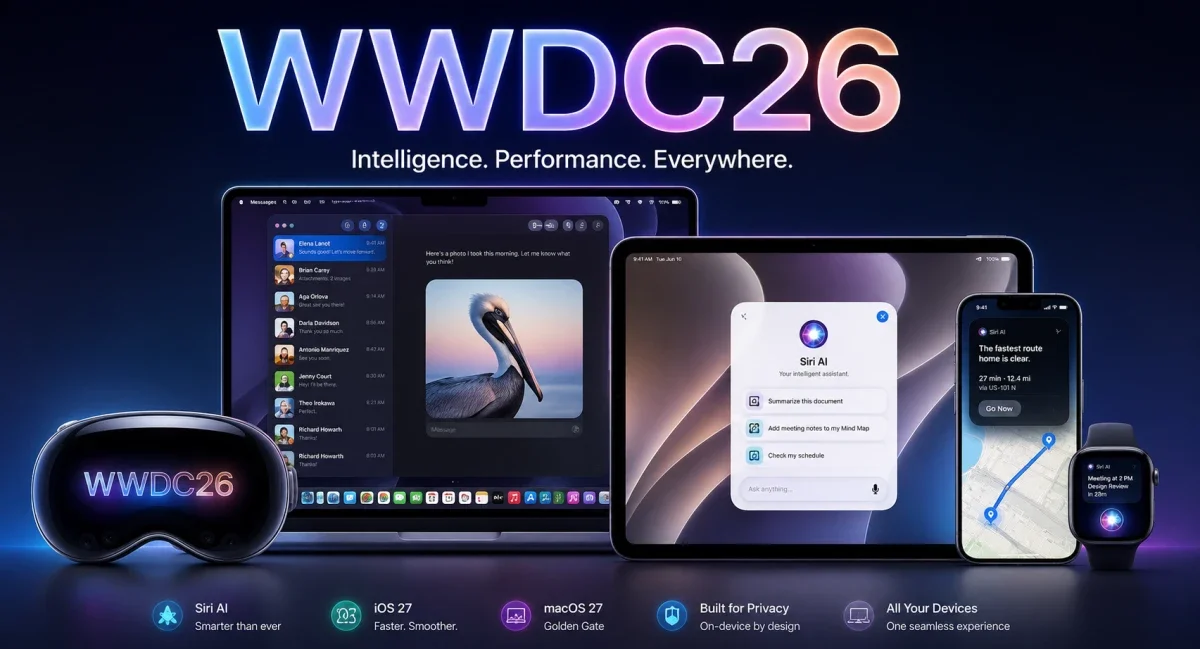
Apple recently concluded its Worldwide Developers Conference keynote, revealing systemic changes across all major operating systems. This analysis details the engineering decisions, performance optimizations, and technical architectures introduced at the event.
Quick Facts: Key Announcements
Category | Primary Announcement | Core Technology |
Artificial Intelligence | Siri AI Infrastructure | Google Gemini Integration |
Mobile Architecture | iOS 27 Performance Pass | Reengineered CPU Scheduler |
Desktop Systems | macOS 27 Golden Gate | Unified Spotlight Indexing |
Data Storage | Core System Search Index | Millisecond Local Indexing |
Privacy Framework | Cloud Compute Verification | Cryptographic Isolation |
Introduction to the 2026 Ecosystem Strategy
The presentations at the conference highlighted a shift away from visual design alterations toward deep architectural refinement. Operating systems received major optimizations aimed at efficiency, legacy device stability, and low-latency local execution.
The primary keyword for understanding this shift is the deployment of integrated intelligence systems that operate under strict privacy constraints. Device processing speeds and storage management protocols saw fundamental rewrites to support these new models.
The Architecture of Siri AI
The core update involves a complete reconstruction of Apple's virtual assistant into a system named Siri AI. This implementation uses next-generation foundation models that rely on Google Gemini technology for complex linguistic processing.
The system transitions from an ephemeral overlay to a persistent local application environment. A dedicated application now manages conversation threads, allowing state synchronization across multiple authorized consumer devices.
Dynamic Island Orchestration
Engineers integrated the interface controls directly into the physical screen cutout zones on mobile hardware. Users invoke the state machine through multi-directional gestures or dedicated physical buttons on the device chassis.
The layout minimizes visual distraction while maintaining an active background thread for context retrieval. Processing occurs seamlessly between local silicone chips and external servers depending on the complexity of the prompt.
Screen and Personal Context Pipelines
The processing pipeline reads real-time rasterized frames directly from the display buffer to extract contextual data. This allows the system to parse on-screen content and establish semantic relationships across separate software applications.
Information transfers securely between native utilities such as email clients, text messengers, and note repositories. The integration creates a unified knowledge graph unique to the storage volume of the local device.
Camera Vision Intelligence
The camera hardware interface now features an active analysis layer when held in a specific diagnostic mode. This subsystem performs optical character recognition and object classification instantly on the raw imaging feed.
The system parses incoming text data, nutritional labels, and structural shapes without saving permanent video files to disk. Data remains volatile in the system memory until the execution loop finishes.
Multi-Command Chaining Engines
The natural language processing engine can now parse compound instructions that contain multiple dependent variables. The system breaks down single strings into sequential API calls that execute in a specific logical order.
The scheduler evaluates dependencies within the string to prevent race conditions between local application databases. If a step fails, the system halts execution and rolls back the database state to prevent data corruption.
iOS 27 and iPadOS 27 Architecture
The mobile operating system updates focus entirely on system stability, battery preservation, and legacy hardware compatibility. The software maintains execution parity with older computing units, extending support back to devices manufactured in 2019.
CPU Scheduler Overhaul
The operating system kernel features a rewritten thread scheduler that dynamically balances performance cores and efficiency cores. The algorithm prioritizes immediate user interactions over background daemon processes to eliminate UI latency.
App initialization routines now bypass non-essential framework loads during the initial boot cycle. This optimization reduces cold start times across third-party applications by nearly one third.
Core Storage Performance
The local file system received specific updates to accelerate read and write operations across internal and external solid-state media. The input-output controller maximizes bus bandwidth during large file operations.
AirDrop protocols now use wide-band wireless channels with reduced cryptographic handshake overhead. This change maximizes throughput when moving dense file structures between separate local hardware nodes.
Interface Composition Adjustments
The system compositor introduces a dedicated variable transparency framework for user interface elements. This system allows precise control over the alpha blending layers used in system menus and notification banners.
Icon rendering engines now apply multi-layered refraction models to maintain visual contrast across varying display backgrounds. The adjustment prevents readability issues caused by bright or complex user wallpapers.
My POV: On Legacy Hardware Support
Maintaining software compatibility for devices stretching back to 2019 is an intentional strategy to stabilize the secondary market. By optimizing the kernel instead of adding heavy visual effects, older processors experience a literal reduction in daily operational friction. This approach prioritizes long-term ecosystem retention over forced upgrade cycles.
Reengineering the Core System Search Index
The foundational search infrastructure across all platforms underwent a complete replacement to fix historical indexing delays. The new indexing engine operates directly on the local file system events database.
Millisecond Event Indexing
The metadata indexer monitors file creation and modification flags in real time to update database records instantly. This methodology replaces the legacy batch-processing system that caused high CPU utilization spikes.
The engine uses small, highly optimized vector segments to store text and image metadata locally. This architecture ensures that newly arrived data is immediately searchable without requiring a system reboot.
Native Mail Search Optimizations
The local mail database now utilizes decentralized indices to allow instant keyword matching across tens of thousands of local messages. The architecture eliminates the need to query remote servers for basic text matching.
Search queries execute entirely within a secure memory sandbox to protect user privacy. Results populate the user interface with minimal latency, even when processing massive archive databases.
Image Playground and Spatial Generation
The generative media framework received updates to its underlying neural networks to improve output fidelity and spatial understanding. The system shifts away from stylized rendering toward photographic accuracy.
Photographic Style Synthesis
The updated generative models analyze structural compositions to produce high-resolution imagery with realistic lighting and textures. The engine runs locally on the neural processing units of compatible hardware.
The generation process uses specialized hardware acceleration matrices to reduce thermal output during creation cycles. The system caps memory consumption to prevent background application eviction.
Spatial Canvas Reframing
The native photo management utility incorporates generative filling techniques to expand the boundaries of existing flat images. The algorithm infers structural details outside the original camera frame by analyzing internal lines and lighting angles.
Users can adjust horizon leveling and perspective matrices after capturing an image. The software synthesizes new pixels to fill the resulting empty zones while maintaining the original grain structure.
macOS 27: Golden Gate
The desktop operating system focuses on unified cross-device execution models and deep command-line integration for intelligence tools. The underlying file systems match the enhancements found on the mobile platforms.
Desktop Spotlight Integration
The desktop search utility acts as a primary interface node for the central intelligence system. Users can expand standard search bars into persistent, multi-window workspaces that retain historical context.
The system handles structured data sources like code repositories and design assets directly through the search interface. Context persistence allows users to move complex data chunks between different applications using standard system inputs.
Contextual Right-Click Pipelines
The system shell injects an intelligence pipeline directly into the context menus of the native file manager. This architecture allows direct file streaming into the localized model environments.
Users can pass code segments, documentation files, and uncompressed images directly to the processing cores. The system processes the input and returns modified variants to the target directory without requiring manual application switching.
Trust, Safety, and Privacy Infrastructure
The implementation of advanced intelligence features required a structural redesign of Apple's security boundaries. The company introduced a framework to verify privacy states when processing off-device data.
Private Cloud Compute Verification
When local processing units lack the compute capacity for a massive linguistic request, the system routes encrypted data packets to external servers. This architecture isolates user data from the host operating system running on the server node.
The server infrastructure relies on custom silicon that uses a locked-down secure enclave execution path. Independent security entities can cryptographically audit the server software images to verify that no user data is recorded to permanent storage.
Parental Control Frameworks
The operating system introduces strict network filtration layers that operate directly at the socket level for supervised user accounts. The system blocks unauthorized communication loops before data leaves the local network interface.
The system dashboard displays resource allocation metrics categorized by application classification. The software uses developmental metrics to suggest baseline time constraints for specific device activities.
My POV: On the Security of External Model Routing
The decision to route complex queries to external servers running Google Gemini technology represents a calculated trade-off. While the Private Cloud Compute architecture provides cryptographic isolation, the introduction of third-party model dependencies creates a complex supply chain risk. The true test of this infrastructure will lie in how transparently the system handles high-volume processing failures under peak loads.
Ecosystem System Integration and Peripheral Syncing
The continuous data exchange between peripheral devices and host machines received minor hardware-level optimizations to reduce latency. These updates ensure uniform data states across separate physical enclosures.
Credential Auto-Update Subsystems
The centralized credential storage application can now audit external authentication profiles to update compromised access tokens automatically. The assistant handles the verification handshakes in the background.
The system uses end-to-end encrypted sync mechanisms to distribute updated credentials across authorized hardware nodes. This architecture minimizes manual user input during security maintenance routines.
Watch Integration and Biometric Sync
The wearable operating system introduces updated interface layers that elevate active intelligence threads based on real-time sensor metrics. The layout matches user activity states dynamically.
Peripheral audio equipment can now interface directly with third-party exercise apparatus to stream high-frequency biometric data. The communication loop bypasses the primary mobile device to reduce power consumption during active use.
Vision Pro Spatial Reconstruction
The spatial computing platform introduces algorithms to convert traditional two-dimensional wide-angle images into fully realized three-dimensional simulation environments. The system maps depth values by analyzing light degradation curves within the flat file.
The internal networking controllers receive software driver optimizations to increase spatial data transfer rates over local wireless infrastructure. This change eliminates visual buffering when streaming dense volumetric environments from local storage networks.
Architectural Comparison: Core Operating Systems
The following table compares the structural enhancements implemented across the primary software platforms for this deployment cycle.
Platform | Core Subsystem Update | Primary Performance Gain | Primary Interface Node |
iOS 27 | CPU Thread Scheduler | 30% App Launch Speed | Dynamic Island Layer |
iPadOS 27 | Files App Storage Driver | 5x External Media Read | Translucent Glass Sliders |
macOS 27 | Spotlight System Index | Real-time Asset Vectoring | Multi-Window Workspaces |
watchOS 13 | Biometric Smart Stack | Low-Latency Sensor Loops | Contextual Complications |
visionOS 3 | Volumetric Mesh Pipeline | 3x Local Wireless Throughput | Spatial Scene Projection |
Software Deployment and Availability Cycles
The distribution of the new software builds follows a structured release methodology divided into distinct validation testing blocks. Developer variants are accessible immediately through authorized distribution channels.
Beta Testing Frameworks
Public testing variants will deploy in the subsequent calendar month once initial crash logs are resolved. The installation process requires an explicitly configured testing profile tied to an active development account.
The general consumer distribution cycle will begin during the autumn season alongside the release of updated physical hardware enclosures. The installation routines will occur via standard over-the-air system update mechanisms.
Geographic and Language Constraints
The initial deployment of the intelligence infrastructure is restricted to systems utilizing English as the primary language configuration. This limitation stems from the localized training models used in the initial deployment phase.
Regulatory differences will delay the availability of specific intelligence subroutines within certain international jurisdictions. Specifically, entities operating within the European Union and China will face separate compliance timelines before the software becomes active.
FAQs
How does the new search indexer affect device battery life?
The search indexer replaces high-power batch processing with real-time event monitoring. By executing index updates instantly at the millisecond level, the system eliminates prolonged CPU spikes, resulting in a net reduction in overall daily power consumption.
Why is the initial rollout limited by language and geography?
The foundation models require comprehensive linguistic tuning and validation to ensure accuracy across different dialects. Furthermore, specific international markets require distinct regulatory certifications regarding data handling before deployment can proceed.
Can the intelligence features function without an active internet connection?
Basic operational tasks and contextual indexing occur entirely on the local device using dedicated neural hardware matrices. Complex requests that require massive model parsing are routed securely to cloud servers when network connectivity is available.
How does the system protect user privacy during cloud processing?
The system uses Private Cloud Compute technology to isolate data packets transmitted to external servers. The processing occurs entirely within secure enclave environments that prevent data persistence or administrative access by the hosting facility.
What devices are compatible with the new software updates?
The system maintains broad compatibility with previous generation devices. The software supports all mobile hardware models released from 2019 onward, ensuring that older processors can run the core optimization updates without requiring a hardware upgrade.
Was this article helpful?

Written By
TechorCoffeeContributing Writer
TechorCoffee is a technology reporter and software creator writing reviews and tutorials for TechOrCoffee.
Comments (0)
Leave a Comment
Read Next

Thu Mar 12 2026
Leaks & Rumors: MacBook Air M4 vs MacBook Neo: Full Comparison
MacBook Air M4 and MacBook Neo target different users in Apple’s lineup. Neo focuses on affordability and everyday tasks, while Air M4 delivers stronger performance, better graphics, and higher memory options for demanding workloads like coding, editing, and multitasking.

Tue Mar 03 2026
MacBook Air M5: Apple's Game-Changing 2026 Launch Review
Apple unveils the MacBook Air M5 with revolutionary 3nm chip technology, enhanced AI capabilities, improved battery life, and stunning display upgrades. This comprehensive analysis covers specifications, performance benchmarks, pricing, and this new release justifies upgrading from previous models.
Tue Jun 16 2026
Apple Intelligence 2.0: Siri AI & iOS 27 at WWDC 2026
Apple Intelligence 2.0 is here. I cover Siri AI, iOS 27 release dates, supported devices, and how Apple's new AI really compares to ChatGPT and Gemini.