ASUS ProArt P16 vs MacBook Pro 16 M5 Max for Creators

Published
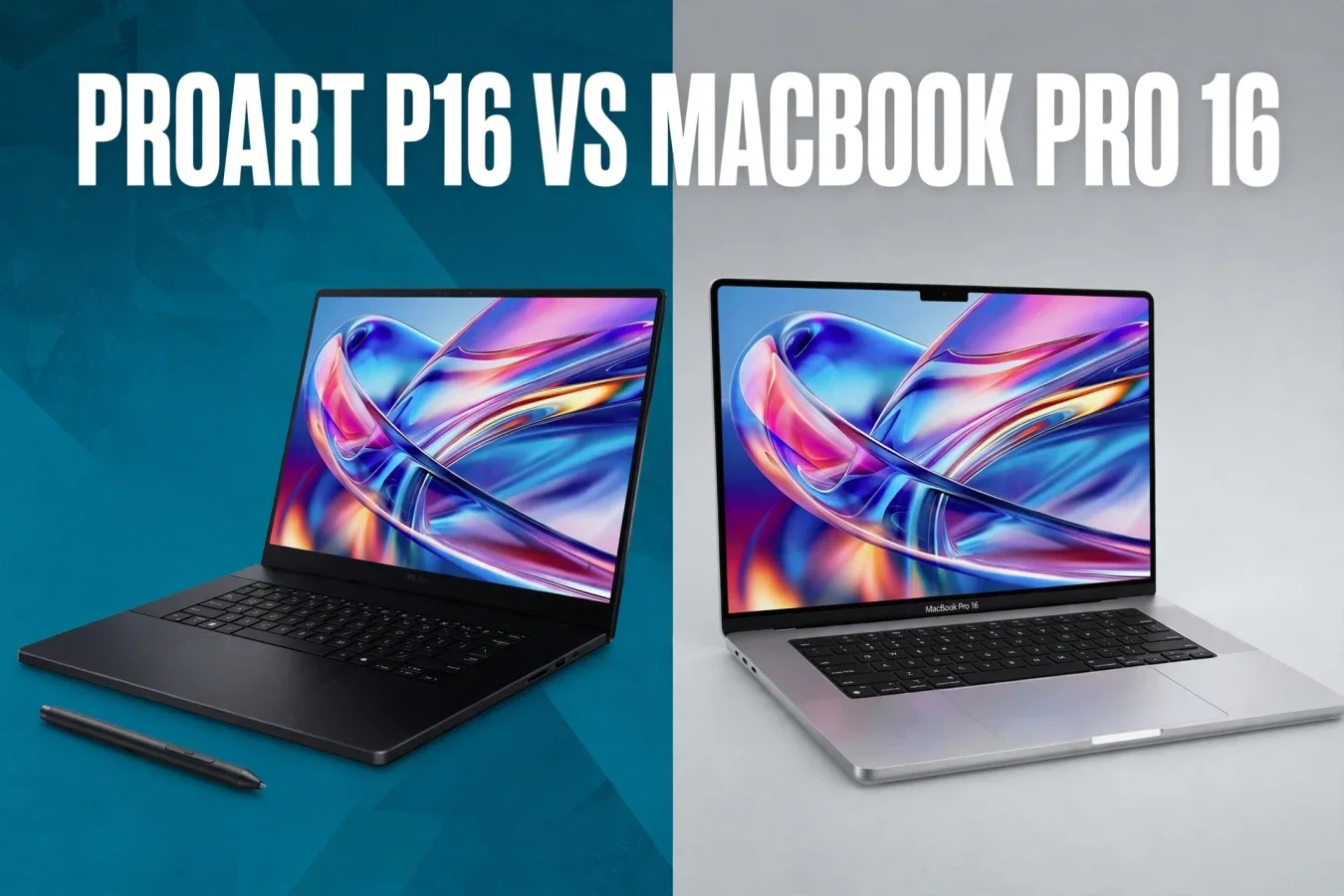
Two creator flagships — one Windows, one macOS
ASUS ProArt P16 vs MacBook Pro 16 M5 Max compares a Windows creator laptop with a dedicated RTX GPU against Apple's most powerful laptop chip. On paper, ProArt P16 has a dedicated RTX 5070 Laptop GPU and a touchscreen OLED display with stylus support, while MacBook Pro 16 M5 Max has a built-in PROLED display and longer battery life. For Windows creators and GPU rendering, ProArt wins; for macOS creators and portable work, MacBook wins.
| Laptop | CPU | GPU | Memory | Display | Battery |
|---|---|---|---|---|---|
| ASUS ProArt P16, RTX 5070 | Ryzen AI 9 HX 370, 12 cores | RTX 5070 Laptop | Up to 64GB LPDDR5X / 2TB | 16-inch 4K OLED, 3840 x 2400, 120Hz, touchscreen | 90Wh |
| MacBook Pro 16, M5 Max | 18-core M5 Max | Up to 40-core Apple GPU | Up to 128GB / 614GB/s | 16.3-inch PROLED, 3472 x 2266, 120Hz | 22h video rating |
Specifications
ASUS ProArt P16 uses a Ryzen AI 9 HX 370, with 12 cores and 24 threads, up to 5.1GHz, a 50 TOPS NPU, up to 64GB of LPDDR5X memory and 2TB of SSD storage, and RTX 5060 to RTX 5090 Laptop GPU options, with the RTX 5070 Laptop configuration as the main comparison. MacBook Pro 16 M5 Max uses an 18-core CPU, up to a 40-core GPU with Neural Accelerators in every core, and up to 128GB of unified memory at 614GB/s of bandwidth.
For everyday work, both laptops are fast. For multitasking, ProArt's 12 cores should handle creator work well, while MacBook's 18 cores should handle most pro work well. For memory, MacBook's 128GB is the bigger advantage, because larger AI models and video projects fit on it. For storage, both laptops offer up to 2TB in the main configurations, with MacBook offering up to 8TB in higher configurations, per retailer listings.
Performance
No controlled side-by-side test between ASUS ProArt P16 and MacBook Pro 16 M5 Max was reviewed for every workload, so this article uses published benchmark summaries with their sources named. MacBook Pro M5 Max scored about 3,769 single-core and 35,656 multi-core in Geekbench 7, per Cult of Mac, with a Metal score of about 239,593 for the 16-inch model, per Onur Ilgaz's ladder. ProArt P16's Ryzen AI 9 HX 370, with 12 cores, should handle creator work well, while its RTX 5070 Laptop GPU should lead in GPU-accelerated rendering, per the Lap 3 research.
For students, both laptops should handle notes, browsing, documents and light coding easily. For creators, MacBook should help more in Final Cut Pro and macOS apps, while ProArt should help more in GPU rendering and Windows apps. For developers, MacBook's core count should help more in parallel builds, while ProArt's GPU should help more in GPU-accelerated builds. For heavy rendering, ProArt wins on GPU; for portable work, MacBook wins on battery.
Gaming
For gaming, ProArt P16 wins, because it has a dedicated RTX 5070 Laptop GPU with DLSS 4 and ray tracing, while MacBook Pro 16 M5 Max uses an integrated Apple GPU. No controlled side-by-side gaming test between these exact two laptops was reviewed, so no FPS winner is claimed beyond the GPU gap, but ProArt's RTX 5070 Laptop should play AAA games at high settings far better than MacBook's integrated GPU. MacBook should play casual and indie games well, but Windows gaming laptops remain the stronger gaming choice.
For gamers, ProArt is the clear choice, with a 120Hz OLED display and RTX 5070 Laptop. For creators who also game, ProArt's GPU should help more, but MacBook's display is excellent for colour work. For students who do not game, gaming should not decide the purchase.
AI performance
MacBook Pro 16 M5 Max has up to 128GB of unified memory at 614GB/s, with dual video encode and dual ProRes engines, and Neural Accelerators in every GPU core. ASUS ProArt P16 has a Ryzen AI 9 HX 370 with a 50 TOPS NPU, and an RTX 5070 Laptop GPU with Tensor cores. For local AI models, MacBook's 128GB is the bigger advantage, because larger models fit on it than on ProArt's 64GB of system memory. For gaming AI features, such as DLSS 4, ProArt benefits, with its RTX 5070 Laptop GPU.
For local LLM research, MacBook is the better choice, because 128GB fits larger models. For photo and video AI features, both laptops should handle them, with ProArt helping more in GPU-accelerated tasks. For Apple Intelligence tasks, MacBook supports them, because it is an Apple Silicon Mac.
Display
MacBook Pro 16 M5 Max PROLED offers a 16.3-inch display at 3472 x 2266, with 254ppi, 2,000 nits HDR and SDR brightness, 10,000,000:1 contrast, P3 plus Adobe RGB colour, and 10Hz to 120Hz ProMotion, plus a Dynamic Island. ASUS ProArt P16 offers a 16-inch 4K OLED display at 3840 x 2400, with 120Hz refresh rate, 1600 nits HDR brightness, touchscreen and stylus support, per the Lap 3 research.
For colour work, both displays are excellent, with MacBook's PROLED offering higher brightness and ProArt's OLED offering touchscreen and stylus. For drawing and design, ProArt wins, with touchscreen and stylus support. For portability, MacBook's display is built-in and excellent, while ProArt's display is also excellent for creators.
Battery
MacBook Pro 16 M5 Max has a battery, with Apple video-streaming ratings of 20 hours for the 14-inch model and 22 hours for the 16-inch model, per the Lap 2 research. ASUS ProArt P16 has a 90Wh battery, but creator laptops with dedicated RTX GPUs do not last long on battery for rendering, because the GPU draws high power, so battery life depends on the laptop's power limits, not just the GPU. No controlled side-by-side battery test between these exact two laptops was reviewed, so no battery winner is claimed beyond the ratings and battery sizes. For travel, MacBook wins clearly; for desk work, battery matters less.
Thermals
ASUS ProArt P16 uses three fans and liquid metal cooling, with up to 120W of sustained power, per the Lap 3 research. MacBook Pro 16 M5 Max uses Apple's laptop cooling, with a thinner chassis and quieter fans for light work. No controlled thermal or fan-noise test between these exact two laptops was reviewed, so no temperature or noise winner is claimed beyond the cooling designs. For sustained rendering, ProArt's larger cooling should help more. For silent work, MacBook should be quieter for light work, while ProArt's fans should be louder under load.
Price
ASUS ProArt P16 prices are listed per configuration, never as one family price, per the Lap 3 research: Germany €2,699 for RTX 5060 and €3,099 for RTX 5070, and India ₹4,39,990 for RTX 5080 with 64GB and 2TB, and ₹4,69,990 for RTX 5080 with 32GB and 1TB. MacBook Pro M5 Max PROLED models start at $4,499 in the US and ₹5,49,900 in India for the 14-inch model, and $4,799 in the US and ₹5,89,900 in India for the 16-inch model, per the Lap 2 research. US prices for ProArt P16 in this configuration were not confirmed in this article, so check current retailer listings before buying. US prices exclude sales tax, while India prices include GST, so headline numbers are not directly comparable.
| Laptop | India | US | Europe |
|---|---|---|---|
| MacBook Pro 16, M5 Max, PROLED | ₹5,89,900 | $4,799 | Not confirmed in this article |
| ASUS ProArt P16, RTX 5070 | Not confirmed in this article | Not confirmed in this article | €3,099, Germany |
| ASUS ProArt P16, RTX 5080, 64GB, 2TB | ₹4,39,990 | Not confirmed in this article | Not confirmed in this article |
For a like-for-like desk setup, ProArt's price plus a display may still be lower than MacBook's price, but MacBook includes a PROLED display and battery. For creators, ProArt's lower price is justified by its RTX GPU and touchscreen; for portable creator work, MacBook's higher price is justified by its display and battery.
Verdict
Buy ASUS ProArt P16 if you need a Windows creator laptop with a dedicated RTX GPU and touchscreen, from €3,099 in Germany for RTX 5070. Buy MacBook Pro 16 M5 Max if you need a portable creator laptop with a PROLED display and long battery, from $4,799 in the US or ₹5,89,900 in India. For most Windows creators, ProArt wins; for most portable creators, MacBook wins.
FAQs
Which is better for creators, ProArt or Book Max?
ProArt for Windows and GPU work, Book Max for portable macOS work.
Which has touchscreen?
ProArt only, with stylus support.
Which has better battery?
Book Max, with 22 hours video rating.
Which has better display?
Both excellent; Book Max for brightness, ProArt for touchscreen.
Which is cheaper?
ProArt, from €3,099 Germany for RTX 5070.
What is the ProArt India price?
₹4,39,990 for RTX 5080, 64GB, 2TB.
What is the Book 16 Max price?
$4,799 US and ₹5,89,900 India, PROLED.
Was this article helpful?

Written By
TechorCoffeeContributing Writer
TechorCoffee is a technology reporter and software creator writing reviews and tutorials for TechOrCoffee.
Comments (0)
Leave a Comment
Read Next

Tue Apr 21 2026
Leaks & Rumors: Apple MacBook M6 with Touch Screen: My 2026 Leaks Expectations
As a tech journalist with 15+ years testing Apple gear, I break down the buzz around the Apple MacBook M6 with touch screen. Expect OLED touch displays, M6 chip leaps in AI tasks, and pricing from $1,099. I compare it to MacBook Air M6 and Pro M6, share my insights on battery life and workflows
Fri Jun 05 2026
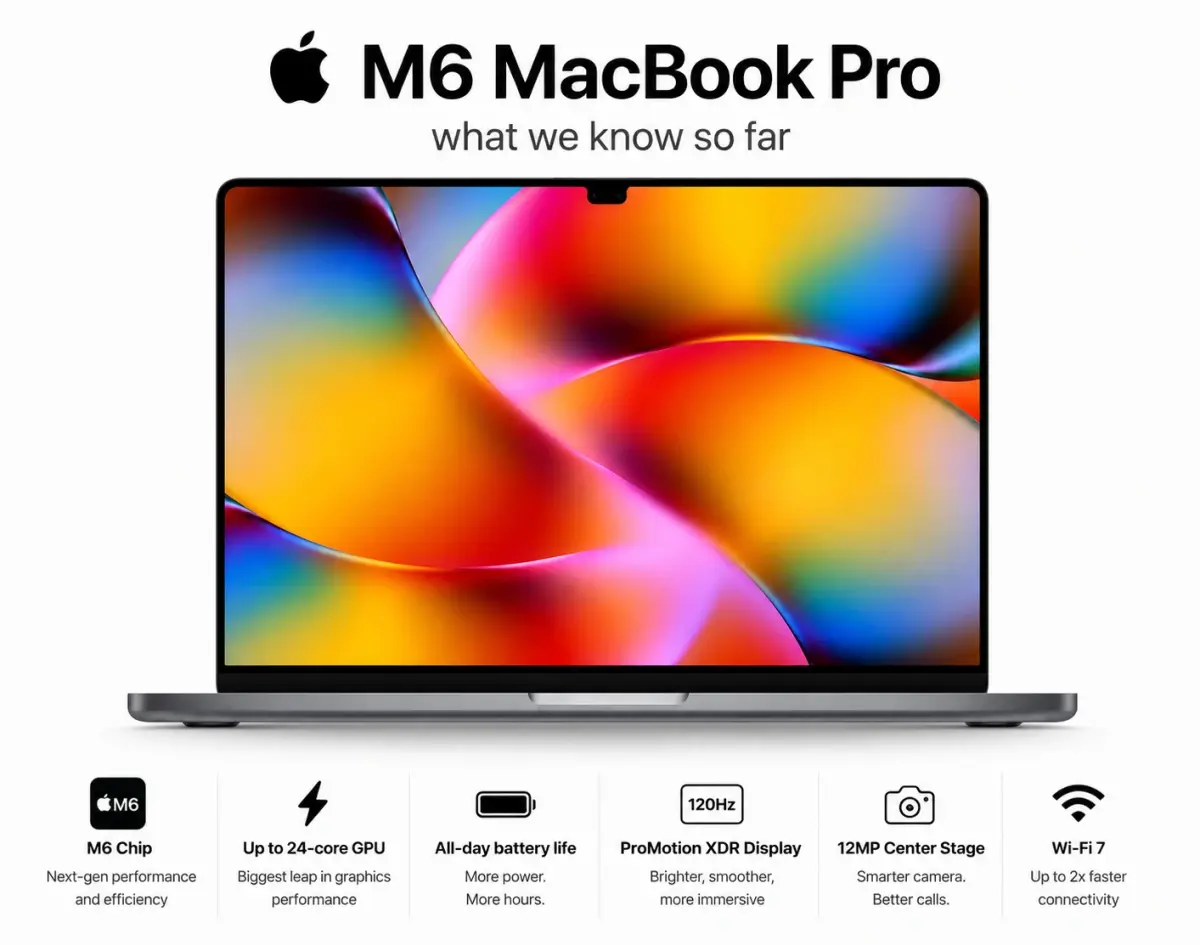
MacBook Pro M6 & OLED Screen: Full 2026 Guide (WWDC 26)
Everything you need to know about the MacBook Pro M6 in 2026 — OLED display, touchscreen, M6 chip specs, release date, and whether it's worth the wait.
Fri Apr 03 2026
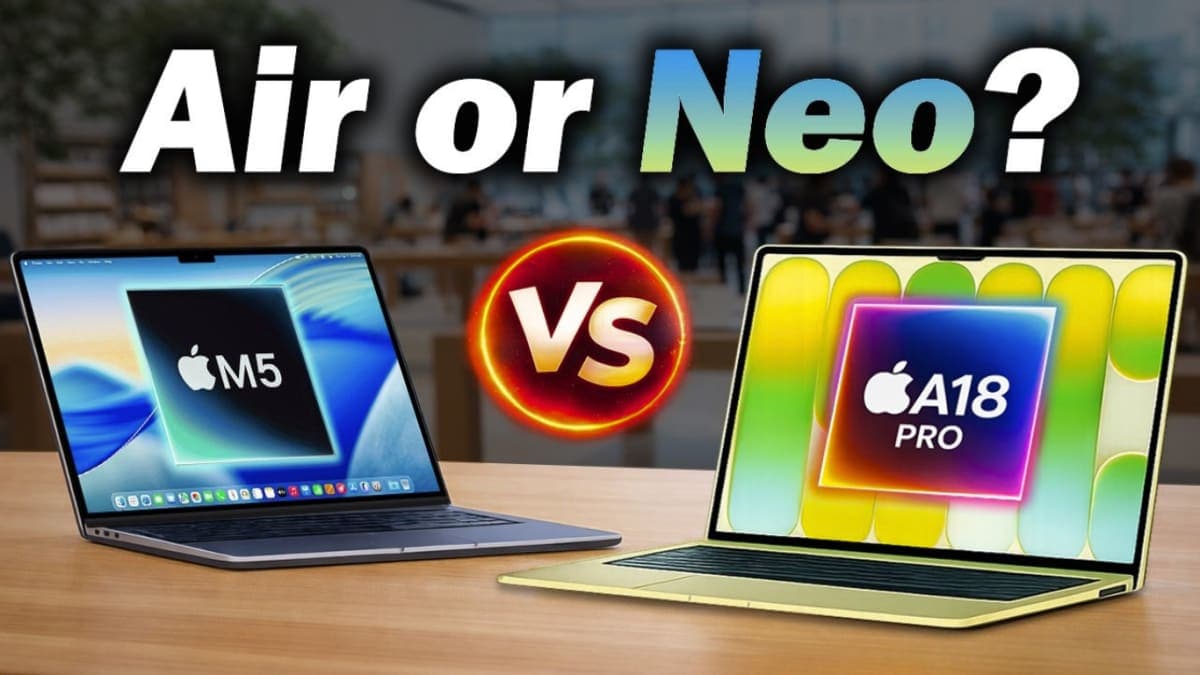
Leaks & Rumors: MacBook Neo vs MacBook Air M5: Which One Should You Buy ?
Apple launched two MacBooks in March 2026. The Neo starts at $599 with an A18 Pro chip great for light users. The Air M5 starts at $1,099 with M5, 16GB RAM, and Thunderbolt 4 built for serious work. One is a smart buy. The other is a smarter one.