Genesis AI Raises $500M to Put Its Eno Robot to Work

Published (Updated )
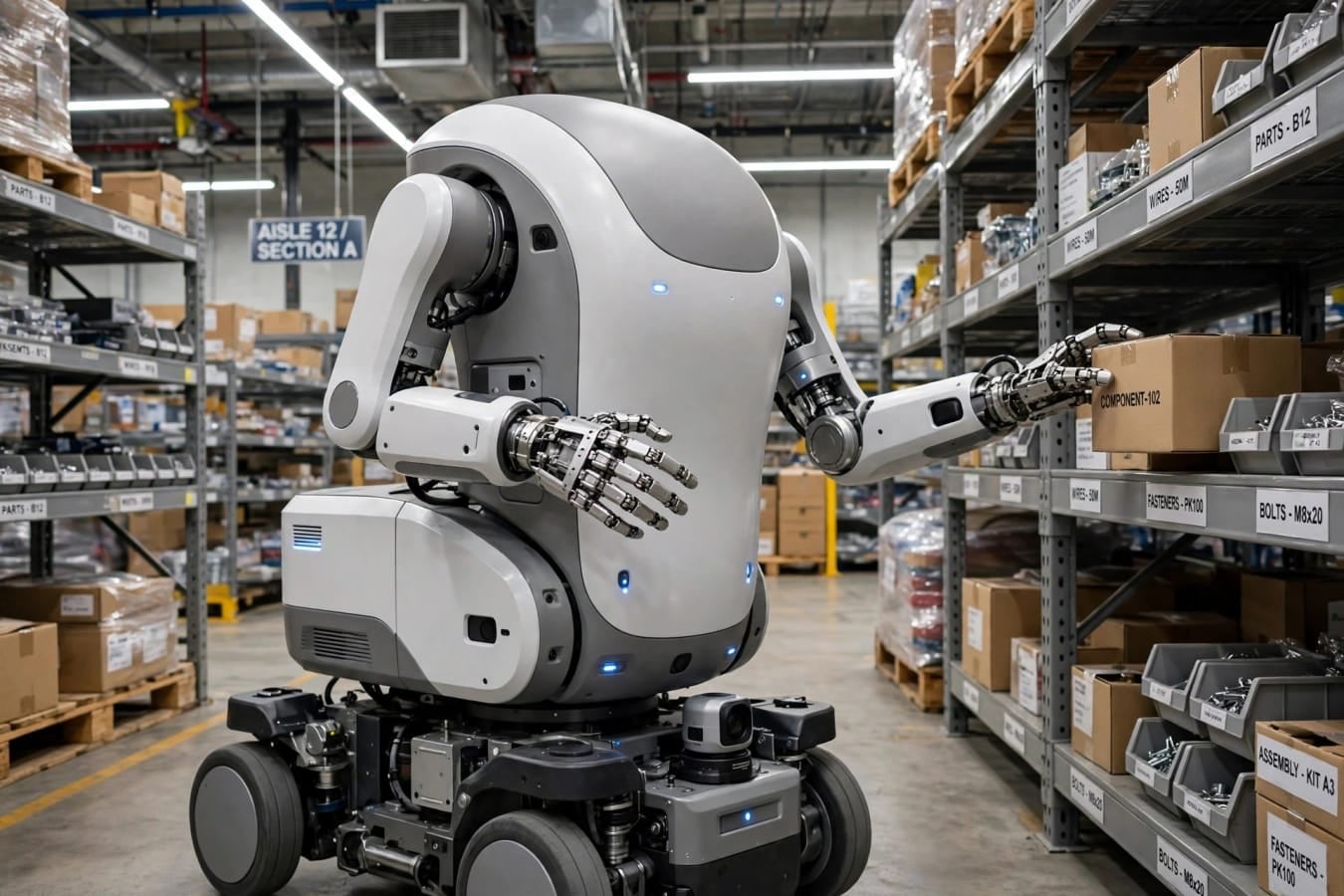
Genesis AI has raised $500 million to teach its robot human hands — and to get that robot into factories, warehouses and labs at scale. The Series A round, announced on November 17, 2026, values the young robotics company at $3.5 billion, and it carries a detail the whole chip industry noticed: Nvidia and AMD Ventures invested in the same round.
The quick answer
- What happened: Genesis AI raised a $500 million Series A at a $3.5 billion post-money valuation
- When: announced November 17, 2026
- Who led it: Premji Invest, Khosla Ventures and Eclipse co-led the round
- The headline investors: Nvidia and AMD Ventures both took part, their first joint investment in an embodied AI company
- What the money is for: scaling production and deployment of Eno, the company's wheeled general-purpose robot, plus more training data and better robot hands
- The timeline: mass production is planned for 2027 through a US contract manufacturer
The round in detail
A $500 million Series A is an unusually large early round, and the investor list explains why it got so big. Three firms co-led: Premji Invest, Khosla Ventures and Eclipse. Behind them came a long list of participants, including Durable Capital Partners, funds advised by T. Rowe Price, Bpifrance, HSG, Nvidia, AMD Ventures, Zoom, Samsung Next and Ericsson. Individual investors joined too: former Google CEO Eric Schmidt, Zoom CEO Eric Yuan, former Yahoo CEO Jerry Yang, French tech entrepreneur Xavier Niel, and former Tesla CFO Zach Kirkhorn. The round follows a $105 million financing announced in July 2025, bringing Genesis AI's total disclosed funding to $605 million since the company was founded in 2024. The company is based in Paris, with a US presence in San Carlos, California, and is led by co-founders chief executive Zhou Xian and president Théophile Gervet. One thing the announcement does not include: revenue. Genesis AI has not publicly disclosed annual revenue, unit pricing for Eno, or how many paying customers it has. The $3.5 billion valuation is a bet on the approach, not on demonstrated sales.
Why Nvidia and AMD in the same round matters
The most talked-about detail of the round is not the size. It is the investor list. Nvidia and AMD are fierce rivals in AI chips, and their venture arms rarely back the same startup. This is their first joint investment in an embodied AI company. That matters for two reasons:
- A vote on the compute stack: both chipmakers backing one robotics company signals that each sees Genesis AI's approach as a serious consumer of AI compute, whatever hardware ends up winning
- A vote on physical AI: the round is part of a wider rush into robots that can act in the real world, after years when most AI investment went to software and chatbots
Eric Schmidt's participation continues a pattern of the former Google CEO backing frontier robotics. But the Nvidia-AMD pairing is the detail other founders and investors will remember from this round.
Meet Eno, the robot the money is for
Eno is Genesis AI's flagship robot, and it deliberately does not look like the humanoid robots that dominate robotics headlines. The company says it favours human capability over human appearance. What Eno looks like:
- A wheeled base instead of legs, which makes it stable and simpler to move around flat factory and warehouse floors
- Two arms with human-proportioned hands
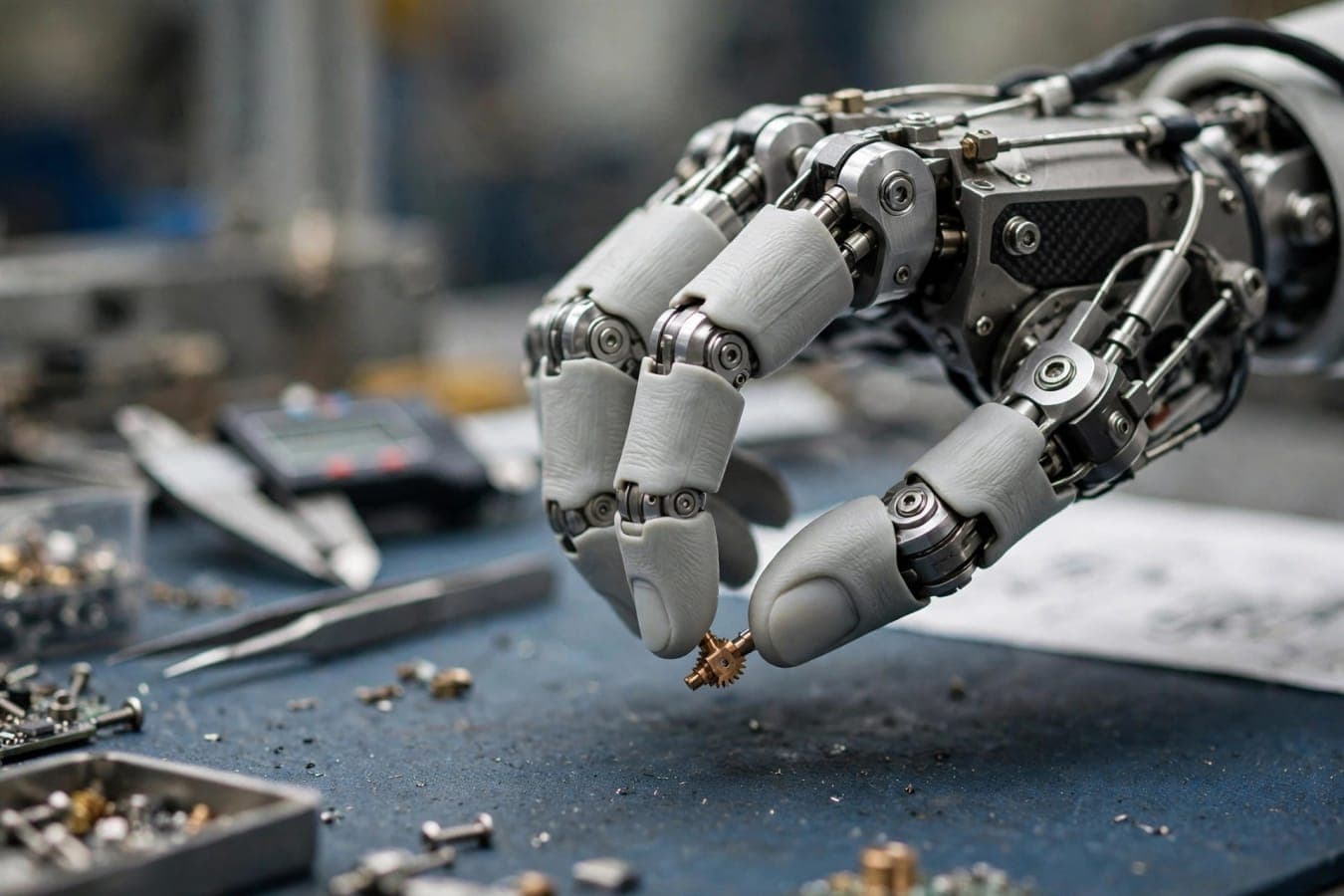
- Hands with 20 actuated degrees of freedom each, built for dexterous manipulation — the fine finger control needed to pick up, hold and use objects the way a person would
- No conventional head, which is the most visible break from humanoid design
- Folding body segments that let it adjust its shape to the task
The design choice is deliberate. Legs and a head make a robot look human, but they add cost, complexity and points of failure. Wheels and a headless body are cheaper to build and easier to keep running in an industrial setting, where nobody cares what the robot looks like as long as it does the job.
The hard problem: human-level dexterity
The real challenge Genesis AI is trying to solve is not walking or seeing. It is hands. Picking up an unfamiliar object, gripping it with the right force, and using it without dropping or crushing it is one of the hardest problems in robotics, and it is the problem that has kept general-purpose robots out of real workplaces. Genesis AI's approach is a closed learning loop with four parts:
- The GENE foundation model: the AI model that learns how to act in the physical world
- A dexterous hand: the company's own hand hardware, designed for fine manipulation
- A data-collection glove: a glove that humans wear so the system can learn from real human hand movements
- Genesis World simulation: a simulated environment that feeds training data back into the model
The idea is that each part improves the others. The glove collects human demonstrations, the simulation multiplies them into more training data, the model gets better at planning movements, and the hand hardware gets better at executing them. That loop is what the $500 million is meant to accelerate: more data acquisition, more large-scale training, and better hands.
Where Eno is today
For all the funding, Eno is still early. Genesis AI told reporters it has built 30 to 40 Eno units so far, and is piloting the robot with a small number of unnamed customers. The company has also described early customer tests and a partnership with LG CNS focused on manufacturing and logistics. The deployment plan, in order:
- First: industrial environments — manufacturing, logistics and laboratories
- Next: hospitality and healthcare
- Later: consumer and outdoor applications
A US contract manufacturer is expected to start mass-production work in 2027, with a broader customer rollout targeted for the same year. Until then, Eno is a pilot-stage machine with a large war chest behind it.
Physical AI is having a funding moment
Genesis AI is not the only robotics company raising big money this month. On the same day, funding news also covered Science Corporation raising $400 million to commercialise a vision-restoration system and fund next-generation neural interfaces, and Stanford's Noeri launching with $110 million. The pattern is clear. After two years in which AI investment concentrated on chatbots, coding assistants and image generators, money is moving into systems that act in the physical world: robots, wearables and neural interfaces. The bet is that the next big AI market is not a better chatbot, but a machine that can do physical work. Genesis AI's round is one of the largest robotics funding rounds of the year. At a $3.5 billion valuation for a company founded in 2024 with 30 to 40 robots built and no disclosed revenue, it is also one of the boldest bets on that thesis.
What could go wrong
Big valuations for early hardware companies carry real risks, and they are worth stating plainly:
- Manufacturing is hard: moving from 30 to 40 hand-built units to mass production through a contract manufacturer is where many robotics startups stumble
- Dexterity is unsolved: no company has yet demonstrated reliable human-level dexterity across unfamiliar objects and tasks at commercial scale
- Customers are unnamed: pilot customers that a company will not name are a weaker signal than signed, public deployments
- The valuation assumes success: $3.5 billion prices in a future where Eno works at scale in real workplaces, which is not yet proven
- Competition is fierce: humanoid and industrial robotics is crowded, with well-funded rivals pursuing different designs and different routes to market
None of that means Genesis AI will fail. It means the round is a bet on a team and an approach, and the proof will come when Eno units start working in real factories and warehouses in 2027.
What this means for you
If you work in manufacturing or logistics, Eno is a name to watch. The first deployments are aimed squarely at your world, and a 2027 rollout means pilot opportunities may appear sooner than the headlines suggest. If you follow AI investment, the Nvidia-AMD joint backing is the signal. When two chip rivals fund the same robotics startup, the industry is telling you physical AI is a real market, not a sideshow. If you are interested in robotics careers, Genesis AI says the funding will also pay for hiring. A company going from tens of robots to mass production needs engineers across hardware, simulation, data and deployment. If you are just curious about robots, the design is the interesting part. Eno's wheeled, headless shape is a bet that useful robots do not need to look human. If that bet pays off, the robots of the next decade may look stranger than the ones in the movies.
What to watch next
- Mass production in 2027: whether the US contract manufacturer starts work on schedule, and how many units roll off the line
- Named customers: whether Genesis AI starts naming the companies piloting Eno, and what they say about it publicly
- The dexterity demo: whether the company shows Eno handling unfamiliar objects reliably, not just rehearsed tasks
- Unit economics: whether a price for Eno is ever disclosed, and whether the numbers work for buyers
- The next round: whether the $3.5 billion valuation holds up when Genesis AI next needs to raise money, and who backs it then
The bottom line
Genesis AI has raised $500 million at a $3.5 billion valuation to put a wheeled, headless robot with human-like hands to work in factories and warehouses. The money is real, the investors are serious, and Nvidia and AMD backing the same robotics startup is a first that the industry will remember. The robot itself is still early — 30 to 40 units, unnamed pilot customers, mass production a year away. The funding buys Genesis AI the chance to prove that its bet on dexterity, data and a non-humanoid design can work at scale. Whether it can is now a $500 million question.
FAQs
What is Genesis AI?
Genesis AI is a robotics company founded in 2024, based in Paris with a US presence in San Carlos, California. It builds general-purpose robots for industrial work, led by its wheeled robot Eno and its GENE foundation model.
How much did Genesis AI raise, and at what valuation?
Genesis AI raised $500 million in a Series A announced on November 17, 2026, at a $3.5 billion post-money valuation. The round was co-led by Premji Invest, Khosla Ventures and Eclipse.
What is the Eno robot?
Eno is Genesis AI's flagship general-purpose robot. It has a wheeled base, two arms with human-proportioned hands offering 20 actuated degrees of freedom per hand, and no conventional head. It is designed for manufacturing, logistics and laboratory work.
Why is Nvidia and AMD investing together notable?
Nvidia and AMD Ventures both participated in the Genesis AI round, their first joint investment in an embodied AI company. The two chipmakers are direct rivals, so backing the same robotics startup is a strong signal about physical AI.
When will the Eno robot be available?
Genesis AI has built 30 to 40 Eno units and is piloting with a small number of unnamed customers. Mass production is planned for 2027 through a US contract manufacturer, with a broader customer rollout targeted for the same year.
Was this article helpful?

Written By
TechorCoffeeContributing Writer
TechorCoffee is a technology reporter and software creator writing reviews and tutorials for TechOrCoffee.
Comments (0)
Leave a Comment
Read Next

Tue Oct 13 2026
Gemini 4 Argon: Everything You Need to Know
Gemini 4 Argon is Google’s new flagship AI model. See its benchmarks vs GPT-6 Astra and Claude, pricing, 1M-token output, safety features and how to get access.
Fri Oct 30 2026
GPU and RAM Prices 2026: Why AI Ate Your Upgrade
GPU and RAM prices in 2026 explained: AI memory shortage, DDR5 and RTX 50 price rises, RTX 50 Super delay, and when relief may come.

Mon Oct 26 2026
Instagram Now Available on Apple TV: Check Out the Details
Social Media will be featured on your home screens! People can now scroll reels and watch videos in their living space with just one step.