SpaceX Catches Starship From Orbit in Historic First

Published (Updated )
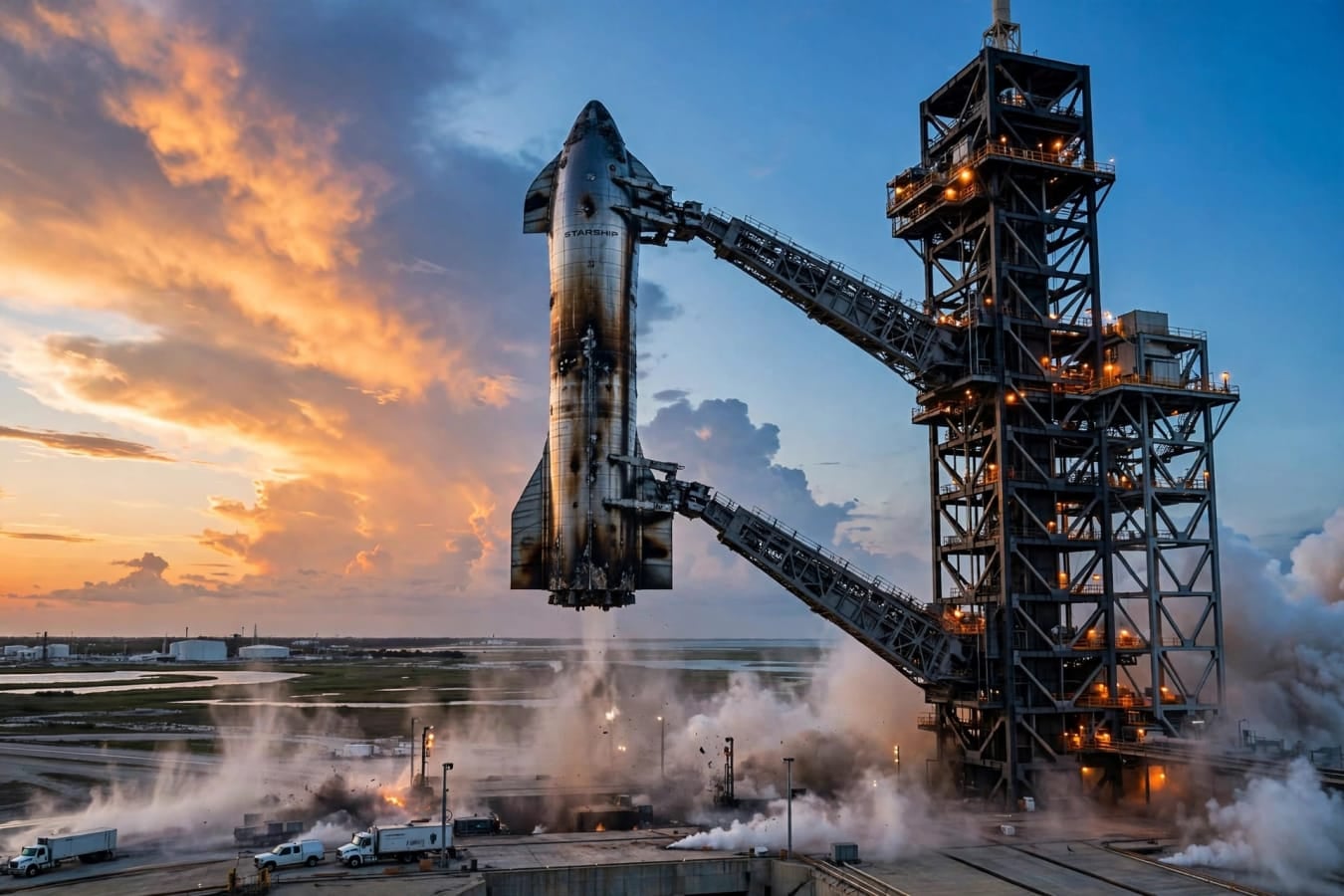
SpaceX Catches Starship From Orbit in Historic First
Quick answer
- SpaceX caught a Starship returning from orbit for the first time on Saturday, November 14, 2026, at its Starbase facility in Texas.
- The ship, known as Ship 42, spent about 22 hours in space, completed 14 orbits of Earth and deployed 26 Starlink V3 satellites before coming home.
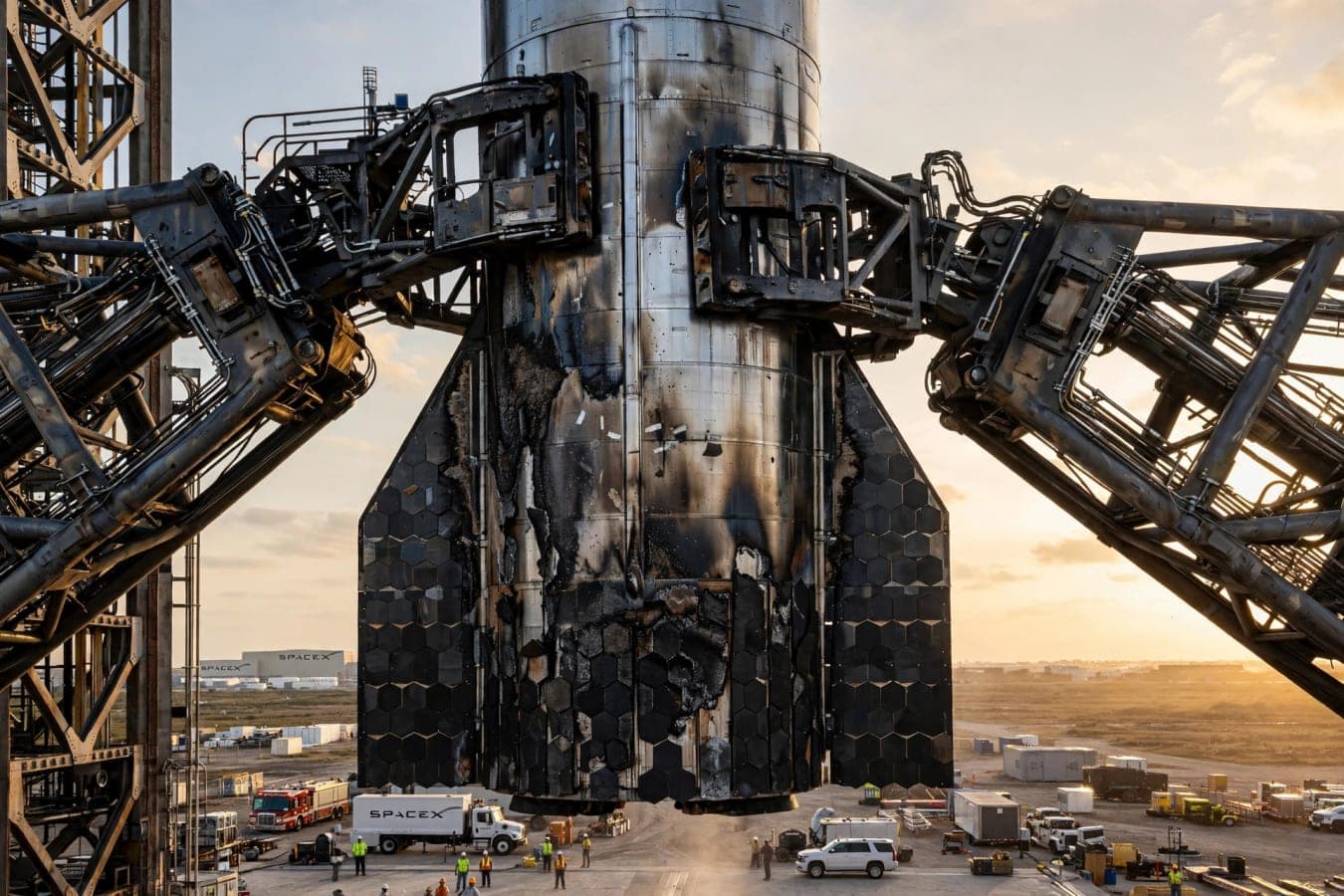
- Giant mechanical arms on the launch tower — nicknamed Mechazilla, or the "chopsticks" — grabbed the 171-foot ship out of the air as it descended vertically.
- The Super Heavy booster did not survive the flight. It was diverted over the Gulf of Mexico and destroyed after its engines shut down too early on the way back.
- The catch is a major step toward a fully reusable orbital rocket, and SpaceX expects to start flying Starships from Florida within months.
A catch 22 hours in the making
The flight began on Friday, November 13, 2026, when Flight 15 lifted off from Starbase on the Texas coast. It was the 15th full-scale Starship test flight since the program began in 2023 — but only the second time a Starship had ever reached orbit. What followed was the longest Starship mission yet, by a huge margin:
- Launch: Friday, November 13, 2026, from Starbase, Texas.
- Time in space: about 22 to 22.5 hours.
- Orbits completed: 14 full trips around Earth.
- Previous record: the longest earlier Starship flight lasted roughly 3 hours, in September 2026.
- Return and catch: Saturday, November 14, 2026, above Launch Pad 2. For most of the day the ship circled the planet, and for the first time SpaceX had a full working day in orbit to prove the vehicle could survive, operate and come home. Then, on its final pass, it dropped out of the sky over Texas, reignited its engines, flipped itself vertical and slid gently into the waiting arms. SpaceX marked the moment on its livestream by playing "Baby Come Back," the 1977 hit by Player. The joke landed: the ship had, quite literally, come back.
How the catch actually works
Catching a rocket sounds simple in a sentence and is brutally hard in practice. Here is what had to go right:
- Re-entry. Ship 42 hit the atmosphere at orbital speed, with heat-shield tiles taking the brunt of temperatures that turn the night sky orange. The ship that emerged from the clouds was visibly charred.
- The flip. After falling belly-first through much of the descent, the ship reignited its engines and rotated itself upright.
- The descent. It dropped toward the tower at a controlled speed, with small fins steering it sideways into position.
- The grab. The two mechanical arms on the tower — the chopsticks — closed around the ship's lifting points and took its full weight. The margin for error is tiny. The ship is 171 feet (52 metres) tall, and it has to arrive at exactly the right height, at exactly the right speed, within a few feet of the tower. Too fast and it smashes into the arms. Too slow and it falls past them. Too far sideways and it misses the tower entirely. Mechazilla had already caught Super Heavy boosters three times on earlier suborbital flights. But those boosters came back from much lower and slower trajectories, minutes after launch. Catching a ship returning from orbit — after a full day in space, after re-entry heating, after 14 trips around the planet — is a different class of problem. No one had ever done it before.
What the ship did in orbit
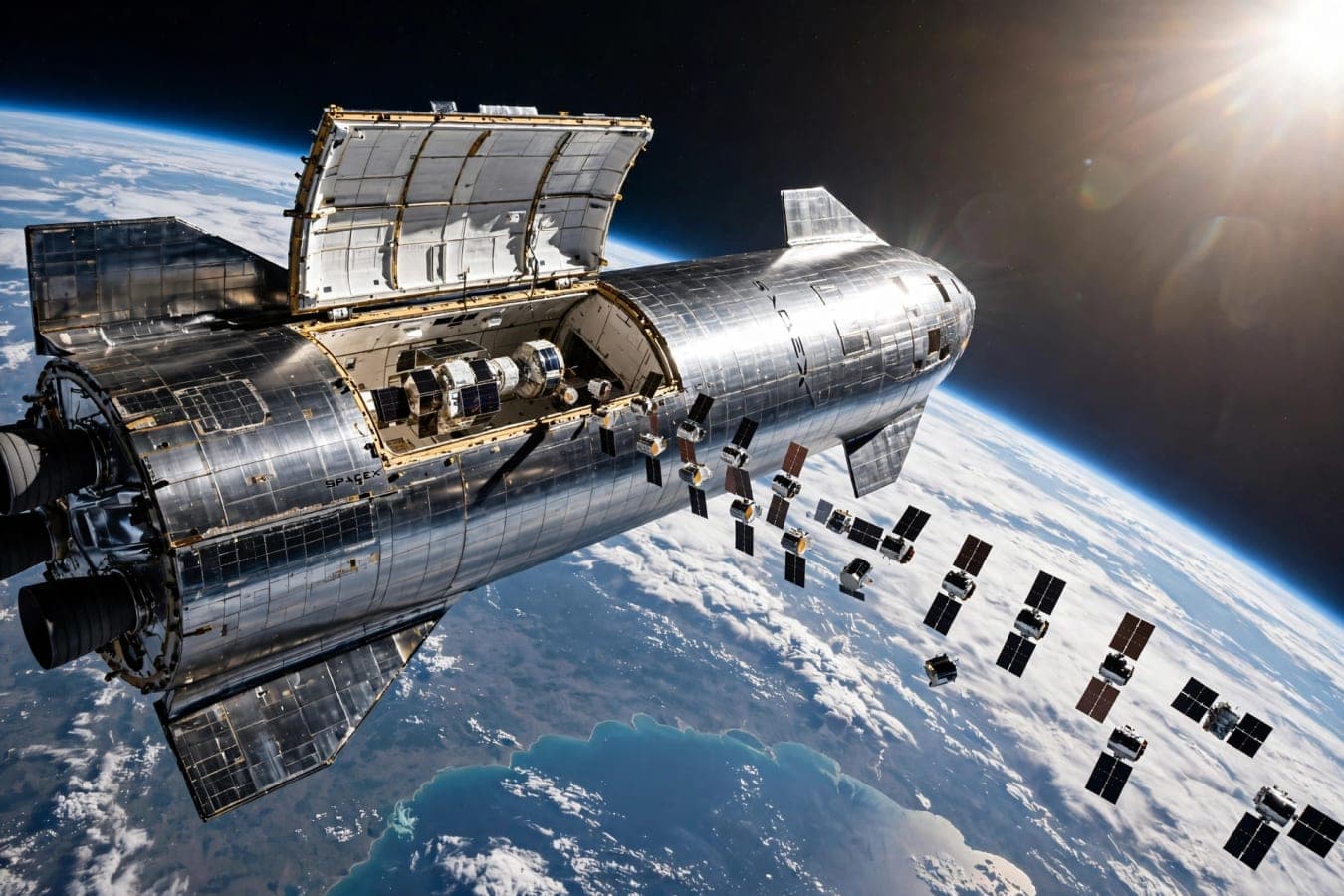
This was not a joyride. Flight 15 had a real job to do while it was up there, and it did it. The ship's main task was deploying 26 Starlink V3 satellites, the newest and largest generation of SpaceX's internet satellites. SpaceX reported that all 26 deployed successfully, are healthy and are raising their orbits to their working positions. With this batch, the V3 fleet in orbit now stands at 52 satellites. The satellite deployment matters for two reasons:
- It proves the payload bay works. Starship is designed to carry large payloads, and opening its doors in orbit and releasing satellites cleanly is a core part of the job.
- It proves the ship can work, not just fly. Surviving launch is one thing. Operating in orbit for nearly a day — managing power, heat and communications — is another. The long duration also gave SpaceX data it could never get from a three-hour flight: how the ship's systems behave over many day-night cycles, how the heat shield holds up after a full orbital re-entry, and how the vehicle handles a long cold soak in space. | Flight 15 at a glance | Detail | | --- | --- | | Ship | Ship 42, 171 ft (52 m) tall | | Launch | Friday, November 13, 2026, Starbase, Texas | | Time in space | About 22–22.5 hours | | Orbits | 14 | | Satellites deployed | 26 Starlink V3 (fleet now 52) | | Catch | Saturday, November 14, 2026, Launch Pad 2 tower | | Booster | Lost — diverted to the Gulf of Mexico | | Flight number | 15th full-scale Starship test since 2023 | | Orbital flights | Only the second Starship trip to orbit |
The booster did not make it
For all the celebration around the catch, Flight 15 was only half a success. The "double catch" — recovering both the ship and the Super Heavy booster in one flight — did not happen. On its way back, the booster ran into trouble. Its engines stopped firing too soon during the return burn, and a fuel-system alarm was detected. The booster's guidance system did what it was programmed to do in that situation: it steered the vehicle away from land and out over the Gulf of Mexico, where it was destroyed before it hit the water. A few things are worth being clear about:
- The booster was not lost over land. The diversion was deliberate, and it worked as designed. No one on the ground was at risk.
- The root cause is not yet known. SpaceX says it is still investigating why the engines shut down early and what triggered the fuel-system alarm.
- This is how the program learns. Starship's test flights are deliberately aggressive. SpaceX flies, breaks things, studies the data and flies again — a pace that traditional rocket programs, which test for years before a first launch, do not match. Still, the booster loss is a real setback for the schedule. The whole point of Starship is rapid reuse of both stages. A caught ship and a lost booster is progress, not the finished product.
Why this catch matters so much
It is easy to get used to SpaceX doing things that used to be impossible, but this one deserves a pause. Here is why experts are calling it a major technical achievement:
- Full reuse is the whole idea. Starship is designed to be the first fully reusable orbital-class rocket. Every other orbital rocket in history has thrown away at least part of itself on every flight. Catching both stages and flying them again is what makes launches cheap.
- Cheap launches change everything. If Starship can fly, land, refuel and fly again quickly, the cost of putting things in orbit falls sharply. That is what makes large satellite constellations, space stations and Moon missions affordable.
- The ship was the hard half. Boosters come back minutes after launch, from a known trajectory. The ship has to survive orbit and re-entry — the hottest, fastest and least forgiving part of the flight — and then land with precision.
- It unlocks the Moon program. NASA's Artemis program plans to use a version of Starship to land astronauts on the Moon. A reusable ship that can be caught, inspected and reflown is central to making that affordable and reliable. Clayton Swope, a space policy expert at the Center for Strategic and International Studies in Washington, described the catch as a major technical achievement — and the reaction across the space industry has been much the same. Even SpaceX's rivals have acknowledged the scale of what was done.
What Starship is, in plain terms
For readers who have not followed every flight, here is the short version:
- Starship is the largest and most powerful rocket system ever built. The full stack — Super Heavy booster plus the Starship upper stage — stands about 400 feet tall.
- It has two stages. The Super Heavy booster lifts the stack off the pad. The Starship upper stage, the ship, carries on to orbit.
- Both stages are meant to be caught. The tower's arms are designed to grab the booster and the ship as they return, so neither needs landing legs.
- It is built for volume. Starship is designed to carry more than 100 tonnes to orbit, far more than any rocket flying today.
- It is built for speed of reuse. The goal is to land, inspect, refuel and relaunch in days or even hours, like an aircraft, rather than months. The program has moved fast since the first full-scale test in 2023. Fifteen flights in under four years, two trips to orbit, three booster catches and now a ship catch from orbit is a pace no other rocket program has matched.
What happens next
The catch does not end the story. In some ways it starts a new chapter, and there are several things to watch in the coming months:
- The booster investigation. SpaceX needs to find out why the engines stopped early. Until that is fixed, the double catch stays out of reach.
- Florida launches. SpaceX expects to begin launching Starships from Kennedy Space Center in Florida within the next few months. A second launch site matters because it adds capacity and gives NASA a Starship base on the East Coast.
- Faster turnaround. The real test of the catch is what happens to Ship 42 now. Can it be inspected, refurbished and flown again quickly? That is the whole point of catching it instead of letting it splash down.
- More orbital flights. Two trips to orbit is a start. The program needs a regular rhythm of long-duration flights to prove reliability.
- The Moon timeline. NASA is watching every Starship flight closely. Each success brings the Artemis Moon landing closer; each failure is a data point that feeds into the schedule. For the US space industry, the Florida move is especially significant. Kennedy Space Center is where Apollo launched, and a Starship pad there would put the world's largest rocket alongside the historic launch complexes of the Space Coast.
The bigger picture
Step back from the details and the picture is this: a rocket the size of a 17-storey building spent a day in space, dropped 26 satellites into orbit, fell back through the atmosphere, and was plucked out of the sky by a pair of robot arms. The ship that landed was scorched black by the heat of re-entry — visible proof of what it had survived. At the same time, the booster that launched it was lost to the sea because its engines quit early. That is the honest shape of Flight 15: a historic success and a real failure in the same mission, on the same day. That is also, in a sense, the story of the Starship program itself. It moves faster than any rocket program before it precisely because it is willing to fly, fail in public and learn. The catch on November 14 is the biggest payoff of that approach so far. Whether the program can now repeat it — with both stages, flight after flight — is the question that will define the next year of spaceflight.
The bottom line
SpaceX caught a Starship from orbit for the first time on November 14, 2026, after a 22-hour, 14-orbit mission that deployed 26 Starlink satellites. Mechazilla's arms grabbed the charred Ship 42 above Launch Pad 2 in Texas — a first that brings fully reusable orbital flight within reach. The Super Heavy booster was lost on the way back, so the double catch will have to wait. But the hard half is now done, and Florida launches are next.
FAQs
When did SpaceX catch a Starship from orbit for the first time?
On Saturday, November 14, 2026. The ship, Ship 42, was caught by the Mechazilla tower arms at Starbase, Texas, after spending about 22 hours in space and completing 14 orbits.
What is Mechazilla?
Mechazilla is the nickname for SpaceX's launch tower at Starbase, Texas, and its two giant mechanical arms, also called the "chopsticks." The arms catch returning Starship vehicles out of the air so they do not need landing legs.
What did Starship Flight 15 do in orbit?
During its roughly 22-hour mission, Ship 42 completed 14 orbits and deployed 26 Starlink V3 satellites. SpaceX reported that all 26 satellites are healthy and raising their orbits, bringing the V3 fleet to 52 satellites.
What happened to the Super Heavy booster on Flight 15?
The booster was lost. Its engines stopped firing too soon on the way back and a fuel-system alarm was detected, so its guidance system diverted it over the Gulf of Mexico, where it was destroyed before hitting the water. SpaceX is investigating the cause.
Why is catching Starship important?
Catching the ship is a key step toward a fully reusable orbital rocket. If both the booster and the ship can be caught, inspected and reflown quickly, the cost of launching to orbit falls sharply — which matters for satellites, space stations and NASA's Artemis Moon missions.
When will Starship launch from Florida?
SpaceX expects to begin launching Starships from Kennedy Space Center in Florida within the next few months, adding a second launch site alongside Starbase in Texas.
Was this article helpful?

Written By
TechorCoffeeContributing Writer
TechorCoffee is a technology reporter and software creator writing reviews and tutorials for TechOrCoffee.
Comments (0)
Leave a Comment
Read Next

Sat Nov 14 2026
SpaceX Starship Flight 15 Deploys 26 Starlink Satellites
SpaceX Starship Flight 15 reached orbit and deployed 26 Starlink V3 satellites, though the booster missed its tower catch. How the flight unfolded.

Sat Nov 14 2026
Nvidia CEO Jensen Huang Resigns After 33 Years at Top
NVIDIA has announced co-founder Jensen Huang has resigned as CEO after 33 years. CFO Colette Kress will serve as interim CEO during the search.

Wed Nov 18 2026
Microsoft 365 Outage: The July Bug That Broke Outlook
Microsoft has explained the November 12 Microsoft 365 outage: a July software bug, a Teams failover and lost server capacity combined to knock Outlook offline.