Agentic AI Explained: Agents That Actually Act

Published
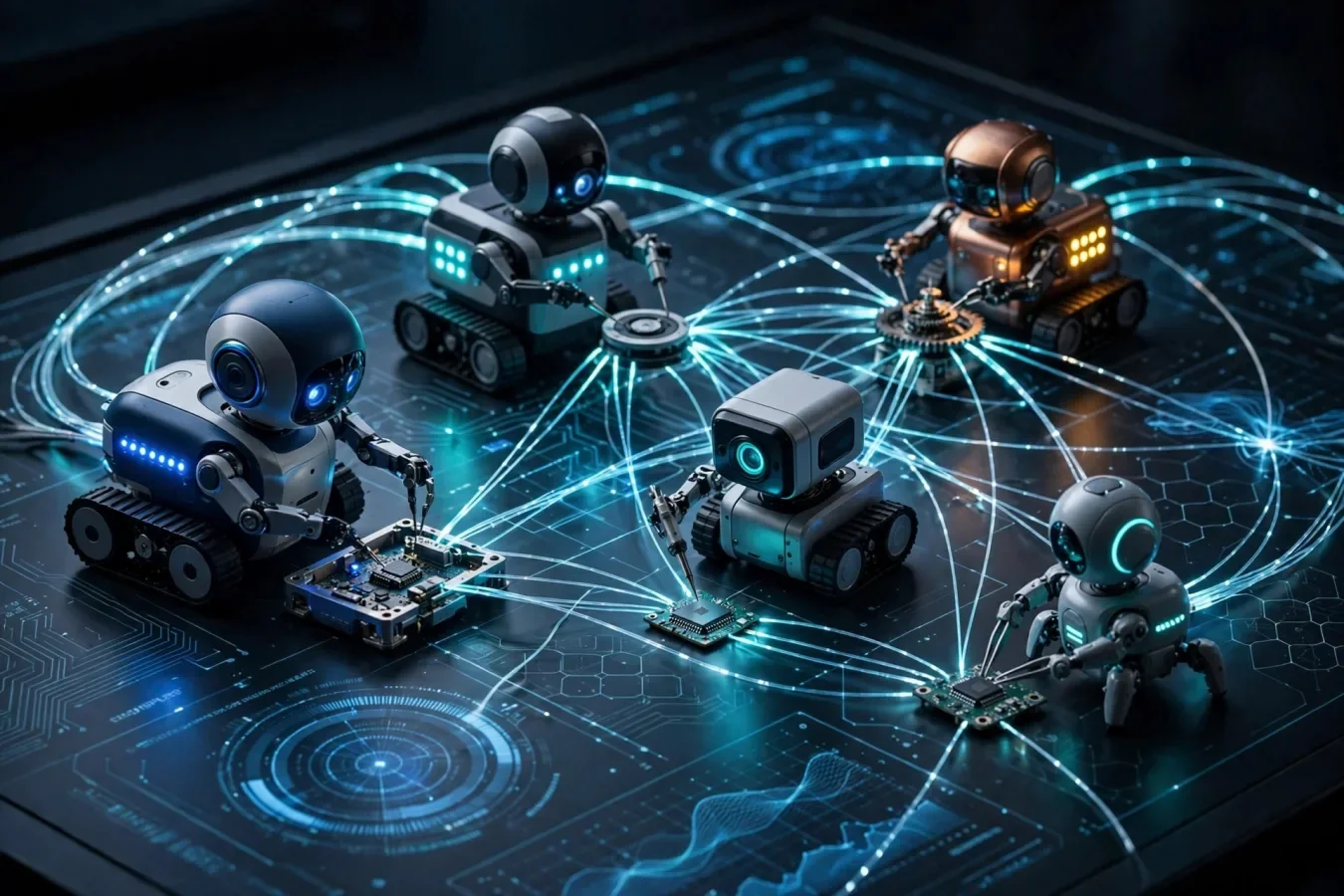
Chatbots answer. Agents act. That difference changes everything
Ask a chatbot a question, and you get an answer. Give an AI agent a goal, and it breaks that goal into steps, chooses tools, calls APIs, runs code, reads files, sends messages, observes the results, adjusts its plan, and keeps going until the task is done — or until it needs a human.
That shift, from conversation to controlled action, is why agentic AI is the major enterprise technology story of 2026. It's also why it's harder to secure, harder to cost, and harder to trust than a chatbot. An agent that can act is not necessarily reliable enough to act unsupervised, and the most important skill in 2026 is knowing where to draw that line.
This guide explains what agentic AI is, how agents work, where they're useful today, why they fail, and how to deploy one safely — for developers and business leaders alike.
What makes a system an agent, not just a chatbot
Anthropic makes a useful distinction that cuts through the hype: a workflow follows paths designed by developers in advance, while an agent dynamically directs its own process and tool use. A workflow is a flowchart. An agent is a colleague who can improvise within bounds.
An AI agent, in the definition used across 2026 guides, is a software system that perceives its environment, makes decisions, and takes actions to achieve a specified goal, with a meaningful degree of autonomy across multiple steps. Four components make that definition work:
- Autonomy: the agent can proceed through a sequence of steps without human approval at each step. A system that asks for confirmation before every action is a UI, not an agent.
- Goal-driven behaviour: the agent has an objective it's working toward, and its behaviour is organised around reaching it, not just responding to the latest message.
- Interaction with the environment: the agent has real effects. It reads files, calls APIs, runs code, queries databases, sends messages, or navigates interfaces.
- Adaptation: when a tool fails or returns an unexpected result, the agent diagnoses the problem and adjusts, rather than stopping cold.
Most agentic systems today are built on a reasoning loop: the model receives a goal, generates a plan, picks a tool, executes it, observes the result, and loops — until the goal is achieved or it needs human input. The building blocks are:
- An LLM backbone — the reasoning engine that plans and decides.
- Tool calling — APIs, web search, code execution, file access — the "hands" of the agent.
- Memory — short-term (the conversation window), long-term (vector databases, files), and episodic (logs of past actions), so the agent remembers what it's done and what's left.
- An orchestration layer — frameworks like LangChain, LangGraph, AutoGen, CrewAI, or a custom loop — that manages the agent's lifecycle.
A sales agent example, from agentic workflow guides, makes this concrete: a single instruction pulls open deals from your CRM, cross-references them against a market intelligence API, writes a personalised follow-up email for each lead, and queues them in your email platform. That's not a chatbot answering a question. That's a multi-step job, done by software, with tools.
Why 2026, and why now
Several factors made 2026 the breakout year for agentic AI:
- Model capability: leading models now reason reliably over longer contexts and make fewer errors during extended tasks — the primary technical challenge that held agents back in 2023 and 2024.
- Tool ecosystem maturity: standardised protocols let agents connect to thousands of services without custom integration work for each one. The most important is MCP, the Model Context Protocol, introduced by Anthropic in 2024, which standardises how agents connect to tools and data. Google's A2A protocol, from 2025, does the same for agent-to-agent communication across team or vendor boundaries, and IBM's ACP covers lightweight local agent calls.
- Cost reduction: the cost of running AI inference has dropped sharply since 2023, making persistent agents economically viable for tasks that would previously have been too expensive to automate this way.
Where agents actually work today
Agentic AI is in production across software engineering, finance, healthcare, and business operations — anywhere repetitive multi-step workflows exist. The strongest use cases are:
- Coding: tools like GitHub Copilot Workspace, Cursor, Devin, and Claude's computer use can take a feature request, write code, run tests, fix bugs, and open a pull request, with minimal developer involvement. Devin, from Cognition Labs, became the first "AI software engineer" to complete real freelance tasks on Upwork in 2024, according to guides. Coding is the most mature agent use case, because code has tests — a built-in way to check whether the agent's work is correct.
- Research: an agent can search the web, query databases, summarise papers, and compile findings into a report, across dozens of sources, faster than a human researcher — provided a human checks the sources and conclusions, because agents still hallucinate citations.
- Customer support: agents can pull order history, check policy, draft a response, and escalate to a human when the case is complex or high-value. The key is escalation: a support agent that never escalates will eventually mishandle a case it doesn't understand.
- Business workflows: invoice processing, onboarding, data entry, and reporting — tasks that involve reading from one system, transforming data, and writing to another. These are where agents save the most time, because they're multi-step, repetitive, and rule-bound.
- Computer use: agents that navigate a browser or desktop interface, clicking buttons and filling forms, for tasks where no API exists. This is powerful, and fragile: a UI change can break the agent, and a mis-click can have real consequences.
Why agents fail: the four failure modes
Agents fail differently from chatbots, and understanding those failure modes is essential before you deploy one.
First, long-loop reliability. Even the best models can lose coherent intent across 30 or more steps. Attention degrades, the agent forgets an earlier constraint, or it drifts from the original goal. Errors compound: one wrong assumption early can derail dozens of subsequent steps, each building on the last. That's why long agent runs need checkpoints, summaries, and a way to restart from a known-good state, rather than blindly continuing.
Second, cost at scale. A 20-step agent using a frontier model can consume 100 times the tokens of a single-turn query, according to agentic workflow guides. Cost accounting for multi-step agents requires a different mental model than chat-based AI: you need to budget per task, not per message, and you need caps — per run, per day, per agent — so a looping agent doesn't run up a bill while stuck on a task it can't complete.
Third, tool failure handling. When an API returns a 500 error, or a web page loads unexpectedly, models vary widely in how gracefully they recover. Most need explicit instructions about what to do when tools fail: retry, try an alternative tool, or escalate to a human. Without those instructions, an agent may hallucinate a tool result, repeat a failing call indefinitely, or silently skip a step and report success.
Fourth, the human-in-the-loop gap. The most dangerous agent is one that acts without a human ever seeing its actions, especially for irreversible steps: sending an email, approving a payment, deleting a record, deploying code. Good deployments enforce human approval for high-risk tasks, and keep humans in the approval seat for irreversible decisions, while letting agents handle research and drafting autonomously.
The security problem: prompt injection becomes an action problem
The security problem with agents is not that they're less secure than chatbots. It's that the consequences are larger, because agents act.
An ordinary chatbot can be manipulated into producing false answers. An agent with access to email, shared drives, tickets, supplier portals, and financial systems can be manipulated into taking actions. Attackers hide malicious instructions inside a retrieved web page, document, email, or database field. If the agent confuses that lower-trust material with authorised commands, it may disclose information, approve an improper transaction, or alter a record.
That's prompt injection, and for agents it's an action problem, not just a content problem. The OWASP Top 10 for Agentic Applications, published 9 December 2025 and built from incidents that happened in 2025 rather than hypothetical scenarios, catalogues the risks: goal hijack, tool misuse, privilege abuse, supply chain compromise, unexpected code execution, memory poisoning, insecure agent-to-agent communication, cascading failures, human-agent trust exploitation, and rogue agents. The three that cause the most damage in enterprise deployments, according to risk guides, are goal hijack (prompt injection redirects the agent's objective), identity privilege abuse (agents inherit standing credentials, so one compromise cascades), and cascading failures (one hijacked agent poisons every agent downstream).
Microsoft has framed agents as "your newest insiders" — secure them like privileged insiders, with least privilege, audit trails, and human oversight.
How to deploy an agent safely: a practical checklist
If you're deploying an agent, whether you built it or bought it, use this checklist before it touches production systems:
- Give each agent its own identity, not a human's credentials. Only 21.9% of organisations treat agents as independent identity-bearing entities, and 45.6% still pass shared API keys between agents, according to Gravitee's February 2026 survey — the pattern that turns one compromised agent into lateral movement across systems.
- Enforce least privilege. Scope credentials tightly to the specific tools and data required for the task, with time-bound or just-in-time elevation where possible. An agent that only needs to read tickets should not be able to delete them.
- Use tool allowlists and network egress restrictions. The agent should only be able to call approved tools, and only reach approved destinations. Prompts alone are not a security boundary.
- Require human approval for irreversible actions: database writes, code deployment, external communications, payments, permission changes. Let agents draft, but keep humans approving.
- Log everything, with protected audit logs. Every tool call, every decision, every escalation, with a timestamp and the agent's identity, so you can investigate when something goes wrong — and you will need to, because something will.
- Isolate untrusted content. Treat web pages, emails, and documents the agent reads as untrusted data, not instructions, and validate tool arguments before execution.
- Keep an inventory, with a named owner for every agent. Shadow agents — agents deployed without IT knowledge, or forgotten after a pilot — are a major risk, because no one is watching them.
- Test in a sandbox before production, with realistic failure cases: a failing API, a poisoned document, a prompt injection attempt, a tool that returns unexpected data. If the agent can't handle those in a sandbox, it won't handle them in production.
- Set cost caps and kill switches. A per-run token cap, a daily spend cap, and a kill switch that a human can hit instantly, without needing the agent's cooperation.
The verdict: agents are real, but they're not magic
Agentic AI in 2026 is real, it's in production, and it's genuinely useful for multi-step, well-defined work — especially coding, research, support, and business workflows where the result can be checked. It's also fragile over long runs, expensive at scale if uncapped, and dangerous if given broad permissions without guardrails.
For most teams, start small and scoped: pick one workflow with a clear check, give the agent read access first, add write access only with human approval, log everything, and measure cost and error rate before you expand.
Agents that act are the future of how we use AI. The teams that succeed with them won't be the ones that give them the most freedom fastest. They'll be the ones that give them the right freedom, with the right guardrails, and keep a human in the loop for the decisions that matter.
FAQs
What is agentic AI?
Agentic AI describes systems that pursue a goal through multiple steps, using tools, observing results, and adapting their actions, rather than simply generating one response to a prompt.
How is an AI agent different from a chatbot?
A chatbot answers a question. An agent breaks a goal into steps, calls tools, runs code, sends messages, and keeps going until the task is done, with a meaningful degree of autonomy.
What is MCP?
The Model Context Protocol, introduced by Anthropic in 2024, standardises how agents connect to tools and data, so each integration does not need custom work. Google's A2A protocol does the same for agent-to-agent communication.
Where are AI agents used today?
Coding, research, customer support, business workflows like invoice processing and onboarding, and computer-use tasks where no API exists. Coding is the most mature use case, because tests check the agent's work.
What is prompt injection for agents?
Malicious instructions hidden in content an agent reads, such as a web page or email, that redirect the agent to take unauthorised actions. For agents, this is an action problem, not just a bad answer, because the agent can send, delete, or approve things.
How do I deploy an AI agent safely?
Give it its own identity, enforce least privilege, use tool allowlists, require human approval for irreversible actions, log everything, test in a sandbox, and set cost caps and a kill switch.
Will agentic AI replace jobs?
It will automate multi-step, repetitive workflows, and create new roles in agent supervision, evaluation, and governance. The shift is from doing the task to checking, scoping, and owning the agent that does it.
Was this article helpful?

Written By
TechorCoffeeContributing Writer
TechorCoffee is a technology reporter and software creator writing reviews and tutorials for TechOrCoffee.
Comments (0)
Leave a Comment
Read Next

Tue Apr 21 2026
Best AI Tools for Students & Creators in 2026:Complete Guide
AI tools are transforming how students learn and creators produce content. From writing assistants to design and research tools, these platforms save time, enhance creativity, and improve efficiency. Choosing the right AI stack can significantly boost productivity and output quality.
Tue Jun 16 2026
Apple Intelligence 2.0: Siri AI & iOS 27 at WWDC 2026
Apple Intelligence 2.0 is here. I cover Siri AI, iOS 27 release dates, supported devices, and how Apple's new AI really compares to ChatGPT and Gemini.
Tue Oct 13 2026
Gemini 4 Argon: Everything You Need to Know
Gemini 4 Argon is Google’s new flagship AI model. See its benchmarks vs GPT-6 Astra and Claude, pricing, 1M-token output, safety features and how to get access.