DeepSeek Free Chat Now Has Daily Limits: What Changed

Published
Quick answer
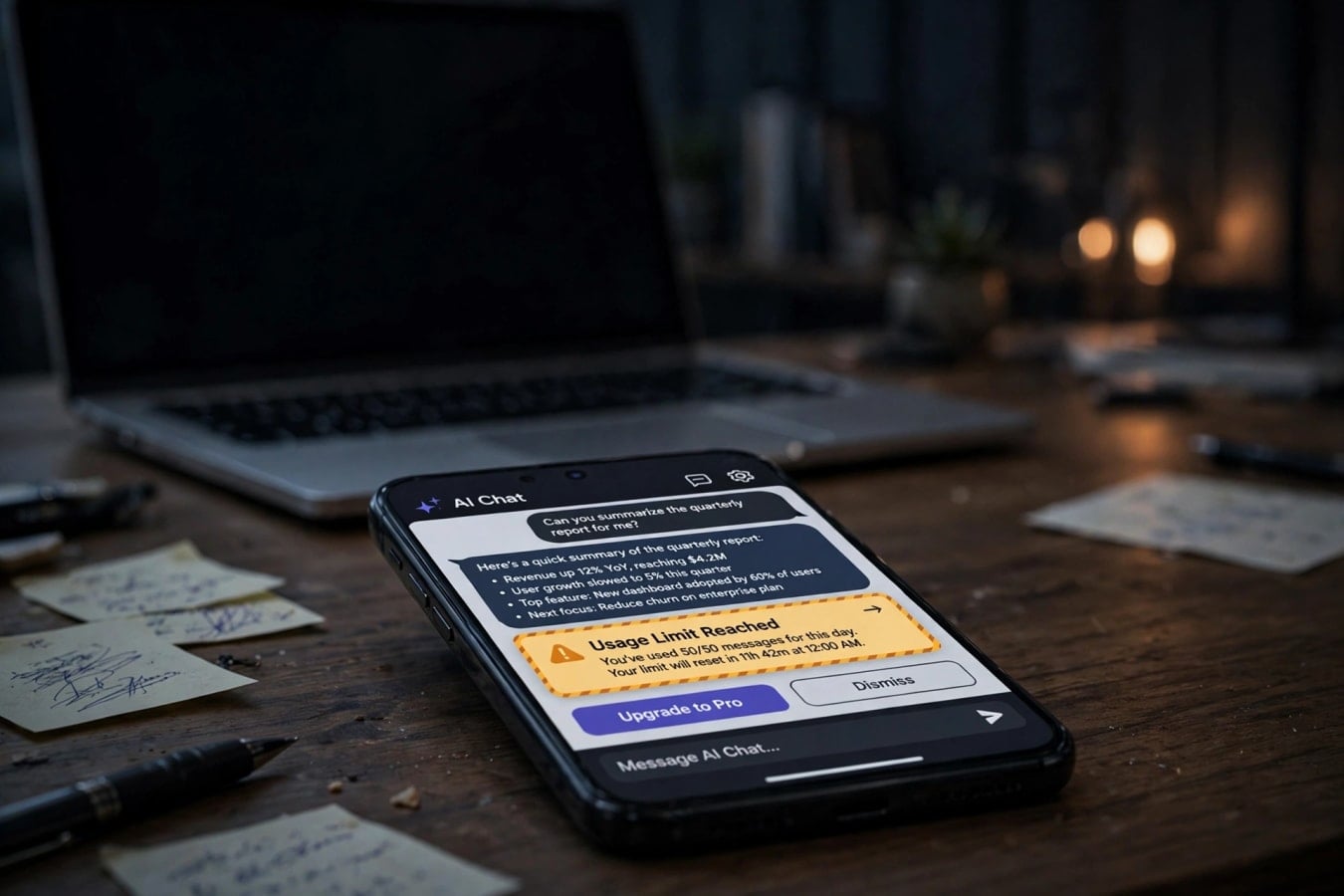
- Since the evening of November 15, 2026, DeepSeek free users have reported new limits on the app and web chat.
- The limits cover three things: a daily conversation quota, a roughly 40,000-character cap on single inputs, and old chats that can no longer be resumed.
- DeepSeek's in-app notice blames "insufficient computing power."
- DeepSeek has published no official statement, no unified quota rules, and no timeline for lifting the limits.
- The limits apply to the free consumer app and web version. The paid API for developers is unaffected.
What changed
DeepSeek built its reputation on a free AI assistant with no published message limits. That changed on the evening of November 15, 2026, when users of the DeepSeek app and web version began seeing new restrictions. According to user reports and Chinese media outlets including the Science and Technology Innovation Board Daily and Dushi Kuaibao, three limits appeared at once:
- A daily quota. When daily usage hits the cap, the app shows a message saying the server is busy and the usage quota has been reached. Users then have to wait for the quota to reset. The size of the daily quota has not been published.
- A shorter input limit. A single text input has been cut to roughly 40,000 characters (about 40,000 Chinese characters, per the reports). That is still generous for everyday questions, but it narrows the room for very long texts, full reports, long code files or batch materials.
- Old chats expire. Conversations that have been inactive for more than seven days can no longer be continued. Users can start a new chat or export the history to another app. Some users reported being unable to resume conversations after just 72 hours of inactivity, so the exact threshold is disputed. The topic trended on Weibo, China's largest social platform, as users compared notes on what they were seeing.
What DeepSeek has said — and not said
DeepSeek has not issued a formal public statement about the limits. It has not published unified quota rules, has not said how big the daily quota is, and has not said whether the restrictions are temporary or permanent. What users do see is the in-app notice itself, which attributes the changes to a shortage of computing power. Media reports cite that notice as the source of the explanation. That silence matters. Without official rules, users cannot plan around the limits, and nobody outside the company knows when — or whether — full free access will return.
Why compute is the bottleneck
Analysts quoted in the coverage interpret the restriction as a sign of processing power shortages in China, linked to US chip export controls. DeepSeek's models are among the most widely used in the world, and demand for free chat has grown fast. A few facts frame the pressure:
- DeepSeek's free chat has no paid plan. The company sells its models to developers through its API instead, so heavy free use is a cost rather than a revenue stream.
- The API, which uses separate call limits and pay-as-you-go billing, is unaffected by the new limits. The restrictions apply only to the consumer app and web version.
- In users' examples, the daily quota resets at 01:00 Beijing time on November 16 and 17. That timing has not been announced officially, so users should go by what the app itself shows. The pattern is familiar across the AI industry. Free tiers attract enormous demand, and when compute runs short, providers ration access — usually by capping messages, shortening context, or both.

How the limits compare with rivals
DeepSeek's change puts it in line with a broader shift: free AI chat is no longer unlimited almost anywhere. A comparison checked on November 16, 2026, found:
- ChatGPT: Unlimited everyday text chats
- Perplexity: Practically unlimited basic searches
- Gemini: Resets every 5 hours
- Claude: Resets every 5 hours
- DeepSeek: Now limited — daily quota, number not published The difference is transparency. Rivals publish their limits or show them clearly in the product. DeepSeek's limits arrived without an announcement, and the quota size is still unpublished.
How DeepSeek got here
DeepSeek's rise was one of the biggest stories in AI. The Chinese company's models, DeepSeek-V3 and DeepSeek-R1, won attention worldwide for strong performance at a fraction of the cost of Western rivals, and its free chat app surged in popularity as users flocked to try them. That popularity is now part of the problem. A free service with no published limits and no paid chat plan to absorb demand can only handle so much traffic before compute runs short. DeepSeek's models also rank among the most heavily used in the world by token volume, which means every free conversation adds to an already enormous bill. The company has not said how many users are affected or how much capacity it needs. What the reports make clear is that the free tier grew faster than the infrastructure behind it, and the new limits are the first visible sign of that strain.
Who is affected most
The daily quota is the bluntest of the three limits, and it affects the most engaged users first, since they hit the cap fastest.
- Heavy daily users may be forced to stop mid-day and wait for the reset.
- People with long-running projects lose the ability to pick up a conversation after a week away, which breaks workflows that rely on cross-period work and repeated retrieval of historical context.
- Users pasting long documents now face the roughly 40,000-character single-input cap, which limits processing of full reports and long code files.
- Casual users asking short questions are least affected, and may never notice the change. For most people, the practical impact is small. For power users who built routines around DeepSeek's free chat, the change is a real disruption.
What you can do
If you use DeepSeek's free chat and hit the new limits, a few steps help:
- Export important chats. If a long conversation matters to you, export its history before it passes the inactivity threshold. Once a chat can no longer be resumed, starting fresh loses the context.
- Keep inputs shorter. Split very long documents into smaller chunks instead of pasting everything in one message.
- Spread heavy use across the day. The daily quota resets — in user reports, at 01:00 Beijing time — so pacing your heaviest work can avoid hitting the cap mid-task.
- Consider alternatives. ChatGPT offers unlimited everyday text chats, and Gemini and Claude reset their limits every 5 hours. If DeepSeek is your main tool, having a backup ready avoids being stuck when the quota runs out.
- Check DeepSeek's own pages. The company's website and app notices are the most reliable source for the current rules, since no official statement has been published and the limits may change without warning.
- Watch for an official update. DeepSeek has not said whether the limits are temporary. Any official statement or change to the in-app notice is the best signal of what comes next.

What this means for the free AI market
DeepSeek's move fits a wider pattern. Free AI chat was the default in the early days of the chatbot boom, when providers were competing for users and compute was cheap enough to give away. That era is ending. Providers are now drawing clearer lines between free and paid. ChatGPT keeps everyday text chats unlimited but charges for its most powerful models and features. Gemini and Claude reset free limits every few hours. Perplexity keeps basic searches practically unlimited but gates advanced features. DeepSeek stood out because it offered a powerful free assistant with no visible ceiling and no paid plan at all. The new limits bring it closer to the rest of the market, but with an important difference: the limits arrived without an announcement, without published numbers, and without a paid option for users who want to keep going. That combination — quiet rationing with no upgrade path — is what makes this change notable. Users cannot pay to remove the limits, because there is no paid chat plan to buy. They can only wait, work around the caps, or switch to a rival. Whether DeepSeek eventually launches a paid plan, restores full free access, or keeps the limits in place will shape how users think about the service. For now, the safest assumption is that the generous, unlimited version of DeepSeek's free chat is over.
The bottom line
DeepSeek's free chat was one of the most generous offers in AI — unlimited, free, and with no paid plan to push users toward. The new limits, introduced without an official announcement, show that even the most popular free AI services have a compute bill to pay. Whether the restrictions are a short-term fix or a permanent change is still unknown. What is clear is that free AI chat is getting less free, and users who depend on DeepSeek should plan for limits rather than assume the old rules still apply.
FAQs
What limits has DeepSeek put on free chat?
Since November 15, 2026, free users report a daily conversation quota, a roughly 40,000-character cap on single inputs, and chats inactive for more than seven days that can no longer be resumed.
Why did DeepSeek add the limits?
The in-app notice cites "insufficient computing power." DeepSeek has not issued a formal public statement, and analysts link the pressure to high demand and chip supply constraints in China.
Do the limits affect DeepSeek's API?
No. The limits apply only to the free consumer app and web version. The developer API has separate call limits and pay-as-you-go billing.
When does the daily quota reset?
In user reports, the quota reset at 01:00 Beijing time on November 16 and 17. DeepSeek has not announced an official reset time, so users should go by what the app shows.
Can I still use DeepSeek for free?
Yes. The free app and web chat still work, but with the new daily quota, input cap and chat expiry rules. There is still no paid chat plan.
What should I do if I hit the daily limit?
Wait for the quota to reset, keep inputs shorter, export important chats before they expire, and consider a backup chatbot such as ChatGPT, Gemini or Claude for heavy work.
Was this article helpful?

Written By
TechorCoffeeContributing Writer
TechorCoffee is a technology reporter and software creator writing reviews and tutorials for TechOrCoffee.
Comments (0)
Leave a Comment
Read Next

Tue Apr 21 2026
Best AI Tools for Students & Creators in 2026:Complete Guide
AI tools are transforming how students learn and creators produce content. From writing assistants to design and research tools, these platforms save time, enhance creativity, and improve efficiency. Choosing the right AI stack can significantly boost productivity and output quality.
Tue Jun 16 2026
Apple Intelligence 2.0: Siri AI & iOS 27 at WWDC 2026
Apple Intelligence 2.0 is here. I cover Siri AI, iOS 27 release dates, supported devices, and how Apple's new AI really compares to ChatGPT and Gemini.
Tue Oct 13 2026
Gemini 4 Argon: Everything You Need to Know
Gemini 4 Argon is Google’s new flagship AI model. See its benchmarks vs GPT-6 Astra and Claude, pricing, 1M-token output, safety features and how to get access.