Gemini 4 Hydrogen: Google's Fastest AI Model Explained

Published (Updated )
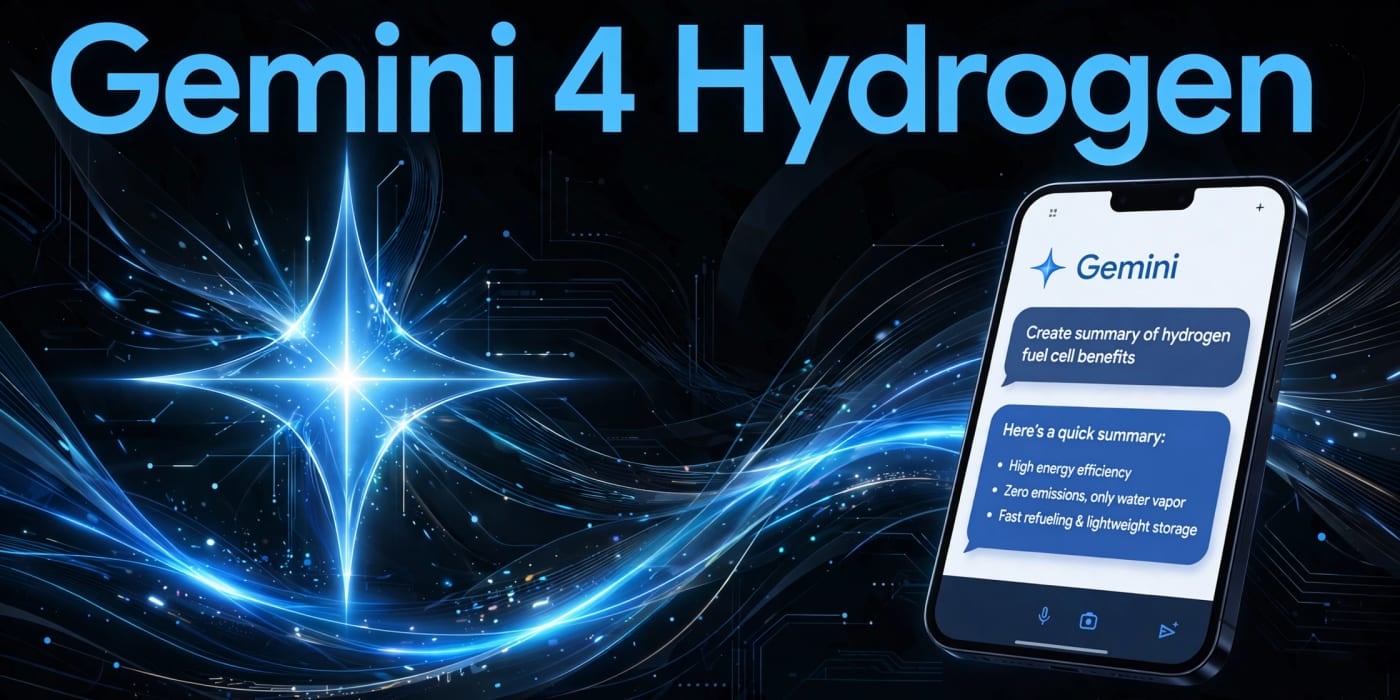
Gemini 4 Hydrogen: Google's Fastest AI Model Explained
Google has a new fast model in the Gemini family, and it is aimed squarely at the everyday chat.
Gemini 4 Hydrogen was unveiled on 12 November 2026, and reports on 14 November 2026 describe it as the speed-focused, lightweight sibling in the Gemini 4 family. That short description tells you most of what you need to know.
Hydrogen is not trying to be the biggest model Google makes. It is trying to be the quickest one you will actually reach for, day after day, for the ordinary questions that fill a normal chat. If you use the free tier of the Gemini app, this is the model Google is putting in front of you by default.
What Gemini 4 Hydrogen actually is
Hydrogen is described as a distilled, highly optimised model. Distilled, in plain language, means a smaller model shaped to keep as much useful behaviour as possible from a larger system, while cutting down on the work needed to produce each reply.
It is built for instant everyday responses. Quick questions, quick drafts, quick checks, quick rewrites, quick summaries. The kind of back-and-forth where waiting feels worse than a slightly simpler answer.
It is not, by the same account, built for winning at hard physics or maths. That line is unusually honest for a product launch, and it is useful. It tells you where Hydrogen is meant to stop, and where another model should take over.
Image 1 — after the "What Gemini 4 Hydrogen actually is" section

Caption: The Gemini app on a phone — Hydrogen is rolling out as the default for the free tier.
Speed first, on purpose
Speed in an AI chatbot is easy to underrate until you use a slow one. A fast reply keeps a conversation moving. You ask a follow-up while the last answer is still fresh. You try a second phrasing without thinking twice.
A slow reply breaks that rhythm. Even a few extra seconds can be enough to make you stop asking the small questions, the ones that are often the most useful. That is why a speed-focused model makes sense as a default, especially for a free tier.
Most free-tier use is not one high-stakes task. It is lots of small tasks through the day: help me word this message, summarise this paragraph, give me a better title. For those jobs, a good-enough answer now often beats a slightly better answer later.
Google has not published, in the material used for this article, a price for Hydrogen, a parameter count, or a context window size. Those details are not included here because they have not been verified.
Hydrogen, Argon and Carbon: how the family fits together
The Gemini 4 family is not one model. It is a set of models with different jobs. Hydrogen is the lightweight, speed-focused one. Argon is the heavyweight. Carbon sits in the middle, at least in how Google routes users to it.
Gemini 4 Carbon was released on 10 November 2026, according to the SpringPrompt release tracker. That is two days before Hydrogen was unveiled. Google did not launch one model and stop. It launched a family in quick succession.
| Model | Role in the Gemini 4 family | Who it is aimed at |
|---|---|---|
| Gemini 4 Hydrogen | Speed-focused, lightweight, distilled model for instant everyday responses | Free-tier users by default; Advanced users can select it |
| Gemini 4 Carbon | Released 10 Nov 2026; one of the defaults for Gemini Advanced, depending on task complexity | Gemini Advanced subscribers |
| Gemini 4 Argon | The heavyweight of the family | Gemini Advanced subscribers, for more complex tasks |
Google is not asking users to memorise a spec sheet. It is asking them to trust the routing. If your task is light, you get the light model. If it is complex, you get a heavier one. For most people, that choice will be invisible. They will open the app, type, and get Hydrogen, because that is the default.
Image 2 — after the "Hydrogen, Argon and Carbon" section

Caption: Gemini on iPhone — the rollout reaches Android, iOS and web in sequence.
Who gets Hydrogen, and when
Hydrogen is being rolled out as the default model for the free tier of the Gemini app. The rollout is sequential across Android, iOS and web. Sequential means not everyone gets it at the same minute, on every device, at once.
If you open the app on your phone and see Hydrogen, then open it on the web and see something else, that does not necessarily mean something is wrong. It may simply mean the rollout has reached one platform for you and not the other yet.
Gemini Advanced subscribers are in a different position. They can select Hydrogen, but they do not default to it. Instead, they default to Carbon or Argon, depending on task complexity. The paid tier keeps steering people toward the heavier models when the task looks like it needs them, while still leaving Hydrogen available.
Users switch via the model selector at the top of the chat interface. If you are on the free tier and Hydrogen is your default, you do not need to do anything. It will simply be there.
What the early ranking says — and what it does not
BenchLeader, a third-party tracker, listed Gemini 4 Hydrogen on 14 November 2026 with a score of 63.4 on its index, ranked number 15, first seen on 12 November 2026. That score belongs to BenchLeader. It is not Google's own claim, and it should not be read as one.
A rank of 15th fits the launch description. Hydrogen is not at the top of that index. It is not meant to be. A speed-focused, lightweight model built for instant everyday responses is unlikely to top a leaderboard that rewards depth and difficulty.
What matters more is whether the model answers quickly, clearly, and usefully for the tasks people actually give it. For now, the BenchLeader listing is best read as a first public data point, not a verdict. It confirms the model exists, it was first seen on 12 November 2026, and it has been placed on that tracker's index.
What Hydrogen is not for, and how to use it well
Hydrogen is not for winning at hard physics or maths. If you give it a genuinely hard problem, you may get a fast answer, but it may not be the best answer Google can give you. That is the trade-off. Speed costs something, and here the cost is depth on the hardest tasks.
Most everyday use will not hit that limit. Most questions are wording, summarising, explaining, planning, and checking. Hydrogen is aimed at that majority.
Treat it like a fast colleague, not a slow expert. Ask the small questions. Use it for drafts you will edit and summaries you will check. Keep prompts short and clear. If the answer is not quite right, try a follow-up, rephrase, or add one detail. And if the task grows into a complex one, switch models. That is what the selector is for.
Image 3 — after the "What Hydrogen is not for, and how to use it well" section

Caption: Gemini is built into Pixel phones — Hydrogen is the fast, everyday model in the family.
The bottom line
Gemini 4 Hydrogen is a small, fast, distilled model with a clear job: make everyday replies instant. It was unveiled on 12 November 2026. It is the lightweight sibling in the Gemini 4 family, with Argon as the heavyweight and Carbon as another option for Advanced users.
It is rolling out as the default for the free tier of the Gemini app, sequentially across Android, iOS and web. BenchLeader lists it at 63.4, ranked 15th, first seen on 12 November 2026 — BenchLeader's score, not Google's claim. If Hydrogen does its job well, you will notice it less as a model name, and more as a feeling: the app just feels quicker.
FAQs
What is Gemini 4 Hydrogen?
Gemini 4 Hydrogen is a speed-focused, lightweight model in Google's Gemini 4 family. It was unveiled on 12 November 2026. It is a distilled, highly optimised model built for instant everyday responses, rather than for hard physics or maths.
Is Gemini 4 Hydrogen the most powerful Gemini 4 model?
No. The heavyweight in the family is Gemini 4 Argon. Hydrogen is the lightweight sibling, aimed at speed and everyday use, not at maximum depth or difficulty.
Who gets Gemini 4 Hydrogen by default?
It is being rolled out as the default model for the free tier of the Gemini app. Gemini Advanced subscribers can select it, but they default to Carbon or Argon depending on task complexity.
Which platforms is Hydrogen rolling out on?
The rollout is sequential across Android, iOS and web. That means it may reach different platforms and users at different times, rather than all at once.
How do I switch to a different Gemini model?
Users switch via the model selector at the top of the chat interface. From there you can pick Hydrogen, or another available model, for that conversation.
What score does BenchLeader give Gemini 4 Hydrogen?
BenchLeader lists Gemini 4 Hydrogen with a score of 63.4 on its index, ranked number 15, first seen on 12 November 2026. That score is BenchLeader's listing, not a claim by Google.
What is Gemini 4 Carbon?
Gemini 4 Carbon is another model in the Gemini 4 family. According to the SpringPrompt release tracker, it was released on 10 November 2026. Gemini Advanced subscribers default to Carbon or Argon depending on task complexity.
Was this article helpful?

Written By
TechorCoffeeContributing Writer
TechorCoffee is a technology reporter and software creator writing reviews and tutorials for TechOrCoffee.
Comments (0)
Leave a Comment
Read Next

Tue Apr 21 2026
Best AI Tools for Students & Creators in 2026:Complete Guide
AI tools are transforming how students learn and creators produce content. From writing assistants to design and research tools, these platforms save time, enhance creativity, and improve efficiency. Choosing the right AI stack can significantly boost productivity and output quality.
Tue Jun 16 2026
Apple Intelligence 2.0: Siri AI & iOS 27 at WWDC 2026
Apple Intelligence 2.0 is here. I cover Siri AI, iOS 27 release dates, supported devices, and how Apple's new AI really compares to ChatGPT and Gemini.
Mon Jun 08 2026
WWDC 2026: Siri AI, iOS 27 & Apple's Biggest Reveal
WWDC 2026 introduced Siri AI, iOS 27, and major Apple Intelligence upgrades. See every game-changing feature Apple announced.