Google Genie 4 API: Build Playable AI Worlds in Seconds

Published (Updated )
The quick answer
- Google's Genie 4 world model is now open to paid developers through the Gemini API and Google AI Studio, as of November 19, 2026.
- Type a text prompt, add a reference image if you like, and Genie 4 builds a world you can walk through in real time.
- It streams 720p video at 24 frames per second, with sound generated in the same pass as the picture.
- Pricing starts at about $0.10 per second of streamed output — roughly $6.05 a minute, or about $12.10 for a full two-minute session.
- Sessions last at most 120 seconds, cannot be resumed, and nothing is saved to reopen later.
- The same model also rolled out on November 18, 2026 in Project Genie, Google's experimental prototype for AI Ultra subscribers.
What Genie 4 actually is
- Genie 4 is Google DeepMind's latest world model.
- A world model does not just generate a video clip. It generates a place you can move through.
- You describe a scene in words, or hand it a picture, and it returns an interactive environment.
- You can walk around inside it with keyboard controls, and you can change it mid-session with a fresh prompt.
- The picture keeps being generated live as you explore, frame by frame.
- Google DeepMind first announced Genie 4 on October 27, 2026, as a research preview for trusted testers.
- The official model card followed on November 18, 2026.
- The public rollout then happened in two steps, one day apart.
Two launches, two days apart
- November 18, 2026: Genie 4 began rolling out in Project Genie to eligible Google AI Ultra subscribers aged 18 and over.
- AI Pro members can join a waitlist for access.
- Project Genie is an experimental research prototype, not a finished product.
- It adds a conversational creative agent that helps you shape worlds by chatting.
- It also adds a gallery where people can share and remix each other's worlds.
- November 19, 2026: Genie 4 opened to paid developers through the Gemini API and Google AI Studio.
- Developers call it as
models/genie-4through the Interactions API, in the v1beta channel. - That is the launch that matters most for builders, because it puts the model inside real apps and products.
How a session works
- A session opens over WebRTC in the browser, or over WebSocket from a server.
- Access uses single-session ephemeral tokens, so each session gets its own short-lived credential.
- You start with a text prompt, a reference image, or both.
- Genie 4 then streams the world back to you as live video.
- You move with the WASD keys, just like a first-person game.
- You can also type a new prompt while the session is running, and the world reshapes itself around you.
- The video streams at 720p and 24 frames per second.
- The sound arrives in sync with the picture — ambient soundscapes, sound effects, and even character dialogue.
- The audio is generated in the same pass as the visuals, not added afterwards.
- That is a first for a DeepMind world model: Genie 4 is the first one to generate audio natively.
What is under the hood
- Genie 4 is adapted from, and built on top of, Gemini Omni Flash.
- Gemini models supply the reasoning and the real-time steering.
- That steering is what lets the world respond when you press a key or type a new instruction.
- The model is designed for interactive use, not for rendering a fixed clip and stopping.
- Every output carries an imperceptible SynthID watermark.
- SynthID marks AI-generated content so it can be identified later, even though viewers cannot see it.
- Google positions the watermark as a guardrail for a technology that can now generate convincing, explorable scenes on demand.
What it costs
- The headline price is about $0.10 per second of streamed output.
- That works out to roughly $6.05 per minute.
- A full session of the maximum 120 seconds costs about $12.10.
- Token pricing has also been reported, for developers who want the finer detail:
- $1.50 per million input tokens.
- $9 per million text output tokens.
- $17.50 per million video output tokens, at 240 tokens per frame.
- At 24 frames per second, the video token rate is what drives most of the cost.
- The per-second figure is the simplest way to budget: every second you stream costs about ten cents.
- For a quick demo or a short prototype, the bill stays small.
- For a product that streams worlds to thousands of users, the cost adds up fast, so session length matters.
The 120-second limit, and one costly catch
- Every session is capped at 120 seconds.
- A session cannot be resumed once it ends.
- No scene is saved, so you cannot reopen a world later.
- That is the biggest practical limit right now: every world is temporary.
- There is also a billing catch that developers need to plan for.
- Closing a browser tab does not stop generation or charges on Google's servers.
- The session keeps running — and billing — until the app calls
complete()orcancel(). - Apps built on the API must handle that cleanup properly, or users will pay for sessions they thought they had closed.
- It is a small detail with a real price tag attached.
Project Genie: the consumer side
- Project Genie is where most people will first meet the model.
- It is an experimental research prototype, and Google is clear about that label.
- Eligible Google AI Ultra subscribers aged 18 and over got access first, from November 18, 2026.
- AI Pro members can join a waitlist.
- The experience is built around a conversational creative agent.
- Instead of writing a perfect prompt, you talk with the agent and shape the world together.
- A gallery lets users share their worlds and remix worlds made by others.
- Two of the example worlds Google has shown give a flavour of what it can do:
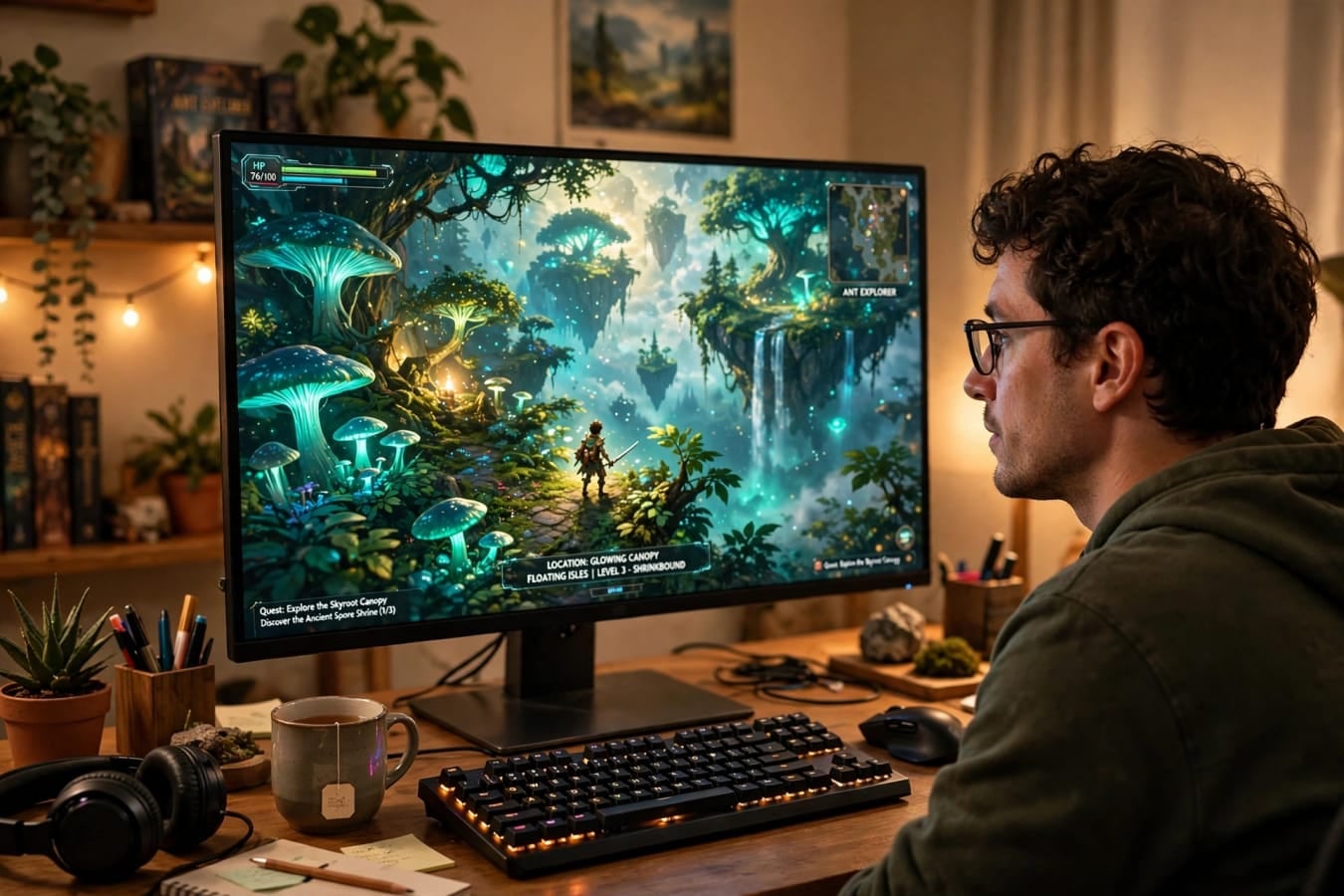
- Exploring a world as an ant, seeing a garden from ground level.
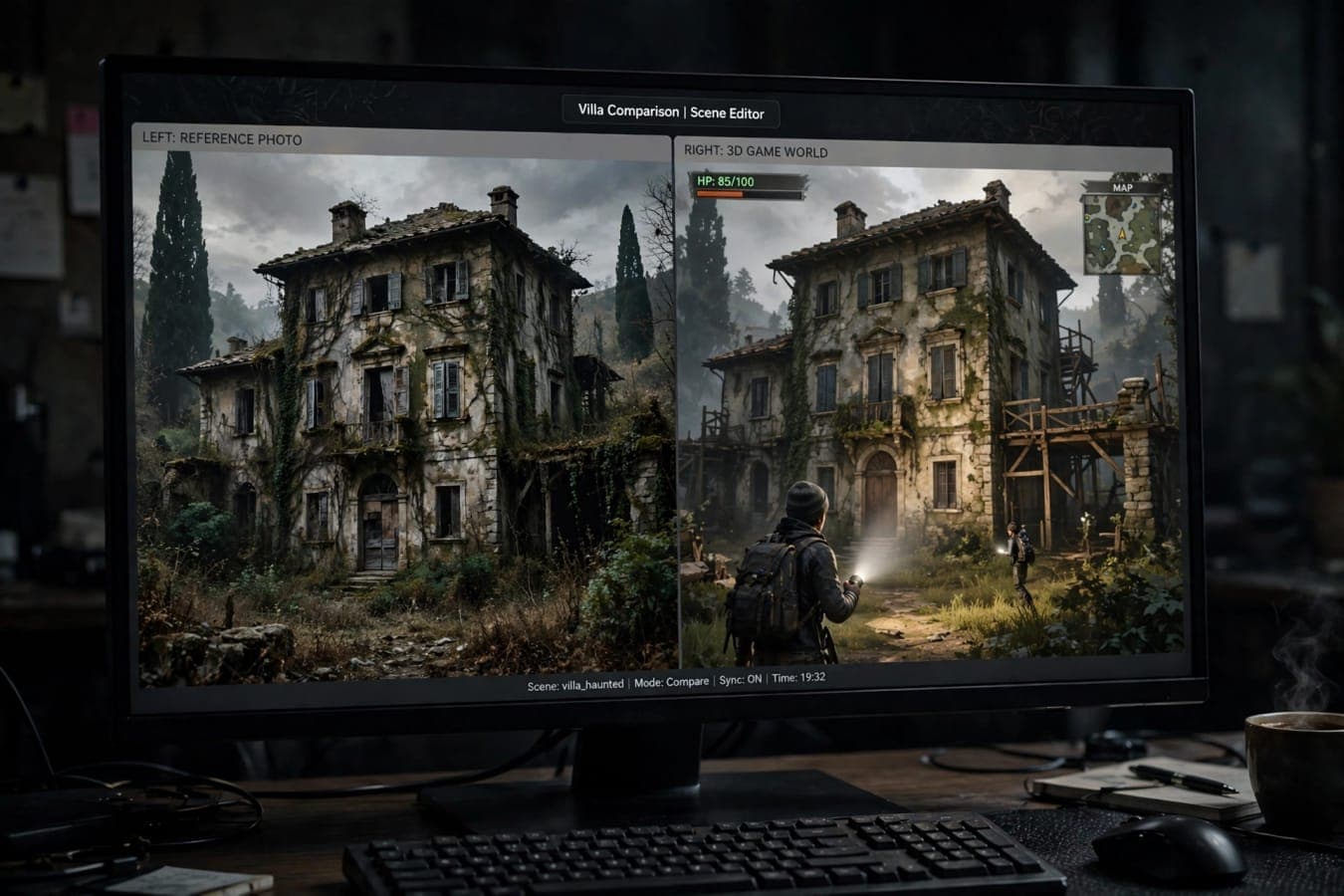
- Searching a haunted villa for clues, like a small mystery game.
- These are demos, not finished games, but they show the range: tiny scale, big scale, calm scenes, and tense ones.
What you can build with it
- Google suggests three main directions, and each one fits a different audience.
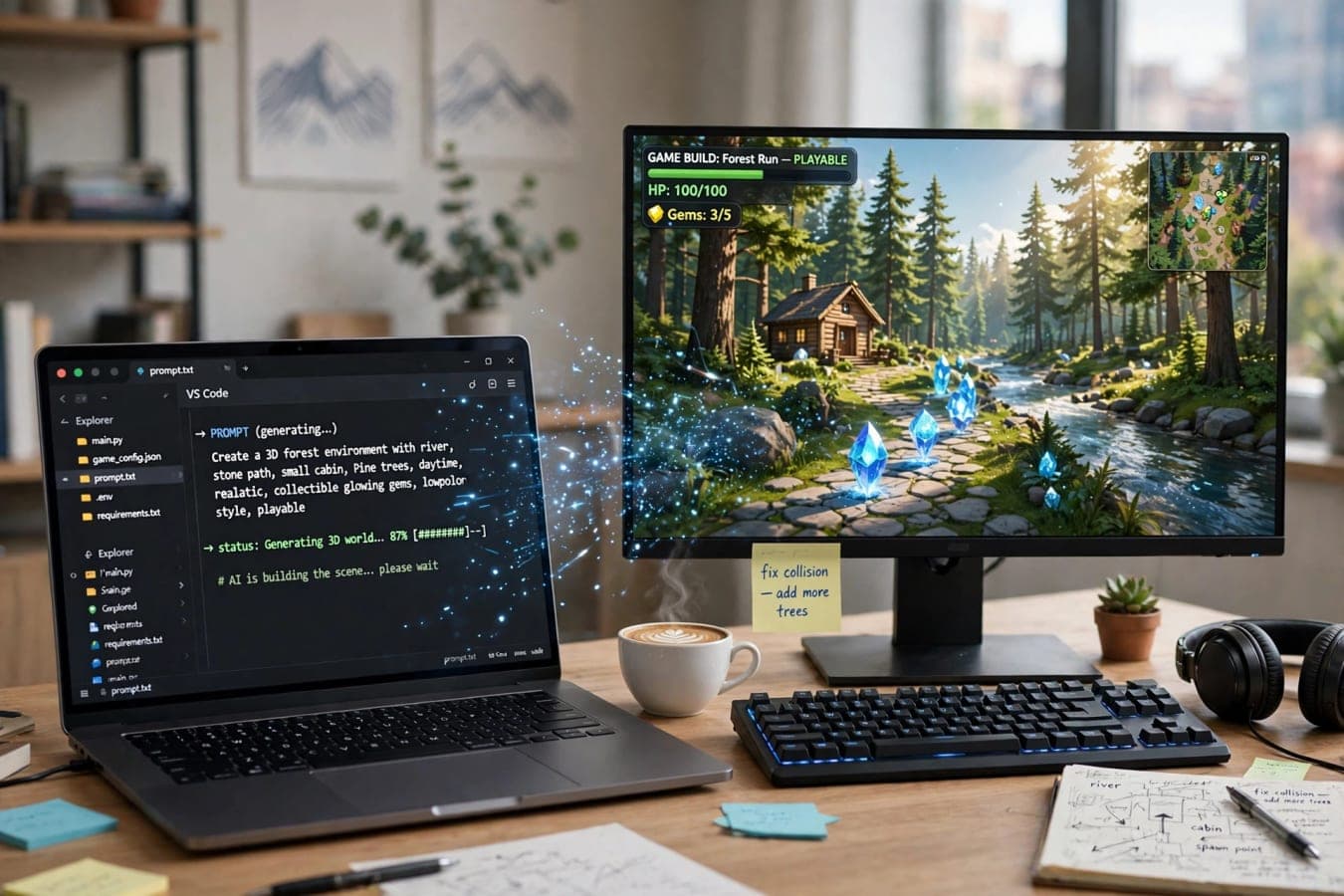
- Prototyping interactive experiences: sketch a game level or an interactive scene in minutes, before committing to full production.
- Visualising spatial designs: walk through a room, a building, or a landscape that only exists as a description or a photo.
- Training robotics and AI agents: give an agent a world to practise in, without building a simulator by hand.
- Game developers get the most obvious win.
- A level designer can test an idea with a prompt, walk through it, and decide in minutes whether it is worth building properly.
- A developer could also pair Genie 4 with Gemini 4 Neon, released on November 18.
- Neon writes the quest text, and Genie 4 renders the world the quest takes place in.
- That pairing shows where Google is heading: one model writes the story, another builds the place.
How to get started as a developer
- You need a paid Gemini API setup, with access to Google AI Studio.
- The model is
models/genie-4, reached through the Interactions API (v1beta). - Sessions connect over WebRTC from a browser, or WebSocket from a server.
- Each session uses a single-session ephemeral token.
- Your app sends a prompt, and optionally a reference image.
- The world streams back as video, and your app passes keyboard input through.
- Plan your session handling from the start:
- Always call
complete()orcancel()when a session should end. - Do not rely on the user closing a tab, because that does not stop billing.
- Keep sessions short while you are testing, because every second costs about $0.10.
- Always call
- Start with one scene and one interaction, and measure the cost before you scale.
Genie 4 vs Genie 3: what changed
- DeepMind announced Genie 3 in August 2025.
- Genie 3 was already a step forward: it generated interactive worlds from a prompt, with more consistency than earlier models.
- The November 2026 update extends Genie 3 sessions to up to 3 minutes, up from 60 seconds.
- It also lets users connect worlds together, or start from a 360-degree panorama.
- Genie 4 is a separate, newer model, and it goes further:
- It adds native audio, generated in the same pass as the picture.
- It is built on Gemini Omni Flash, with Gemini reasoning steering it live.
- It is the one now open to developers through the Gemini API.
- In short: Genie 3 got longer and more connected, while Genie 4 became the developer-facing model with sound.
The limits you should know before you build
- Genie 4 is impressive, but it is still a research-stage model, and Google is open about the rough edges.
- Object permanence can drift.
- Look away from an object for 8 seconds or more, or turn a full circle, and landmarks, doors and buttons can move or reset.
- The world does not keep a perfect memory of everything in it.
- Complex physical interactions are still an active research area.
- Legible text inside the world is another weak spot.
- Spatial accuracy and long-term consistency are also works in progress.
- None of this makes the model useless — it makes it a prototyping tool, not a production engine.
- If you need a world that stays exactly the same every time, build it with a game engine.
- If you need a world fast, to test an idea or show a concept, Genie 4 is the quicker path.
Who this is for
- Indie game developers: prototype levels and mechanics without an art team.
- Game studios: test ideas with stakeholders before full production starts.
- Designers and architects: walk a client through a space that does not exist yet.
- Robotics teams: generate training environments on demand.
- AI researchers: study how agents behave in worlds that are generated, not hand-built.
- Curious creators: AI Ultra subscribers can simply play with Project Genie and see what a prompt can become.
- The common thread is speed: the value is not a perfect world, but a world in seconds.
What it means for games and AI
- World models are becoming the next layer of the AI stack, after text, images and video.
- Text models write, image models draw, video models animate — world models let you step inside.
- Genie 4 arriving in the Gemini API makes that layer available to any developer with a paid account.
- The price, about $0.10 a second, puts it in reach of experiments and demos, though not yet of always-on consumer products.
- The 120-second cap and the lack of saved scenes show this is still early.
- But the direction is clear: worlds are becoming something you generate, not something you build by hand.
- Expect the caps to rise, the costs to fall, and the consistency to improve.
- The developers who learn the limits now — the drifting objects, the short sessions, the cleanup calls — will be ready when those limits lift.
Bottom line
- Genie 4 turns a sentence into a place you can walk through, with sound, for about $0.10 a second.
- Developers can use it today through the Gemini API and Google AI Studio.
- AI Ultra subscribers can try it in Project Genie, with AI Pro members on a waitlist.
- The two-minute session cap, the lack of saved worlds, and the drifting objects are real limits.
- But as a way to prototype an interactive experience, visualise a design, or train an agent, it is a genuine step forward.
- The worlds are temporary, the bill runs by the second, and the model is still learning to remember.
- Even so, the idea that anyone can type a prompt and walk through the result is now a product, not a demo.
FAQs
What is Google Genie 4?
Genie 4 is Google DeepMind's latest AI world model. It turns a text prompt, a reference image, or both into an interactive 3D world you can walk through in real time, streaming 720p video at 24 frames per second with synchronised sound.
How can developers use Genie 4?
Paid developers can access Genie 4 through the Gemini API and Google AI Studio as models/genie-4, via the Interactions API (v1beta). Sessions connect over WebRTC in the browser or WebSocket from a server, using single-session ephemeral tokens.
How much does Genie 4 cost?
About $0.10 per second of streamed output — roughly $6.05 per minute, or about $12.10 for a full 120-second session. Token pricing is also reported at $1.50 per million input tokens, $9 per million text output tokens, and $17.50 per million video output tokens.
How long can a Genie 4 session last?
A maximum of 120 seconds. Sessions cannot be resumed, and no scene is saved to reopen later. Closing a browser tab does not stop generation or charges — apps must call complete() or cancel().
What is Project Genie, and who can use it?
Project Genie is Google's experimental research prototype for exploring Genie 4. It rolled out on November 18, 2026 to eligible Google AI Ultra subscribers aged 18 and over, with a conversational creative agent and a gallery for sharing and remixing worlds. AI Pro members can join a waitlist.
What are Genie 4's main limitations?
Object permanence can drift — looking away from an object for 8+ seconds or turning a full circle can move or reset landmarks, doors and buttons. Complex physical interactions, legible text, spatial accuracy and long-term consistency are active research areas. Every output also carries an imperceptible SynthID watermark.
Was this article helpful?

Written By
TechorCoffeeContributing Writer
TechorCoffee is a technology reporter and software creator writing reviews and tutorials for TechOrCoffee.
Comments (0)
Leave a Comment
Read Next
Tue Oct 13 2026
Gemini 4 Argon: Everything You Need to Know
Gemini 4 Argon is Google’s new flagship AI model. See its benchmarks vs GPT-6 Astra and Claude, pricing, 1M-token output, safety features and how to get access.
Tue Oct 13 2026
Google Gemini 4 Argon: Features, Benchmarks, Pricing & Guide
Discover Google DeepMind's Gemini 4 Argon. Explore its 1M token output limit, #1 Vals Index ranking, API pricing, coding capabilities, and enterprise use cases.
Sat Nov 14 2026
Google Launches Gemini 4 Hydrogen for Faster AI Agents
Google has launched Gemini 4 Hydrogen, a fast, low-cost AI model built for coding and agentic workflows. What it does, what it costs and who should try it.