Google Launches Gemini 4 Hydrogen for Faster AI Agents

Published (Updated )
Google Launches Gemini 4 Hydrogen for Faster AI Agents
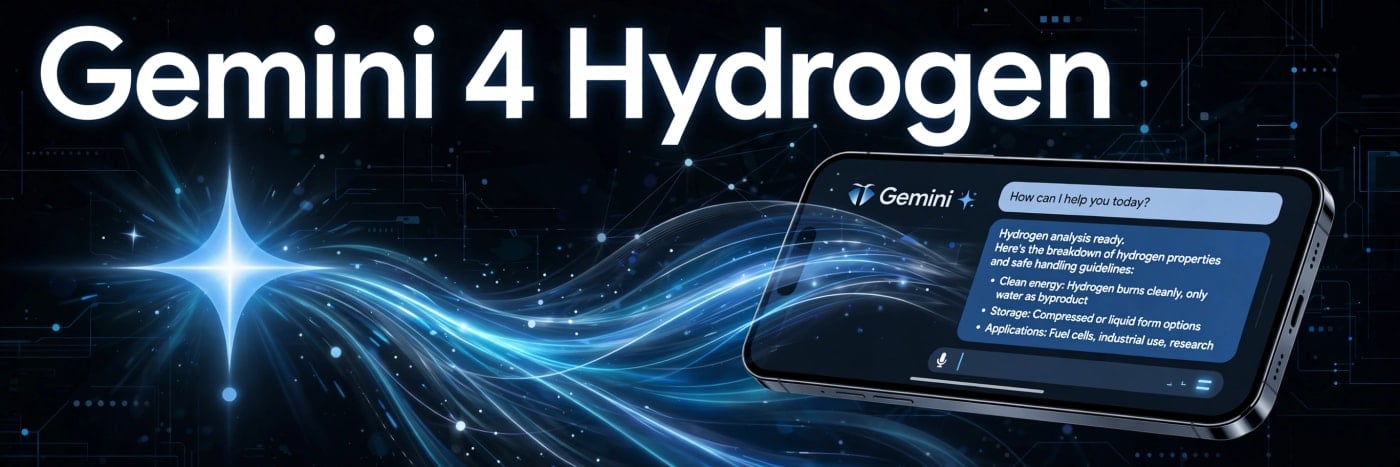
Google has launched a new AI model built for speed. Gemini 4 Hydrogen, announced on 12 November 2026, is designed for rapid execution across agentic workflows, everyday coding and multimodal work. It is generally available from that day, and Google is positioning it as the fast, low-cost option in its Gemini 4 family.

What Gemini 4 Hydrogen is
Gemini 4 Hydrogen is a fast model built for rapid execution across agentic workflows, everyday coding and multimodal work. That description, from Google's announcement on blog.google on 12 November 2026, covers three distinct kinds of use, and each one points to a different reason speed matters.
Agentic workflows are tasks where an AI system works through several steps on its own, rather than answering a single prompt and stopping. An agent might read a request, look at a codebase, make a change, run a test, read the result, and then adjust its approach. Each of those steps is a call to the model. If the model is slow, the whole workflow drags. If it is fast, the agent can try more approaches in the same time, and the user waits less for a result.
Hydrogen is adapted from Gemini 4 Carbon, according to Google. Carbon is the other model in the family, and the relationship between the two matters for how Google expects people to use them. Carbon is for complex planning, while Hydrogen is for execution and verification. That split is explicit in Google's description of the new Orchestrator in Antigravity, which switches between the two. The idea is that you use the heavier model to work out what to do, and the lighter, faster model to do it and check it.
The model has a knowledge cutoff of March 2026. That means its training data goes up to that point, and it will not know about events after that date unless it is given that information in the prompt or through a tool. That is normal for a large model, but it is worth knowing if you are asking about recent news or recent releases. For coding and agentic work, where the task is usually about files and instructions you provide, the cutoff matters less than it does for general questions.
Four thinking levels
One of the more practical features of Gemini 4 Hydrogen is that it has four thinking levels: Low, Medium, High and XHigh. Thinking levels control how much reasoning the model does before it answers. A lower level means a faster, shorter answer. A higher level means the model spends more time thinking, which can improve accuracy on harder tasks but takes longer and costs more in tokens.
Google's benchmark figures reflect that choice. At default high thinking, Hydrogen scores 51 on the Artificial Analysis Intelligence Index, compared with 50 for the model called Argon. At XHigh, Hydrogen reaches 54. That is a small gap at the default level, but it shows that the higher thinking setting does move the score, and that Hydrogen is competitive on that index even before the top setting is used.
Speed and benchmark scores
Speed is the headline claim for Hydrogen, and Google has put a number on it. The model is up to about 2.5 times faster than Gemini 3.8 Flash in Google's reporting. That is a large difference, and if it holds in real use, it would be noticeable. A task that took a minute with Flash could take well under half a minute with Hydrogen, and a multi-step agent workflow could finish much sooner.
Google has also published benchmark scores for Hydrogen. On Terminal-Bench 4.1, it scores 57 percent. On Agents' Last Exam v1.1, it scores 71.6 percent. On HLE-Diamond, it scores 58.8 percent. Those are three different tests, each measuring a different kind of capability, and the scores are given as percentages.
Pricing, and the comparison with Flash
Pricing is where Hydrogen's positioning becomes clearest. It has a 1-million-token context window, and flat pricing across the whole window: $1.50 per million input tokens and $7.50 per million output tokens. Output includes thinking tokens, which means the tokens the model uses while reasoning are counted in that output price.
The price itself is $1.50 per million input tokens and $7.50 per million output tokens. That is double the current price of Gemini 3.8 Flash, which is $0.75 per million input tokens and $3.75 per million output tokens. On that comparison alone, Hydrogen looks more expensive than Flash. The picture changes when you look at what happens next.
Flash's standard rates rise to the same $1.50 and $7.50 on 1 January 2027. At that point, Hydrogen and Flash will cost the same on those rates. The difference is that Hydrogen is faster, and, according to Google, scores higher on the Artificial Analysis Intelligence Index. If those claims hold, Hydrogen would be the better value at the same price, at least for the tasks it is built for.
No shutdown date has been set for gemini-3.8-flash, according to Google. That matters for developers who have built workflows around Flash and do not want to be forced to move. They can keep using Flash for now, and decide later whether to switch. The lack of a shutdown date does not mean Flash will stay unchanged forever, but it does mean there is no immediate deadline to migrate.
Where you can use it
Gemini 4 Hydrogen is available in a wide range of Google products and tools. It is available in Google AI Studio, the Gemini API, the Gemini app, Google Search, Gemini for business, Google Antigravity, Android Studio and Gemini in Google Sheets. That is a long list, and it shows that Google is not launching Hydrogen as a niche developer tool. It is launching it across the places where people already use Gemini.
Gemini for business is the workplace route, for teams using Gemini in their work. Android Studio is the route for Android developers, who can use Hydrogen while building apps. Gemini in Google Sheets is the route for spreadsheet work, where AI can help with formulas, analysis and data tasks. Together, those routes cover a lot of ground, from coding to office work to mobile development.

Google DeepMind is the team behind Gemini, and its work shapes how these models are built and released. The launch of Hydrogen is part of a steady pattern of releases from DeepMind, each one aimed at a different part of the market. Carbon is for complex planning. Hydrogen is for fast execution. Flash, in the earlier generation, was for low cost. That pattern suggests Google is building a family of models, not a single model that has to do everything.
Antigravity and the Orchestrator
One of the more specific uses for Hydrogen is in Google Antigravity, where it is available for paid Google AI Pro and Ultra subscribers. Antigravity is Google's agentic development environment, where AI agents can work on coding tasks, and the way Hydrogen is used there shows how Google expects the model family to work together.
In Antigravity, a new Orchestrator switches between Gemini 4 Carbon and Hydrogen. Carbon handles complex planning, while Hydrogen handles execution and verification. That division is deliberate. Planning a large coding task takes careful reasoning. Carrying out the steps, running the code, and checking the results takes speed and repetition. Using the right model for each part should make the whole workflow faster and cheaper than using one model for everything.
Google reported that this approach uses 24 percent less quota and completes tasks 19 percent faster than Carbon alone on Terminal-Bench 4.0. Those are useful figures, because they show the benefit of switching, not just the benefit of Hydrogen on its own. A 24 percent saving in quota means the work costs less in usage terms. A 19 percent saving in time means the work finishes sooner. Together, they point to a real gain from the Orchestrator, at least on that benchmark.
Who should try it, and who should wait
Gemini 4 Hydrogen is most relevant for people who run AI tasks frequently, and who care about speed and cost as much as about raw capability. That includes developers building agents, developers doing everyday coding, and teams running automated workflows where the model is called many times a day. For those users, a faster model at a flat price can make a real difference to how much work gets done, and how much it costs.
It is also relevant for anyone who has been using Gemini 3.8 Flash and is thinking about what comes next. Hydrogen costs double Flash today, but Flash's price rises to the same level on 1 January 2027. Trying Hydrogen now gives you time to test it, compare it on your own tasks, and decide whether to switch before the price change takes effect. There is no shutdown date for Flash, so there is no rush, but there is a clear reason to test.
Users who need the deepest reasoning, or the highest scores on the hardest benchmarks, may still prefer a different model. Hydrogen is built for speed, not for maximum capability on every task. Its four thinking levels help, and XHigh raises its score on the Artificial Analysis Intelligence Index to 54, but it is still positioned as the fast option, not the most powerful one. If your task needs long, careful planning, Carbon may be the better choice, or the Orchestrator may be the better route, using Carbon for planning and Hydrogen for the rest.

The launch on 12 November 2026 is also a reminder of how quickly this field moves. Gemini 4 Hydrogen arrives as part of a generation of models that are being released in quick succession, each one aimed at a narrower slice of work. The question for users is not whether Hydrogen is the best model in every respect. It is whether it is the best model for the work they actually do, at a price they can afford, and at a speed they can live with. On the figures Google has published, it is a strong candidate for fast, frequent, agentic and coding work. The next step is to try it on a real task, measure the result, and decide from there.
FAQs
What is Gemini 4 Hydrogen?
Gemini 4 Hydrogen is a fast AI model from Google, announced on 12 November 2026, built for rapid execution across agentic workflows, everyday coding and multimodal work. It is generally available from that day.
What are the four thinking levels?
Gemini 4 Hydrogen has four thinking levels: Low, Medium, High and XHigh. They control how much reasoning the model does before answering, with higher levels taking longer but potentially improving accuracy on harder tasks.
How fast is Gemini 4 Hydrogen?
Google reports it is up to about 2.5 times faster than Gemini 3.8 Flash. It scores 51 on the Artificial Analysis Intelligence Index at default high thinking, compared with 50 for Argon, and reaches 54 at XHigh.
What does Gemini 4 Hydrogen cost?
It has a 1-million-token context window with flat pricing across the whole window: $1.50 per million input tokens and $7.50 per million output tokens, with output including thinking tokens. That is double the current $0.75 and $3.75 for Gemini 3.8 Flash, but Flash rises to the same rates on 1 January 2027.
What benchmark scores has Google published?
Google cited Terminal-Bench 4.1 at 57 percent, Agents' Last Exam v1.1 at 71.6 percent, and HLE-Diamond at 58.8 percent for Gemini 4 Hydrogen.
Where can I use Gemini 4 Hydrogen?
It is available in Google AI Studio, Gemini API, Gemini app, Google Search, Gemini for business, Google Antigravity, Android Studio and Gemini in Google Sheets. In Antigravity, it is for paid Google AI Pro and Ultra subscribers.
What is the Orchestrator in Antigravity?
In Antigravity, a new Orchestrator switches between Gemini 4 Carbon for complex planning and Hydrogen for execution and verification. Google reported 24 percent less quota used and tasks 19 percent faster than Carbon alone on Terminal-Bench 4.0.
Was this article helpful?

Written By
TechorCoffeeContributing Writer
TechorCoffee is a technology reporter and software creator writing reviews and tutorials for TechOrCoffee.
Comments (0)
Leave a Comment
Read Next

Tue Apr 21 2026
Best AI Tools for Students & Creators in 2026:Complete Guide
AI tools are transforming how students learn and creators produce content. From writing assistants to design and research tools, these platforms save time, enhance creativity, and improve efficiency. Choosing the right AI stack can significantly boost productivity and output quality.
Tue Jun 16 2026
Apple Intelligence 2.0: Siri AI & iOS 27 at WWDC 2026
Apple Intelligence 2.0 is here. I cover Siri AI, iOS 27 release dates, supported devices, and how Apple's new AI really compares to ChatGPT and Gemini.
Mon Jun 08 2026
WWDC 2026: Siri AI, iOS 27 & Apple's Biggest Reveal
WWDC 2026 introduced Siri AI, iOS 27, and major Apple Intelligence upgrades. See every game-changing feature Apple announced.