Isomorphic Labs Raises $5B to Bring AI Drugs to Trials

Published (Updated )

Quick answer
- Isomorphic Labs, the AI drug-discovery company spun out of Google DeepMind in 2021, has raised $5 billion in a Series C funding round announced on November 17, 2026, in London.
- The round was co-led by Greenoaks and Sequoia Capital and was described as oversubscribed, with Andreessen Horowitz joining as a new investor and Alphabet making what the company calls continued significant investment.
- Total external funding now stands at about $7.7 billion across three rounds in under 20 months, and BioSpace called the Series C the largest venture round in biotech history.
- The money will fund development of the company's IsoDDE drug-design engine, new biology models, a partner ecosystem and infrastructure for clinical development.
- No drug candidate has been named and no trial start date has been given, so the funding is a bet on the platform, not on a medicine that is close to reaching patients.
The announcement
Isomorphic Labs announced the $5 billion Series C on November 17, 2026, in London, through a press release carried by PR Newswire. The company is based in London and was spun out of Google DeepMind in 2021 to apply the AI behind AlphaFold to the problem of designing new medicines.
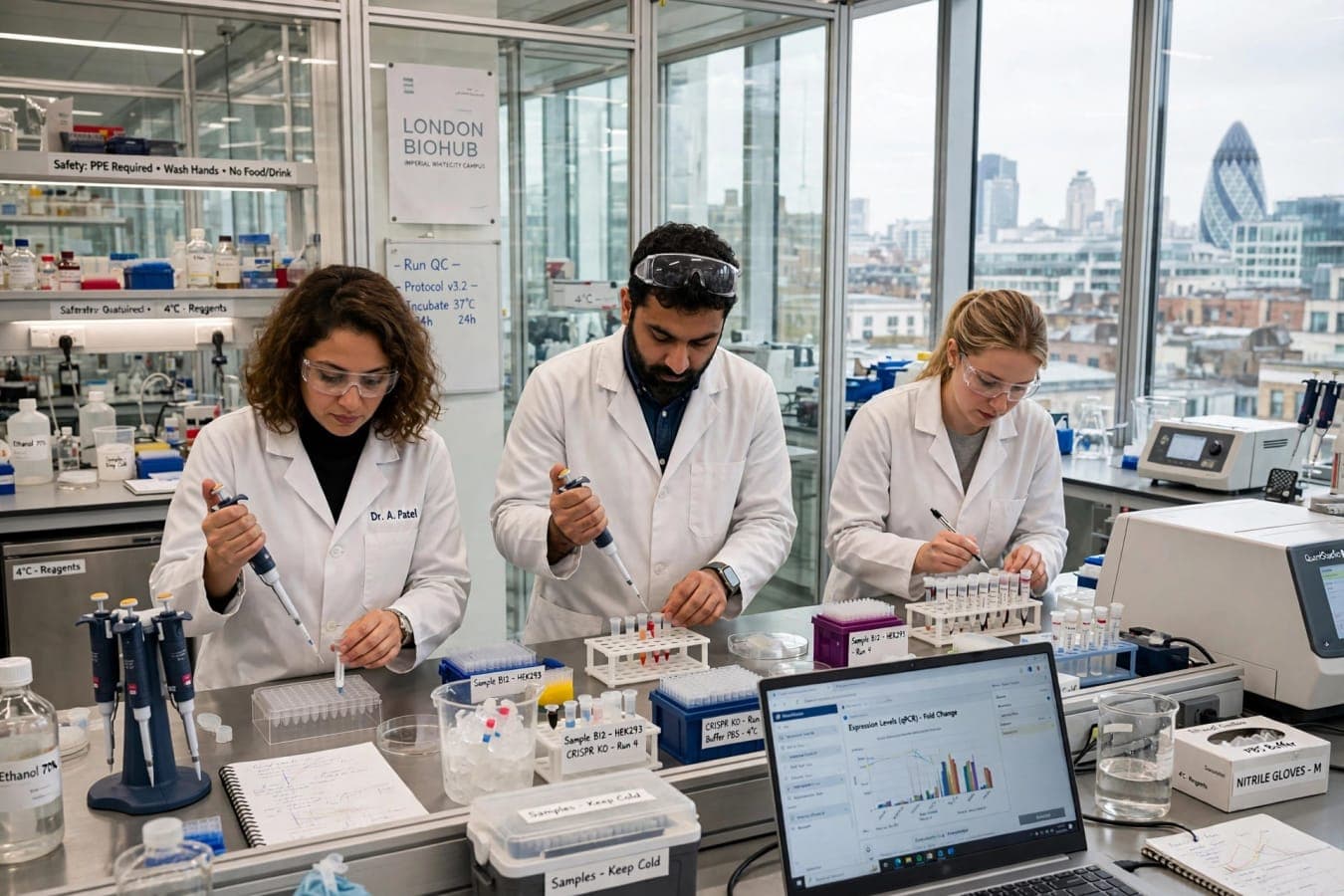
The size of the round is what made the announcement travel so fast. A $5 billion single venture round is enormous by any standard, and in biotech it is without precedent. BioSpace, the life-sciences news outlet, called it the largest venture round in biotech history, and the claim has been repeated across coverage of the deal in the days since. The round was co-led by Greenoaks and Sequoia Capital, two firms with long track records in technology investing. Andreessen Horowitz joined as a new investor. Alphabet, Google's parent company, made what Isomorphic describes as continued significant investment. All of the company's existing investors took part, including Thrive Capital, MGX, GV, CapitalG, Temasek and the UK Sovereign AI Fund. That last detail matters. When every existing investor returns for a round of this size, it signals that the people who already know the company best are willing to put in far more money. The company also described the round as oversubscribed, meaning that demand from investors was greater than the amount it was looking to raise.
The funding in numbers
The Series C is the third large external round Isomorphic has closed in under 20 months, and the amounts have grown sharply each time.
- March 31, 2025: $600 million first external round, led by Thrive Capital
- May 12, 2026: $2.1 billion Series B, also led by Thrive Capital
- November 17, 2026: $5 billion Series C, co-led by Greenoaks and Sequoia Capital
- Total external funding: about $7.7 billion across the three rounds The pace is striking. In less than two years, the company has gone from a $600 million debut round to a $5 billion round that is more than eight times larger. Each round has been bigger than the last, and the gaps between them have been short: roughly 13 months between the first and second rounds, and just over six months between the second and third.
A record round for biotech
Calling the Series C the largest venture round in biotech history is a big claim, and it is worth asking what it rests on. BioSpace made the call in its coverage of the announcement, and the figure itself is not in dispute: $5 billion in a single venture round for a drug-discovery company has no obvious precedent. The record matters for two reasons. First, it shows how much capital is now flowing into AI drug discovery specifically, rather than into biotech in general. Investors are treating AI-designed medicines as a distinct category, one that deserves funding at a scale normally reserved for the biggest technology companies. Second, it raises the stakes for Isomorphic itself. A company that has raised $7.7 billion in under 20 months will be expected to show results to match. The money buys time and talent, but it also creates pressure to turn the platform into medicines that reach human trials, and eventually into medicines that reach patients.
What IsoDDE actually does
At the centre of Isomorphic's pitch is IsoDDE, its drug-design engine, which the company unveiled on February 10, 2026, with benchmarks published in a company technical report. The idea behind the engine is straightforward to describe, even if the engineering is not. Traditional drug discovery starts with a disease target, usually a protein, and then searches through vast libraries of chemical compounds to find one that might bind to it and change its behaviour. The process is slow, expensive and mostly fails: the great majority of candidate compounds never become medicines. Isomorphic's approach is to design the drug with AI instead of searching for it. The engine is built to do the following:
- Predict the structure of a target protein and how a drug molecule could bind to it
- Design new molecules from scratch, rather than picking from an existing library
- Score and refine those molecules against the properties a real medicine needs, such as stability and safety
- Iterate quickly, testing thousands of designs in software before any of them are made in a lab
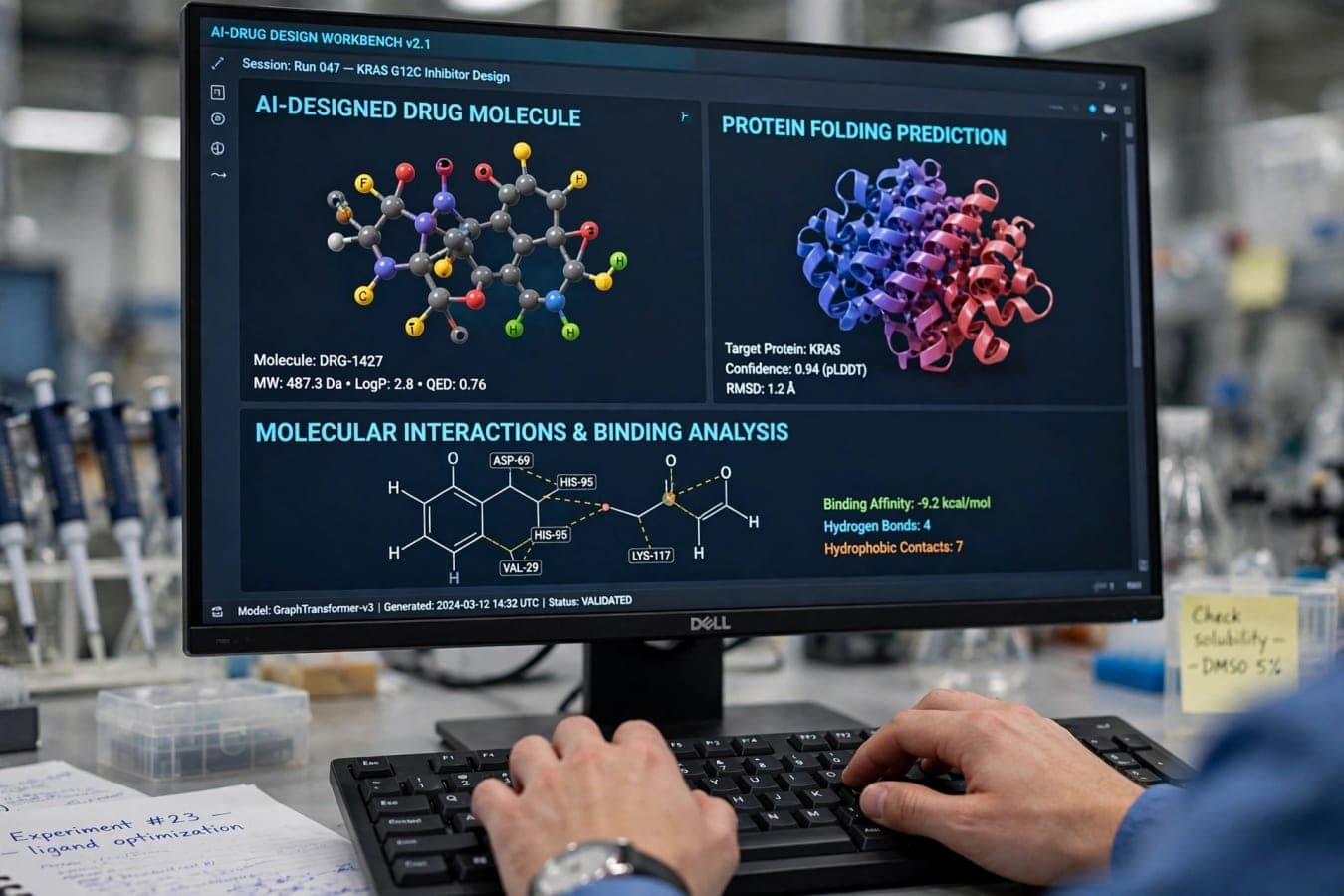
The company says its programs are focused on oncology and immunology, two areas where new medicines are badly needed and where the biology is complex enough that a better design tool could make a real difference. It has also reported positive preclinical results from its own programs. That last phrase needs careful handling. Preclinical means work done in computers and in laboratory experiments, not in people. A positive preclinical result is a genuine milestone, but it is an early one. Most drug candidates that look promising in preclinical work still fail when they reach human trials, and that is true whether they were designed by AI or by traditional methods.
Where the $5 billion goes
The announcement sets out broad areas where the money will be spent, but it gives no dollar split between them and no schedule of milestones. The areas named are:
- Further development of the IsoDDE drug-design engine
- New biology models, meaning AI models of how living systems work
- Building a partner ecosystem around the platform
- AI-led bioengineering infrastructure
- Infrastructure for clinical development The mention of clinical development infrastructure is the most significant item on the list. Building the capacity to run clinical trials is expensive and slow, and it is the step that turns a drug-discovery company into a company that can actually test medicines in people. Investors putting $5 billion into that capacity are betting that Isomorphic's candidates will be ready for trials, and that the company should own the infrastructure to run them. The partner ecosystem is also worth watching. Isomorphic already works with large pharmaceutical companies, and the funding suggests it plans to deepen those relationships rather than trying to do everything alone.
The man behind it: Demis Hassabis
Isomorphic's founder and chief executive is Demis Hassabis, who won the 2024 Nobel Prize in Chemistry for his work on AlphaFold, the AI system that predicts protein structures. AlphaFold solved a problem that had challenged biologists for decades, and it is the foundation on which Isomorphic is built. Hassabis recently left his role as head of DeepMind to focus on Isomorphic, moving to a chairman role at DeepMind. The move is a signal in itself: the person who led one of the world's most important AI labs has chosen to spend his time on drug discovery instead. His public statements about timing have shifted over time, and the shift is worth recording honestly. He previously said he wanted Isomorphic's first drugs in clinical trials by the end of 2025, then later spoke of the end of 2026. In a Bloomberg interview published on November 17, 2026, the same day as the funding announcement, he declined to give a new date. That refusal is not a failure, but it is informative. It suggests the company is not willing to commit publicly to a trial date it may not meet, and it means that anyone looking for a firm timeline will not find one in the announcement.
Big pharma is already on board
One of the strongest signals in the announcement is the list of pharmaceutical partners named by the company: Novartis, Eli Lilly and Johnson & Johnson. These are three of the largest drug makers in the world, and their involvement gives Isomorphic's platform a credibility that funding alone cannot buy. Partnerships with large drug companies work in both directions. For Isomorphic, they bring money, expertise in running trials, and a route to market for any medicine that succeeds. For the drug companies, they bring access to an AI design engine they would struggle to build themselves. The partnerships also matter because they show that the industry's biggest players are taking AI drug design seriously as a practical tool, not just as a research curiosity. Novartis, Eli Lilly and Johnson & Johnson do not lend their names to speculative projects lightly, and their presence in the announcement is a vote of confidence in the platform. What the announcement does not say is how much each partner is contributing, or what specific programs they are working on together. Those details are usually kept private, and they are not part of this announcement.
Why Alphabet's stake matters
Alphabet, Google's parent company, is not just an investor in Isomorphic. According to UK Companies House records, Alphabet owns 75% or more of Isomorphic's shares and voting rights. That level of ownership makes Isomorphic something unusual: a company that raises venture rounds like an independent startup, but that is majority-owned by one of the world's largest technology companies. The arrangement gives Isomorphic access to Alphabet's computing power, research and talent, and it gives Alphabet a major position in AI drug discovery. It also raises questions that investors and observers will keep asking. How independent is Isomorphic's decision-making when one shareholder controls three quarters of the votes? None of those questions has a public answer in the announcement, and they may never have one. But the ownership structure is a fact worth knowing, because it shapes how the company is governed and how its future is decided.
What this does not mean yet
A $5 billion funding round is a huge event, but it is important to be clear about what it does not mean.
- No drug candidate has been named publicly, so there is no specific medicine to follow.
- No trial start date has been given, and the chief executive declined to offer one in his latest interview.
- The positive results reported so far are preclinical, meaning they come from lab and computer work, not from human trials.
- The company's benchmarks for IsoDDE come from its own technical report, not from an independent evaluation.
- The funding announcement gives no milestone schedule, so there is no public timetable to hold the company to. None of this makes the funding less significant. It makes the significance different. The $5 billion is a vote of confidence in a platform and a team, not proof that a medicine is close to reaching patients. The distance between a well-funded AI platform and an approved drug is still measured in years, and in the hard work of clinical trials that no amount of computing power can skip. For readers, the honest way to follow this story is to watch for the next concrete steps: a named drug candidate, a trial registration, and a date for the first human study. Those will be the moments when the platform starts to become a medicine.
The $50 billion question
One figure has been widely discussed alongside the funding, and it needs to be labelled carefully. Bloomberg reported earlier in November 2026 that Isomorphic was seeking funding at a valuation of about $50 billion. That figure is reported, not confirmed. The company has not disclosed its valuation, and the funding announcement says nothing about it. A reported valuation from a news outlet, even a well-sourced one, is not the same as a confirmed figure from the company or its investors. If the reported figure were accurate, it would place Isomorphic among the most valuable private biotech companies in the world, and it would mean the $5 billion round bought investors roughly a tenth of the company. But without confirmation, that arithmetic is speculation, and it should be treated as such. The reason the valuation question matters is that it shapes expectations. A company valued at $50 billion is expected to produce medicines worth far more than that over time. A company valued at a lower figure faces lower expectations. Until Isomorphic or its investors confirm a number, the honest position is to say that the valuation was not disclosed, and that $50 billion is a reported figure only.
What to watch next
The funding announcement is the start of the story, not the end of it. The developments worth watching over the coming months are:
- Whether Isomorphic names its first drug candidate, and in which disease area
- Whether a clinical trial is registered, and when the first human study begins
- How the partnerships with Novartis, Eli Lilly and Johnson & Johnson develop, and whether new partners join
- Whether the company publishes independent validation of IsoDDE, beyond its own technical report
- Whether the valuation is ever confirmed, and at what figure
- How quickly the company hires and builds the clinical development infrastructure the funding is meant to pay for Each of these will say more about the company's progress than the size of the funding round itself. The money is a means to an end, and the end is a medicine that works in people.
The bottom line
Isomorphic Labs has raised $5 billion in a Series C round, co-led by Greenoaks and Sequoia Capital, taking its total external funding to about $7.7 billion in under 20 months. The round has been called the largest venture round in biotech history, and it gives the company the resources to develop its IsoDDE drug-design engine, build new biology models and prepare for clinical trials. But no drug candidate has been named, no trial date has been set, and the valuation was not disclosed. The funding is a remarkable vote of confidence in AI drug discovery. The proof will come when a drug designed by the platform enters a human trial.
FAQs
What is Isomorphic Labs?
Isomorphic Labs is an AI drug-discovery company spun out of Google DeepMind in 2021. It uses AI to design new medicines, starting with its IsoDDE drug-design engine, and its programs focus on oncology and immunology.
How much did Isomorphic Labs raise in its Series C?
The company raised $5 billion in a Series C round announced on November 17, 2026, co-led by Greenoaks and Sequoia Capital. Its total external funding now stands at about $7.7 billion across three rounds in under 20 months.
Is this the largest biotech funding round ever?
BioSpace called the $5 billion Series C the largest venture round in biotech history. The size of the round is not in dispute, and no larger biotech venture round has been reported.
What is IsoDDE?
IsoDDE is Isomorphic Labs' drug-design engine, unveiled on February 10, 2026. It is designed to create new drug molecules with AI, predicting how they bind to target proteins and refining them for the properties a real medicine needs.
When will Isomorphic's first drug enter clinical trials?
No date has been given. CEO Demis Hassabis previously targeted the end of 2026, after earlier aiming for the end of 2025, and in a Bloomberg interview published on November 17, 2026, he declined to give a new date.
What is Isomorphic Labs valued at?
The company has not disclosed its valuation. Bloomberg reported earlier in November 2026 that it was seeking funding at about a $50 billion valuation, but that figure is reported and unconfirmed.
Who are Isomorphic Labs' pharmaceutical partners?
The company names Novartis, Eli Lilly and Johnson & Johnson as external pharmaceutical partners. Alphabet, its majority owner, is also a significant investor in the round.
Who owns Isomorphic Labs?
Alphabet owns 75% or more of Isomorphic's shares and voting rights, according to UK Companies House records. The company was spun out of Google DeepMind in 2021 and is led by founder and CEO Demis Hassabis.
Was this article helpful?

Written By
TechorCoffeeContributing Writer
TechorCoffee is a technology reporter and software creator writing reviews and tutorials for TechOrCoffee.
Comments (0)
Leave a Comment
Read Next
Tue Oct 13 2026
Gemini 4 Argon: Everything You Need to Know
Gemini 4 Argon is Google’s new flagship AI model. See its benchmarks vs GPT-6 Astra and Claude, pricing, 1M-token output, safety features and how to get access.
Tue Oct 13 2026
Google Gemini 4 Argon: Features, Benchmarks, Pricing & Guide
Discover Google DeepMind's Gemini 4 Argon. Explore its 1M token output limit, #1 Vals Index ranking, API pricing, coding capabilities, and enterprise use cases.

Mon Oct 26 2026
Instagram Now Available on Apple TV: Check Out the Details
Social Media will be featured on your home screens! People can now scroll reels and watch videos in their living space with just one step.