Nothing's First AI Device Has No Screen, Ships in December

Published (Updated )
A December launch, confirmed at last
Nothing has finally put a date on its most intriguing project yet. The London-based company will launch its first AI-native hardware product in December 2026, and it will not have a screen.
The confirmation came from the top. Nothing chief executive Carl Pei set out the plan in an essay titled "Toolmakers", published through his official X account. It was not a leak or a line buried in an earnings call. It was a deliberate statement of intent from the founder himself.
For a company that built its name on striking, transparent smartphones and earbuds, a screenless device is a genuine departure. Nothing's phones are defined by their displays — the Glyph interface, the clean software. To launch a product with no display at all is to ask a different question: what can technology do for you when it never asks for your attention?
Pei's answer is that this device is a tool, not a phone replacement. In his words, it "couldn't have been an app". Apps live on screens you already own; this thing exists because a screen would get in the way of what it is trying to do. The announcement, reported by Beebom on 5 November 2026 and by The Outpost the same day, citing CNET, came with no stage event — just an essay, a teaser image, and a month: December 2026.
What Carl Pei actually said
Pei's essay, "Toolmakers", argues that the next wave of useful technology will not be defined by more powerful screens or faster chips alone, but by tools that fit quietly into the way people already work and think. Pei did not describe a gadget designed to be shown off, or a lifestyle accessory with a chip inside it. He described a productivity tool — built for a narrower job, done well.
The device will have no screen or display. That much is confirmed, and both Beebom and The Outpost reported it plainly. In a market where almost every new piece of hardware competes on display quality, removing the screen entirely is a statement in itself.
Pei also made clear that the product could not have existed as an app. Plenty of AI features today live happily inside apps: transcription, summarisation, voice notes, reminders. If Nothing's device were simply a bundle of those features, there would be no reason to build hardware for it. Pei is arguing the opposite: whatever this device does, it does it in a way a phone app cannot replicate — because it needs to be always present, always ready without being unlocked, or positioned somewhere an app cannot go. He did not say which, and that is where the confirmed facts end and interpretation begins.
The teaser image says very little — deliberately
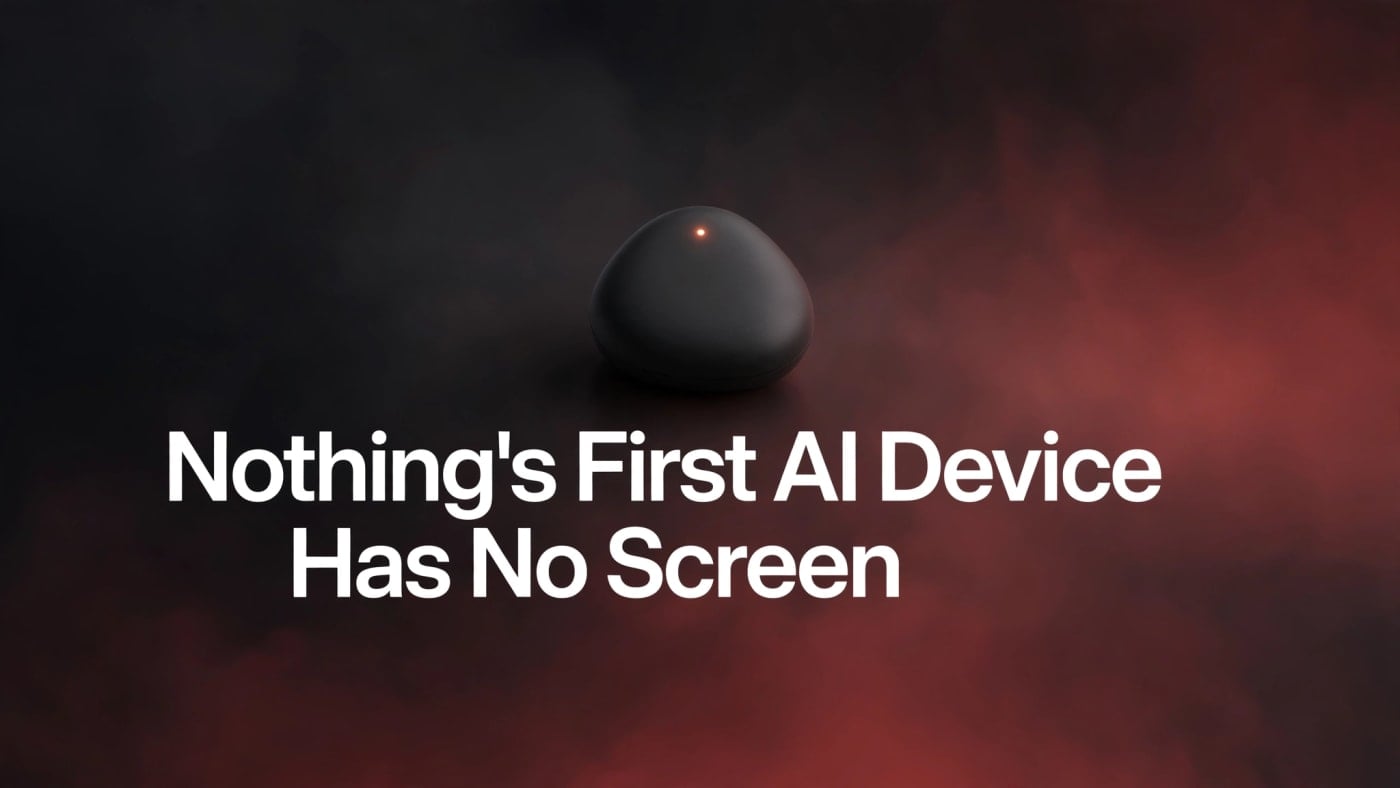
Alongside the essay, Nothing shared a teaser image. It shows a matte, dark object with rounded corners, labelled "Coming Soon". That is genuinely all we can say about it with confidence. The object gives away almost nothing about scale: it could be pocket-sized, desk-sized, or something in between.
What the image does not show is just as telling. There is no visible button, no port, no seam, no branding, and no sense of how the device is switched on or charged. Nothing has a long history of drip-feeding hints before a launch, and this image fits that pattern.
Why "no screen" is the most important detail
It is tempting to treat the absence of a screen as a missing feature. It is more useful to treat it as the product's defining idea. Screens demand attention: they light up, notify, and pull the eye. Even the best-designed phone is an interruption machine. A device without a screen cannot interrupt you in that way. It can only work in the background, respond when spoken to, or capture something quietly and hand it back later through another device.
That is why Pei's description points so strongly toward an ambient device — something that sits in the environment and works without being looked at. The phrase "ambient capture" is not Pei's; it is an interpretation, not a confirmed product category. But it is the most natural reading of a screenless, AI-native productivity tool that could not have been an app.
Think about the jobs such a device might do. It could record and transcribe conversations and ideas, then turn them into organised notes. It could listen for tasks and commitments and file them away without anyone having to open an app and type. None of these jobs needs a display; a display would arguably make each of them worse, by adding friction and distraction. That interpretation is speculation, and it should be labelled as such. Nothing has not confirmed that the device is a recorder or a note-taker. What Pei has confirmed is narrower: a screenless, AI-native hardware product, positioned as a productivity tool, launching in December 2026.
What the device is not — at least, not yet
It is equally important to say what Nothing has not confirmed: the product's name, specifications, or price. It has not said exactly when in December it will launch, which markets it will reach first, or how it will be sold. Any post claiming to know the name, the price, or the internal hardware is, at best, repeating a rumour and, at worst, inventing a detail.
The same caution applies to what the device connects to. A screenless product will almost certainly need a companion app on a phone or computer, because that is where its output will be read and searched. That is a reasonable expectation, not a confirmed fact. Nothing has not described the software side in public yet, and how it handles the relationship between a screenless device and the screens we already own will be one of the most interesting things to learn.
Confirmed facts versus rumours
Because this story will attract a lot of speculation, it helps to draw the line clearly. The table below separates what has been confirmed by Pei or reported from his essay from what remains rumour or interpretation.
| Detail | Status | What we know |
|---|---|---|
| Launch timing | Confirmed | December 2026, announced by Carl Pei in "Toolmakers" |
| Screen | Confirmed | No screen or display |
| Product category | Confirmed in broad terms | AI-native hardware, described as a productivity tool |
| Name | Not revealed | Nothing has not announced a name |
| Specifications | Not revealed | No confirmed specs |
| Price | Not revealed | No confirmed price |
| Exact launch date in December | Not revealed | Only the month is confirmed |
| Ambient capture / AI recorder role | Speculation | Fits Pei's description, but not confirmed |
| Two pairs of AI smart glasses | Rumour | Reported previously; not confirmed by Pei |
| AI-integrated earbuds | Rumour | Reported previously; not confirmed by Pei |
The March report that pointed this way
Pei's confirmation did not arrive out of nowhere. In March 2026, Bloomberg's Mark Gurman reported that Nothing's first AI-focused hardware would arrive before the end of 2026 — one of the clearest signals that AI hardware was a serious priority for the company, not a side project.
Gurman's reporting gave the story a timeline — before the end of 2026 — without giving away the product itself. Pei's essay now fills in part of that gap: the timing is December, and the product has no screen. What Gurman reported and what Pei has confirmed line up neatly, which is reassuring for anyone trying to separate solid reporting from noise.
Rumours about glasses and earbuds
Separate from the December device, previous rumours have indicated that Nothing plans two pairs of AI smart glasses — one of them without cameras — alongside AI-integrated earbuds. These are rumours, not confirmations, and they should be read as such.
It is easy to see why they gained traction. Smart glasses are the most talked-about category in AI hardware right now, and earbuds are a natural home for voice-first AI, since they already sit in the ear and carry microphones. Nothing already makes well-regarded earbuds and has the design credibility to make glasses people would want to wear. The rumours are plausible — but plausible is not confirmed.
None of those rumoured products is the device Pei has just confirmed. The December product is a separate thing: screenless, positioned as a productivity tool, and described in a way that points away from glasses or earbuds. If the rumours turn out to be true, they would be additional products in a wider AI hardware line-up, not alternative descriptions of the same device.
Nothing is becoming an AI-first company
Pei's essay was not only about a single product. It was also about repositioning Nothing itself as an AI-first company, and the December device is the clearest expression of that shift so far.
Nothing's phones already lean heavily on AI features, from software smarts to camera processing, and its earbuds use AI for calls and noise handling. But adding AI features to existing products is different from building a product whose entire reason for existing is AI. The December device is the second kind. Without AI at its centre, it would be, at most, a recorder with no screen — a hard sell. With AI, it becomes a tool that understands, organises, and retrieves, rather than merely capturing.
That is the bet Nothing is making: that the next useful category is not a better phone, but a quieter companion to the phone — something that handles remembering, organising, and summarising so the phone, and the person holding it, can do less of it. Whether that bet pays off will depend on execution. AI hardware has a mixed record, and the devices that have worked best tend to do a narrow job well. Pei's emphasis on a productivity tool, rather than a mainstream consumer gadget, suggests Nothing has learned that lesson.
There is also a question of trust. A screenless device that captures audio, notes, or ideas will live or die on how people feel about what it records and where that information goes. Nothing has not yet set out the privacy design in public, and that will be one of the most important details to watch.
A careful kind of excitement
It is reasonable to be excited about this device, and reasonable to be cautious. The confirmed facts are genuinely interesting: a screenless, AI-native productivity tool, from a company with a strong record of hardware design, launching in December 2026. The speculation is interesting too, but it should be held lightly until Nothing confirms more.
Between now and December, Nothing still has a great deal to show: the name, the price, the design in full, the way it is charged and controlled, the companion software, and the privacy controls. Each detail will narrow the gap between speculation and fact. The most important questions are practical: how do you start and stop it? How do you know it is listening? Where does a recording live, and how long is it kept?
What Pei has done with "Toolmakers" is to set the terms of the conversation. This is not a gadget launch in the usual sense. It is an argument about what technology should do: less demanding of attention, more useful in the background, built as a tool rather than a distraction. The device will be judged on whether it lives up to that argument in daily use. Until then, the most honest position is the one Pei's own announcement invites: curious, attentive, and unwilling to fill the gaps with invention. The device has no screen — and that may turn out to be the detail that defines it.
FAQs
When is Nothing's first AI device launching?
Nothing has confirmed the device will launch in December 2026. CEO Carl Pei announced the timing in his essay "Toolmakers", published via his official X account. Nothing has not yet given an exact date within December, so the specific day remains unconfirmed.
Does Nothing's first AI device have a screen?
No. Pei confirmed the device will have no screen or display. That is one of the few details Nothing has stated plainly. The absence of a screen is central to the product's design, positioning it as a tool that works in the background rather than demanding visual attention.
What is the device called, and how much will it cost?
Nothing has not revealed the product's name, specifications, or price yet. Any name or price circulating online before an official announcement should be treated as unconfirmed. Pei's essay and the accompanying teaser image give the launch month and the screenless design, but no further product details.
What will Nothing's AI device actually do?
Nothing has not confirmed the device's exact function. Pei described it as a productivity tool and said it "couldn't have been an app", which points toward an ambient capture device such as an AI recorder or note-taker. That interpretation is speculation, not confirmation, and the real function will only be clear when Nothing shares more details.
Is the device an AI recorder or note-taker?
That is a reasonable interpretation of Pei's description, but it has not been confirmed. A screenless, AI-native productivity tool could plausibly record, transcribe, and organise spoken notes and meetings. Until Nothing confirms the function, however, it should be described as speculation rather than fact.
What did Bloomberg report about Nothing's AI hardware?
In March 2026, Bloomberg's Mark Gurman reported that Nothing's first AI-focused hardware would arrive before the end of 2026. Pei's confirmation of a December 2026 launch fits that timeline. The report gave the timing without revealing the product itself, which Pei has now partly described.
Is Nothing also making AI smart glasses?
Previous rumours indicated Nothing plans two pairs of AI smart glasses, one without cameras, alongside AI-integrated earbuds. Those are rumours, not confirmations. They describe separate future products, not the screenless device launching in December 2026, and should be treated as unconfirmed until Nothing announces them.
Was this article helpful?

Written By
TechorCoffeeContributing Writer
TechorCoffee is a technology reporter and software creator writing reviews and tutorials for TechOrCoffee.
Comments (0)
Leave a Comment
Read Next

Tue Apr 21 2026
Best AI Tools for Students & Creators in 2026:Complete Guide
AI tools are transforming how students learn and creators produce content. From writing assistants to design and research tools, these platforms save time, enhance creativity, and improve efficiency. Choosing the right AI stack can significantly boost productivity and output quality.
Tue Jun 16 2026
Apple Intelligence 2.0: Siri AI & iOS 27 at WWDC 2026
Apple Intelligence 2.0 is here. I cover Siri AI, iOS 27 release dates, supported devices, and how Apple's new AI really compares to ChatGPT and Gemini.
Tue Oct 13 2026
Gemini 4 Argon: Everything You Need to Know
Gemini 4 Argon is Google’s new flagship AI model. See its benchmarks vs GPT-6 Astra and Claude, pricing, 1M-token output, safety features and how to get access.