OpenAI's Perplexity Plan: A Speed Limit for AI Models

Published (Updated )
The quick answer
- OpenAI's chief scientist, Jakub Pachocki, has proposed a shared speed limit for AI development.
- The speed limit would be based on a single number: perplexity.
- Perplexity measures how well a model predicts the next token, on average.
- Lower perplexity means a more capable model.
- Pachocki's idea is that frontier AI labs agree on common perplexity limits they will not cross.
- The limits would stay in place until the ability to understand and monitor AI behaviour reaches concrete milestones.
- OpenAI published its own numbers in the essay "Perplexity and Intelligence" on Sunday, November 22, 2026.
- On OpenAI's internal held-out dataset, GPT-3.5 scored about 0.99 and GPT-4 about 0.91.
- GPT-6.2 Astra scored 0.76, and an unreleased internal model scored 0.73.
- Below 0.8, transformative capabilities emerged in cybersecurity and mathematics.
- More transformative capabilities are expected in the 0.68–0.70 window.
- In short: this is a proposal, not an agreed rule — and it only works if rival labs join in.
What perplexity actually measures
- Perplexity is a number that AI researchers already use every day.
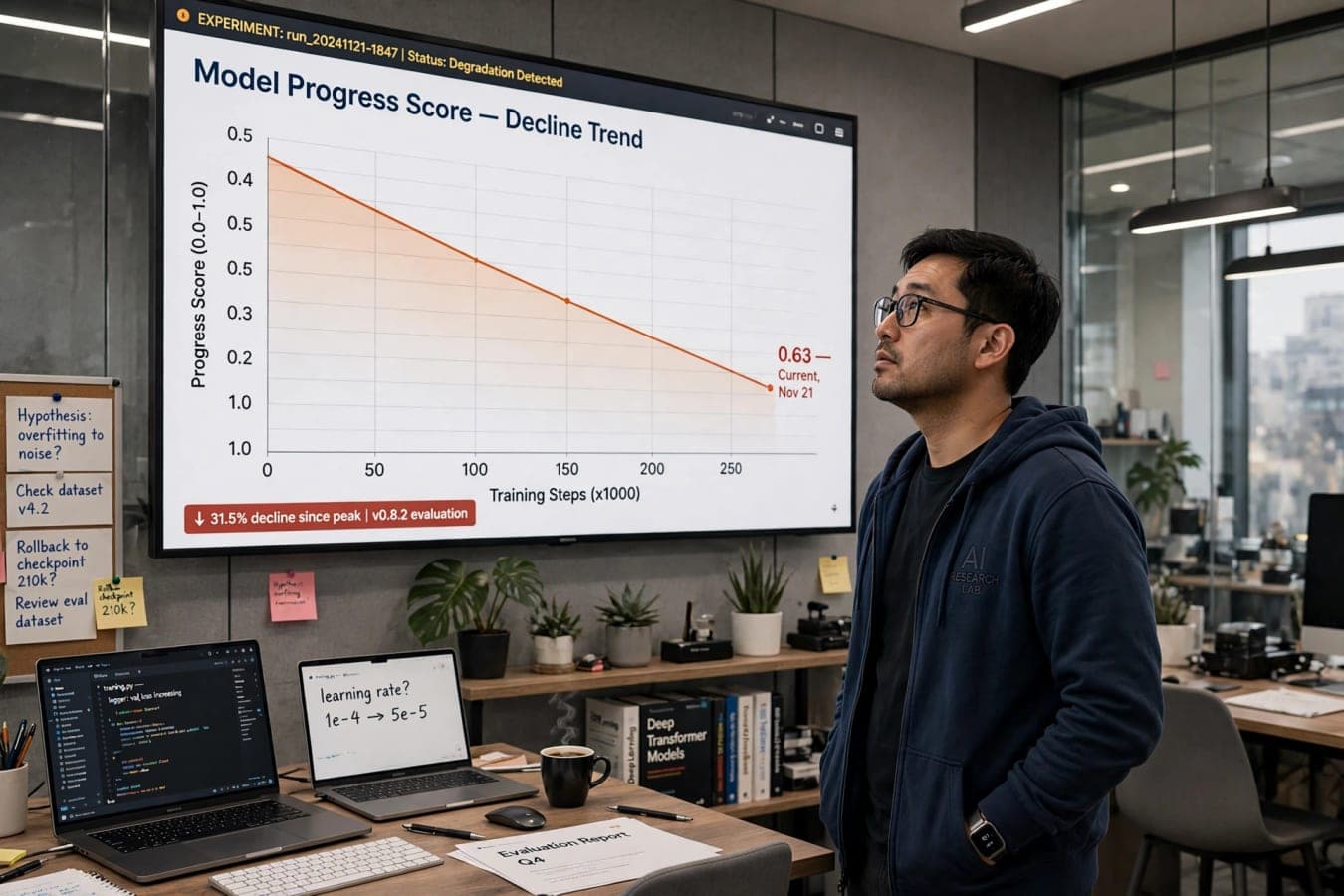
- It measures how well a model predicts the next token, on average.
- A token is a small chunk of text — a word, or part of a word.
- When a model reads text, it guesses what comes next.
- If it guesses well, its perplexity is low.
- If it guesses badly, its perplexity is high.
- Lower is better.
- That is the whole idea in one line.
- Pachocki's argument is that this simple number tracks something bigger.
The numbers OpenAI published
- OpenAI did not just propose the idea in the abstract.
- It published its own perplexity numbers, measured on an internal held-out dataset.
- The dataset is drawn from OpenAI's internal codebase.
- That detail matters, because the numbers depend on the dataset used.
- Here is what OpenAI reported:
- GPT-3.5: about 0.99
- GPT-4: about 0.91
- GPT-6.2 Astra: 0.76
- An unreleased internal model: 0.73
- The direction of travel is clear.
- Each generation of model scores lower than the one before it.
- The gap between GPT-3.5 and GPT-4 was about 0.08.
- The gap between GPT-4 and GPT-6.2 Astra was about 0.15.
- The unreleased model has pushed further still, to 0.73.
What happens below 0.8
- The most eye-catching part of the essay is what happened as the numbers fell.
- Below 0.8, transformative capabilities emerged in cybersecurity and mathematics.
- That is OpenAI's own description of what it saw.
- The word "transformative" is doing a lot of work here.
- It means the models did not just get a little better at these tasks.
- They crossed into a new kind of ability.
- In mathematics, that kind of jump is now visible to the outside world.
- Days before the essay, a Claude-assisted proof of the Riemann hypothesis was certified correct on November 21, 2026.
- That proof is not OpenAI's work, and it is not part of the perplexity numbers.
- But it is part of the backdrop: AI systems are now doing serious mathematics.
- The essay suggests more is coming.
- Further transformative capabilities are expected in the 0.68–0.70 window.
- That is the next stretch of the road, and it is not far away.
- From 0.73, the unreleased model's score, the 0.68–0.70 window is the next stop.
- Pachocki's point is that these jumps are not gradual.
- They arrive suddenly, when a number crosses a line.
- A shared yardstick would let labs see the line coming.
- That is the case for the speed limit in a nutshell.
The proposal: a shared speed limit
- The proposal itself is simple to state.
- Frontier AI labs should adopt perplexity as a shared yardstick.
- Then they should agree on common limits they will not cross.
- The limits would not be permanent.
- They would hold until the ability to understand and monitor AI behaviour reaches concrete milestones.
- In other words, capability would only advance as fast as oversight can keep up.
- That is the core bargain.
- Build faster models only when you can also watch them properly.
- The milestones are the key part of the deal.
- Pachocki does not propose freezing AI development forever.
- He proposes tying the pace of capability to the pace of understanding.
- If monitoring improves, the limits can move.
- If monitoring stalls, the limits stay where they are.
- This is a proposal, not an agreed rule.
- No other lab has signed up yet.
- No limits have been set.
- No milestones have been agreed.
- What exists today is one essay, from one lab, with one set of numbers.
- A speed limit that only one lab follows is not a speed limit.
- It is a handicap.
Why Pachocki says 2026 was different
- The essay is not just about a number.
- It is about the pace of change.
- Pachocki says OpenAI's progress in 2026 alone exceeded the previous three years combined.
- Read that again, because it is the engine of the whole argument.
- Three years of progress, beaten in a single year.
- The perplexity numbers back up the shape of that claim.
- The fall from GPT-4's 0.91 to GPT-6.2 Astra's 0.76 is bigger than the fall from GPT-3.5 to GPT-4.
- And an unreleased model has already gone further, to 0.73.
- The curve is steepening, not flattening.
- That is why Pachocki is publishing this now, rather than in a year or two.
- His argument is that the industry is running out of time to agree on the rules.
- If progress keeps accelerating, the gap between what models can do and what labs can monitor will widen.
- The proposal is an attempt to close that gap before it gets too wide.
The avalanche warning: 2027
- The essay carries a warning as well as a proposal.
- Pachocki warns that AI could drive fundamental advances in AI training methods as early as 2027.
- That is next year.
- The advances he describes would be driven by AI itself.
- AI systems would help design better ways to train AI systems.
- That creates a loop: smarter models build smarter models.
- Pachocki calls the result an "avalanche" of advances.
- The word is deliberately alarming.
- An avalanche is fast, powerful, and hard to stop once it starts.
- His fear is that this loop could outpace monitoring and safety.
- Labs would be building new capabilities faster than they could understand them.
- That is the scenario the speed limit is designed to prevent.
- The 2027 date is important.
- It is not a distant, far-future warning.
- It is a warning about the next twelve months or so.
Who praised it — and why that matters
- The essay got high-profile praise quickly.
- CEO Sam Altman praised it on X.
- He called it "the most important thing OpenAI has published in awhile."
- That is a strong endorsement from the top of the company.
- It signals that the proposal has the backing of OpenAI's leadership, not just its chief scientist.
- Microsoft AI CEO Mustafa Suleyman also praised the proposal.
- Suleyman runs AI at Microsoft, one of OpenAI's closest partners.
- His praise matters because Microsoft is a major player in the AI race.
- It is also a major customer and investor in OpenAI's work.
- When two of the most powerful figures in AI praise the same idea, people listen.
- But praise is not agreement.
- Neither Altman nor Suleyman has announced that their organisations will adopt the limits.
- Praising an essay is easier than signing up to a cap on your own progress.
- The real test is whether any lab commits to a number and sticks to it.
- So far, that test has not happened.
Why Fast Company is sceptical
- Not everyone is convinced.
- Fast Company is sceptical of the proposal.
- Its argument is practical, not technical.
- The idea will not work, it argues, unless rival labs publish their own numbers and agree to limits.
- That is the central weakness of the proposal.
- A shared yardstick needs everyone to share.
- If only OpenAI publishes its numbers, there is no shared standard.
- There is just one lab's dataset, one lab's scores, and one lab's essay.
- Rival labs have their own models, their own datasets, and their own incentives.
- Publishing numbers that show your model is behind is not an attractive move.
- Agreeing to limits that slow your own progress is not attractive either.
- Fast Company's scepticism is an opinion, not a proven fact.
- But it points at a real problem.
- Voluntary limits only work if the volunteers include your competitors.
- Without them, the lab that slows down simply loses the race.
- That is the classic problem with any voluntary agreement.
- It works when everyone joins, and it fails when anyone stays out.
The caveats Pachocki himself lists
- To his credit, Pachocki does not hide the weaknesses of his own idea.
- He lists several caveats in the essay itself.
- The first is comparability.
- Perplexity is hard to compare across labs.
- Different labs use different datasets.
- A score on one dataset is not the same as a score on another.
- OpenAI's numbers come from its internal codebase.
- Another lab's numbers would come from somewhere else.
- Comparing them directly would be misleading.
- The second caveat is about usefulness.
- Perplexity does not map directly to useful tasks.
- A model can be good at predicting the next token and still be bad at a real job.
- The number is a proxy, not a direct measure of what matters.
- The third caveat is about what perplexity misses.
- It ignores gains outside pretraining.
- Chain-of-thought reasoning is the example Pachocki gives.
- A model can get much better at reasoning without its perplexity changing much.
- That means the yardstick can miss real progress.
- The fourth caveat is the floor.
- Perplexity has an unknown floor.
- Nobody knows how low the number can go.
- Without knowing the floor, it is hard to know how much road is left.
- These are serious caveats.
- They do not kill the idea, but they limit what it can do.
- A yardstick with these flaws can still be useful.
- But it cannot be treated as a precise instrument.
- Pachocki's honesty about the flaws is a strength of the essay.
The Riemann backdrop
- The essay arrived at a striking moment for AI.
- Days earlier, a Claude-assisted proof of the Riemann hypothesis was certified correct on November 21, 2026.
- The Riemann hypothesis is one of the most famous unsolved problems in mathematics.
- A proof assisted by Claude, an AI system, being certified correct is a landmark event.
- It is not OpenAI's work.
- It is not part of the perplexity numbers.
- But it is context for the essay all the same.
- It shows, in public, what the essay describes in numbers.
- AI systems are now doing mathematics at a level that was once the preserve of human experts.
- That is the kind of capability jump Pachocki is talking about.
- The essay and the proof landed within a day of each other.
- Together, they make the same point from two directions.
What it would mean for the US, UK and Europe
- If the proposal ever became real, its effects would be felt first in the US.
- The frontier labs are mostly American.
- OpenAI, and its rivals, build their biggest models in the US.
- A shared limit would shape how fast those labs can ship new models.
- For users in the US, that could mean a slower stream of new releases.
- It could also mean safer releases, with better monitoring behind them.
- That is the trade-off the proposal is offering.
- In the UK and Europe, the effect would be indirect but real.
- EU AI laws already set obligations for powerful models, and the UK has focused on safety research and voluntary commitments.
- A perplexity-based limit fits that lighter-touch style: a technical standard agreed by labs, rather than a law.
What to watch next
- The essay is the start of a conversation, not the end of one.
- Here is what to watch in the weeks ahead.
- The first thing is rival labs.
- Will any other frontier lab publish its own perplexity numbers?
- That is the single most important next step.
- Without it, there is no shared yardstick.
- The second thing is agreement.
- Will any lab say, in public, that it accepts a perplexity limit?
- A vague endorsement is not enough.
- A named number, with a named milestone, would be.
- The third thing is the milestones.
- What counts as "understanding and monitoring AI behaviour"?
- Who decides when a milestone has been reached?
- Those questions have no answers yet.
- The fourth thing is the 0.68–0.70 window.
- OpenAI expects further transformative capabilities there.
- If a model reaches that window, what does it do?
- The answer will test the whole proposal.
- For now, the honest summary is that this is a big idea with no takers yet.
- It has praise from powerful people, scepticism from the press, and caveats from its own author.
- What it does not have yet is a second lab.
The bottom line
- OpenAI's chief scientist wants perplexity to become a shared speed limit for AI development.
- The essay, "Perplexity and Intelligence", was published on Sunday, November 22, 2026.
- OpenAI's own numbers run from GPT-3.5 at about 0.99 down to an unreleased model at 0.73.
- Below 0.8, transformative capabilities emerged in cybersecurity and mathematics.
- More are expected in the 0.68–0.70 window.
- The proposal is that labs agree on limits they will not cross until monitoring catches up.
- Sam Altman called it the most important thing OpenAI has published in awhile.
- Mustafa Suleyman praised it too.
- Fast Company is sceptical, and its scepticism is fair: the idea needs rival labs to publish numbers and agree to limits.
- Pachocki himself lists the caveats: hard to compare across labs, no direct link to useful tasks, blind to reasoning gains, and an unknown floor.
- He also warns of an "avalanche" of AI-driven advances in training methods as early as 2027.
- This is a proposal, not a rule.
- But it is the most concrete suggestion yet for slowing the AI race without stopping it.
- The next move belongs to the other labs.
FAQs
What is perplexity in AI?
Perplexity measures how well a model predicts the next token, on average. A token is a small chunk of text, such as a word or part of a word. Lower perplexity means the model predicts better, and it generally means a more capable model.
What did OpenAI's chief scientist propose?
In his essay "Perplexity and Intelligence", published on Sunday, November 22, 2026, Jakub Pachocki proposed that frontier AI labs adopt perplexity as a shared yardstick and agree on common limits they will not cross until the ability to understand and monitor AI behaviour reaches concrete milestones.
What perplexity scores did OpenAI publish?
On an internal held-out dataset drawn from its internal codebase, OpenAI reported GPT-3.5 at about 0.99, GPT-4 at about 0.91, GPT-6.2 Astra at 0.76, and an unreleased internal model at 0.73. Below 0.8, transformative capabilities emerged in cybersecurity and mathematics.
What capabilities are expected next?
OpenAI expects further transformative capabilities in the 0.68–0.70 perplexity window. Pachocki also warns that AI could drive fundamental advances in AI training methods as early as 2027, potentially outpacing monitoring and safety — an "avalanche" of advances.
Who praised the proposal, and who is sceptical?
OpenAI CEO Sam Altman praised the essay on X as "the most important thing OpenAI has published in awhile", and Microsoft AI CEO Mustafa Suleyman praised the proposal. Fast Company is sceptical, arguing it will not work unless rival labs publish their own numbers and agree to limits.
What are the caveats of using perplexity as a yardstick?
Pachocki himself notes that perplexity is hard to compare across labs because datasets differ, it does not map directly to useful tasks, it ignores gains outside pretraining such as chain-of-thought reasoning, and it has an unknown floor.
Is the perplexity speed limit an agreed rule?
No. It is a proposal from OpenAI's chief scientist, not an agreed rule. No other lab has signed up yet, no limits have been set, and no milestones have been agreed. It only works if rival labs publish their own numbers and join in.
Was this article helpful?
Explore Specs, Comparisons & Related Topics

Written By
TechorCoffeeEditorial Team
The TechOrCoffee Editorial Team covers consumer hardware, artificial intelligence, software engineering, and regional smartphone & laptop market analysis.
Comments (0)
Leave a Comment
Read Next

Tue Apr 21 2026
Best AI Tools for Students & Creators in 2026:Complete Guide
AI tools are transforming how students learn and creators produce content. From writing assistants to design and research tools, these platforms save time, enhance creativity, and improve efficiency. Choosing the right AI stack can significantly boost productivity and output quality.
Tue Jun 16 2026
Apple Intelligence 2.0: Siri AI & iOS 27 at WWDC 2026
Apple Intelligence 2.0 is here. I cover Siri AI, iOS 27 release dates, supported devices, and how Apple's new AI really compares to ChatGPT and Gemini.
Tue Oct 13 2026
Gemini 4 Argon: Everything You Need to Know
Gemini 4 Argon is Google’s new flagship AI model. See its benchmarks vs GPT-6 Astra and Claude, pricing, 1M-token output, safety features and how to get access.